


By Liu Xinyu
(ECNS)–Traditional Chinese culture has long embraced ideas of caring for, valuing and loving people, which embody a wealth of human rights resources. Do these intellectual treasures constitute the unique ideological DNA of the Chinese concept of human rights and represent an early exploration of it? What is their contemporary value and global impact? What fundamental differences exist between the Eastern and Western human rights discourses?
Li Juan, lecturer at the Institute of Human Rights, Southwest University of Political Science and Law, delivered a general education lecture on "Human Rights Concepts in Traditional Chinese Culture" at the university.
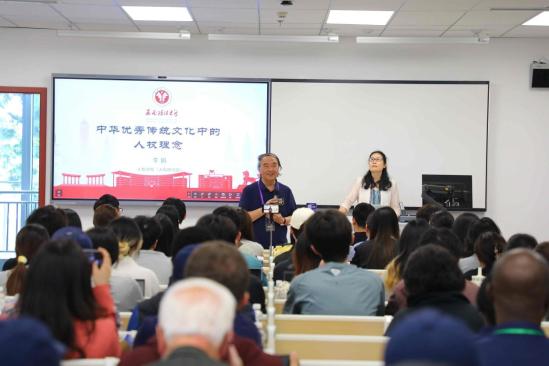
After the lecture, human rights experts from Peru, Nepal, Tunisia, the African Union and Chad spontaneously took the podium to engage in an in-depth discussion on the above topics.
Tracing classic expositions in traditional Chinese culture, Li noted that the expression "Of all living things, humanity's spirit shines brightest" from the Book of History (Shangshu) provides the deepest ontological basis and the core source of dignity for human rights.
"The benevolent person loves others" from the Analects of Confucius is the overarching principle of benevolence, while "don't do unto others what you don't want others to do unto you" is the practical method and bottom-line criterion for realizing benevolence. The classic Confucian objective from the Book of Rites, "Widowers, widows, orphans, the childless, the disabled and the ill shall all be cared for," describes state policies for helping vulnerable groups.
These intellectual treasures, spanning millennia, have long embedded the concepts of respecting life, cherishing value, advocating equality and upholding justice in the Chinese civilization, representing the early exploration of human dignity and rights by the Chinese nation, and contributing unique Eastern wisdom and ideological resources to the global human rights endeavor.
Drawing on his over 30 years of experience in human rights education, Eduardo Melchor Arana Ysa, Former Prime Minister of Peru, observed that human rights have political origins, with rules and regulations serving as a manifestation of the ruling class's power.
Reviewing the history of human rights development in Western countries, he noted that Western human rights declarations are often the product of domestic party struggles, political games and international rivalries.
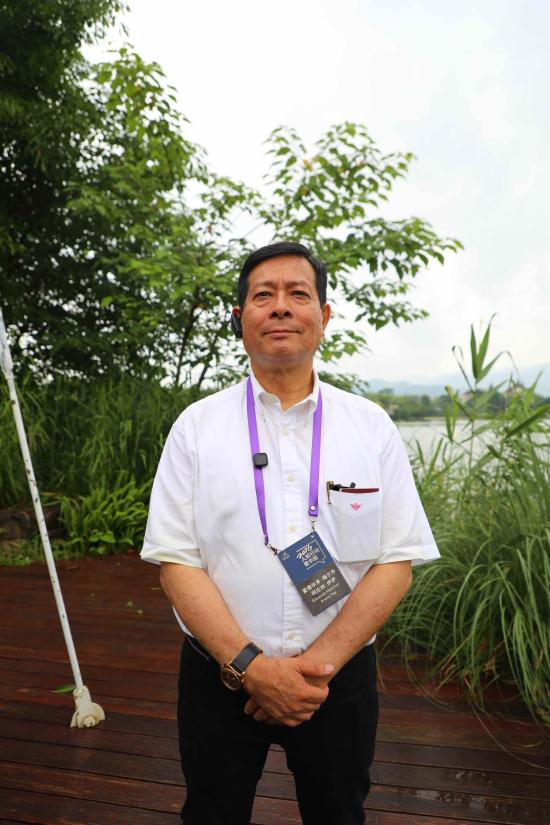
Arana stated that Western countries often emphasize a single approach on human rights and demand that other nations follow and implement it, but each country should handle human rights affairs in a manner suited to its own realities.
He noted that the Western world should not impose its human rights standards on other countries. "China, Egypt and Peru, all ancient civilizations with millennia of profound history, ground their human rights practices in their own traditional cultures and practical needs."
"When practising democracy, specific practices should be distinguished based on different cultures, ethnic groups and fields, and we should take pride in that. The quality of a democracy should not be judged by a single criterion. Whether a country is a constitutional monarchy or a democratic republic, what matters is whether it truly benefits its own citizens," Arana emphasized.
"Many Western countries have signed numerous agreements, but their practical implementation and fulfillment of human rights are highly inefficient. Conversely, other countries that are often criticized by the West have achieved remarkable results in people's livelihoods such as healthcare, education and employment, practicing human rights very successfully. China should continue moving forward along its own path of human rights practice." He particularly urged young scholars not to blindly follow Western propaganda, but to broaden their horizons and strengthen exchanges.
Sharing her practical experience around basic human rights, Indira Rana, member of the Federal Parliament of Nepal and former deputy speaker of the House of Representatives of Nepal, said she began working at a human rights center at the age of 18. Witnessing the helplessness of children behind bars, she resolutely devoted herself to helping children in prison.
Over 36 years, she has worked tirelessly to secure their rights to education, shelter and a brighter future. Several years ago, Rana decided to enter politics to advance her work more effectively.
In Nepal, due to the lack of comprehensive child protection laws, when parents go to prison, their children often end up there too. Rana has helped raise more than 2,000 such children, and has started classes in prisons.
Rana noted, "How human rights are practically implemented is crucial. Every child has the right to live with dignity - the right to education, food and shelter. Human rights practices in different countries must be based on their respective social structures and realities, and political will is a prerequisite for achieving all of this."
Stating that human rights are not limited to freedom of speech, civil rights and political rights, Radhia Jerbi Ep Chiha, president of the National Union of Tunisian Women, said that they constitute a holistic concept and a comprehensive set of rights.
"When the West talks about human rights, it often injects excessive political considerations and even uses them as a means of controlling people. A single dimension of human rights and freedom cannot cover all the needs of people for a better life. The contemporary Tunisian people are focusing on exploring the right to development, the right to education and other human rights fields, gradually forming a holistic understanding of human rights," she said.
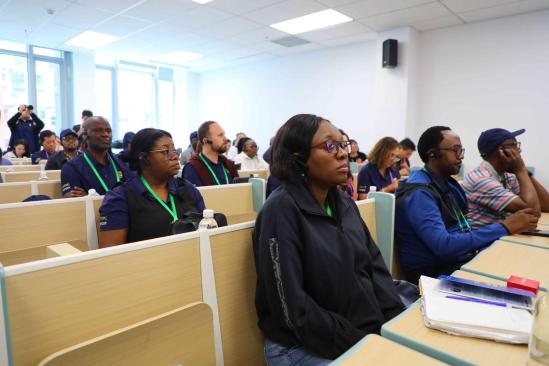
Finding deep resonance between traditional African culture and Chinese civilization, Seraphine Kando, principal human rights officer of the Department of Political Affairs, Peace and Security, African Union Commission, said, "In Africa, the concept of human rights is also rooted in our own culture, not just in globally adopted legal instruments. We must teach young people, as China is doing today, about the concept of human rights in our history and culture."
She explained that the Ubuntu philosophy in African culture, which advocates "I am because you are" and calls for mutual respect, resonates highly with Confucian concepts such as "loving people and all beings" and "Great Harmony under Heaven."
Kando introduced that as early as the 13th century, long before the Universal Declaration of Human Rights, Africa had proclaimed the Charter of Manden (Kurukan Fuga Charter), which advocates social harmony in diversity and the inviolability of people, education, territorial integrity and food security. The Charter was inscribed on UNESCO's Representative List of the Intangible Cultural Heritage of Humanity in 2009.
"Human rights are first and foremost about responding to people's needs. When teaching human rights to young people, scholars should incorporate traditional culture into their academic perspective, rooting human rights issues in the context of their respective civilizations and histories," Kando emphasized.
Nandjede Abba Daoud, director of the Office of the Foreign Affairs Commission of the Senate of Chad, secretary-general of the Alliance for the Defense of Human Rights and the Environment, candidly admitted that he and his colleagues initially thought only Western countries would discuss human rights and were skeptical that China would.
Yet after traveling from Chad to China for study and inspection, he witnessed the living conditions and lifestyles of the Chinese people, as well as the development of rural and urban areas, and was deeply amazed. "The right to development, the right to economy and the right to culture are 100 percent realized in China. This is exactly what Africa urgently needs now," he said.







































 京公网安备 11010202009201号