


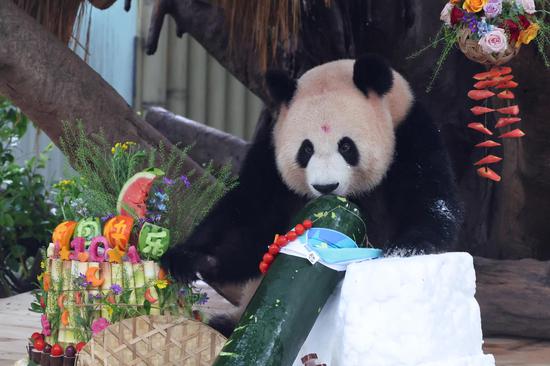
(ECNS) -- Beixia, a 4-year-old giant panda living at a base in southwest China, has completed nearly six months of treatment to correct its misaligned lower jaw — the first treatment of its kind ever reported in a giant panda.
The unusual case was recently announced by Sichuan University West China Hospital of Stomatology.
Doctors and researchers from the hospital worked with the Chengdu Research Base of Giant Panda Breeding to correct the position of Beixia's jaw using a treatment approach adapted from human orthodontics.
Beixia was born in 2022 and suffered serious injuries to its left front leg and jaw shortly after birth. Because the leg could not be saved, it was amputated less than 24 hours after Beixia was born.
After losing the leg, Beixia had to change the way it used its body to exert force. Combined with the earlier jaw injury, this affected the normal development of its jaw and face. At just three months old, Beixia often struggled to suck milk without it leaking from its mouth, affecting its growth.
After consulting specialists from several fields, the team decided that treatment should begin while Beixia was still young. They were concerned that the uneven development of its lower jaw could affect its growth, said Long Hu, chief physician of the hospital's Department of Orthodontics.
The team designed a special orthodontic device for Beixia, using it to gradually guide the lower jaw back into the correct position.
The treatment initially required round-the-clock care. Keepers carefully removed the elastic bands before each feeding and replaced them immediately afterward to prevent Beixia from accidentally swallowing them. Veterinarians also adjusted its diet to ensure it continued to grow normally.
Nearly six months later, a follow-up examination showed encouraging results. Beixia's lower jaw had largely returned to the correct position, allowing it to suck, chew and swallow normally again. The teeth supporting the device also remained firmly in place.
"This is the world's first treatment to correct uneven development of the lower jaw in a giant panda," said Han Xianglong, president of Sichuan University West China Hospital of Stomatology.
Han said the successful cooperation between the hospital and the Chengdu panda base had provided new ideas and potential approaches for treating jaw and dental problems in wild animals in the future.
Today, Beixia lives at Dujiangyan Panda Valley, part of the Chengdu Research Base of Giant Panda Breeding, and has regained its lively personality. Its ability to eat has not been affected by the treatment.

(By Evelyn)































 京公网安备 11010202009201号