


(ECNS) -- From young flag bearers and match officials to smart technology, designer toys, transport services and stadium renovation, Chinese elements are making a wide-ranging impact at the 2026 FIFA World Cup.
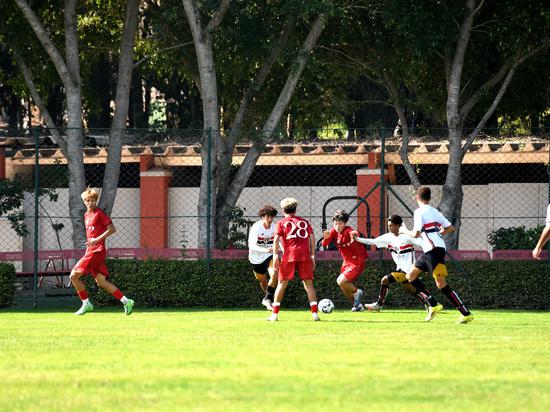
At Mexico City's iconic Azteca Stadium, six Chinese teenagers had the honor of escorting the FIFA flag onto the pitch during the opening ceremony, stepping onto football's biggest stage before a global audience of billions. The oldest was 17, while the youngest was just 15 years old.

Chinese participation extends to officiating. Chinese referees Ma Ning, Fu Ming and Zhou Fei were selected for key officiating roles as referee, video assistant referee and assistant referee, respectively.
Among the most eye-catching Chinese elements were two giant Labubu figures, the wildly popular designer toy characters that appeared during the opening ceremony. Videos of LABUBU, dressed in customized football kits as they hold a miniature World Cup trophy, quickly went viral on social media platforms. This collaboration marked the first official World Cup partnership with an original Chinese designer toy.
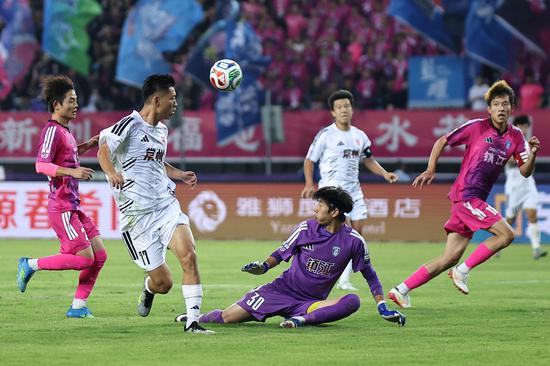
At the heart of the competition is Trionda, the tournament's official match ball, which is manufactured entirely by a sports equipment factory in Shenzhen City, south China's Guangdong Province. The ball contains a smart sensor-equipped core featuring a 500Hz chip capable of recording up to 500 touch-point data readings per second. The intelligent ball core itself is produced by a Chinese company based in Huai'an, Jiangsu Province. Combined with player-tracking technology, the system helps referees make more accurate decisions.
Chinese technology from Hisense and Lenovo is also supporting the tournament behind the scenes. Hisense has supplied display systems for both the International Broadcast Center and the Referee Operations Center in Dallas, helping officials analyze match details. Lenovo, meanwhile, deployed a wide range of AI solutions, including a World Cup football AI assistant and 3D digital human visualization systems, supporting tactical analysis across all 16 tournament venues in the U.S, Canada and Mexico.
From the VAR control room to pitch-side advertising boards, Chinese companies are no longer merely seeking brand exposure through sponsorships. Instead, they are increasingly embedding their technologies into the daily operations of major international sporting events.
China's contribution extends far beyond what goes on in the stadium. The extensive renovation of the Azteca Stadium ahead of the World Cup was carried out by China Railway Construction Engineering Group. In Mexico, 115 new light-rail trains operating in the country's three host cities were manufactured by CRRC, one of China's leading rail equipment producers. In Mexico City, 95% of the 800 new-energy shuttle buses serving World Cup visitors were also made in China.
From culture and youth participation to infrastructure, transport and intelligent technology, Chinese elements are becoming increasingly visible across the World Cup. As the tournament unfolds, China's role in supporting the world's biggest sporting event continues to grow.
(By Gong Weiwei)























 京公网安备 11010202009201号