


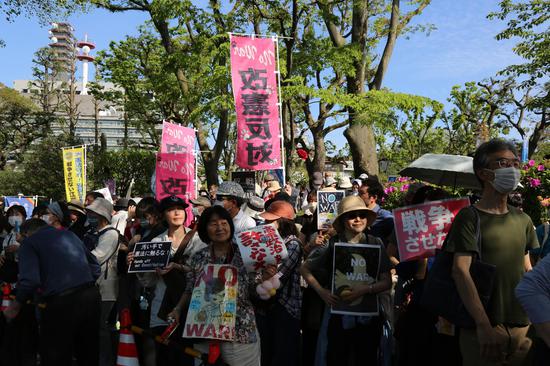
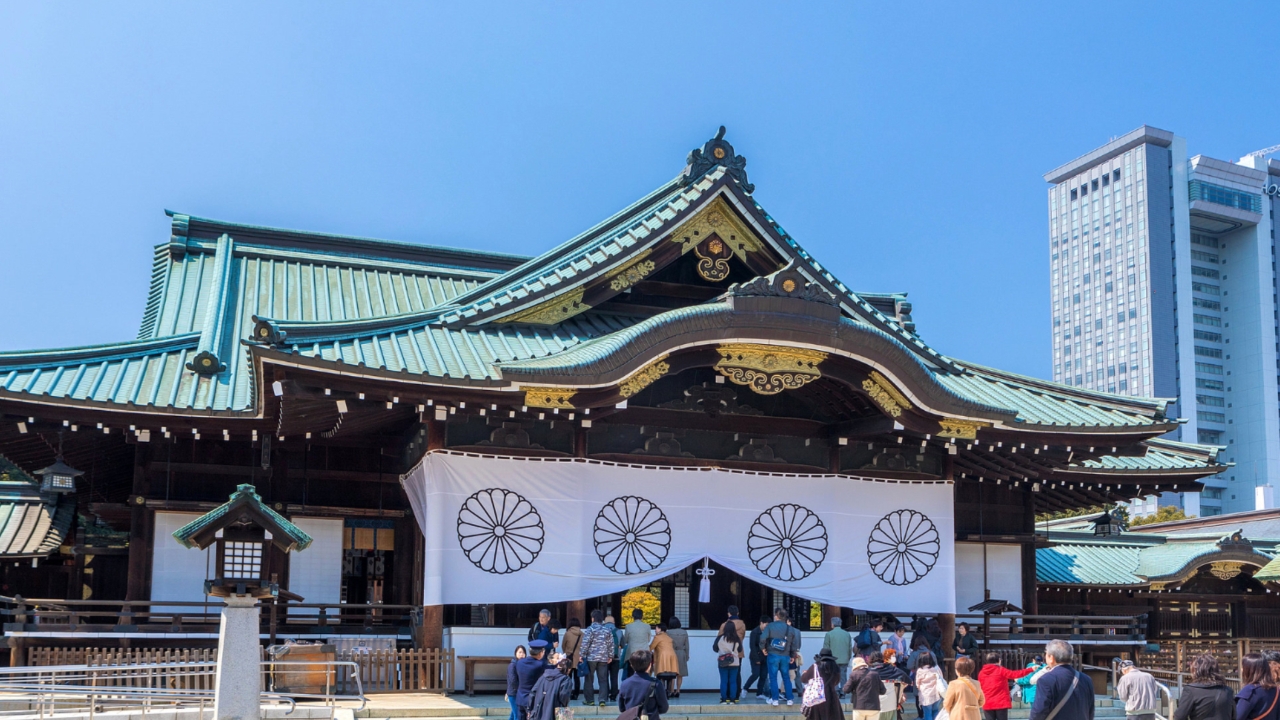
(ECNS) -- Recently, Japanese government officials worshiped the notorious Yasukuni Shrine, which honors 14 convicted Class-A Japanese war criminals from World War II alongside the war dead, while Prime Minister Sanae Takaichi sent a ritual offering. Coupled with moves to revise the Constitution for allowing lethal weapons export and restore the rank titles of Self-Defense Forces officers, these moves have raised serious concerns. Japan's military buildup has entered a more aggressive phase.
These moves reflect a shift in Japan's security policy from defense to offense, said Chen Zilei, president of the Shanghai Association for Japanese Studies and director of the Japanese Economic Research Center at Shanghai University of International Business and Economics, in an exclusive interview with China News Network. He warned that vigilance is needed against a possible resurgence of militarism in Japan.
Chen noted that Takaichi has constantly used various means to provide political compensation to right-wing forces in Japan. By stoking confrontation with countries such as China and South Korea over historical issues, she seeks to consolidate support from internal right-wing groups and strengthen her political base.
At the same time, heightened tensions between Japan and its neighboring countries help Washington maintain greater control over Tokyo, and allow the United States to leverage Japan to stir up the situation in East Asia—an outcome the U.S. is willing to see, Chen said.
Chen further pointed out that Takaichi's campaign slogan, "Japan is back," combined with the April 21 revisions to "three principles on transfer of defense equipment and technology" and their implementation guidelines, clearly signals her policy direction—the growing rise of neo-militarist forces in Japan.
Looking back at Japan's gradual efforts to break free from the constraints of its postwar pacifist constitution, Chen explained that the origins of these principles can be traced back to the 1967 "Three Principles on Arms Exports" introduced under then-Prime Minister Eisaku Sato.
The 1967 principles prohibited arms exports to socialist countries, countries subject to "arms" exports embargo under the UN resolutions, and countries involved in or likely to be involved in international conflicts.
In 1976, then- Prime Minister Takeo Miki's administration revised the 1967 principles, creating a near-total ban on arms exports and reflecting Japan's postwar pacifist stance at that time.
However, with the rise of right-wing forces, Japan has gradually loosened these restrictions. In 1983, it began allowing the transfer of military technology to the United States.
In 2014, by replacing the original arms export ban with the current framework, the Japanese government permitted Japan to export defense equipment and technology across five non-combat categories, signaling a fundamental shift from arms exports being "prohibited in principle" to "permitted in principle." Chen said this move signaled Japan's intent to hollow out its pacifist constitution and push forward strategic transformation beyond legal constraints.
In 2022, these principles were further revised in response to the Ukraine Crisis, during which Japan provided equipment such as bulletproof vests to Ukraine.
Subsequently, in 2023, Japan approved the re-export of Patriot air defense missiles to the United States. In 2024, Japan also relaxed rules on jointly developed defense equipment, allowing next-generation fighter jets developed with the United Kingdom and Italy to be exported directly to third countries, removing key barriers to the export of large-scale offensive weapons.
On April 21, 2026, Japan scraped rules that had limited Japan's defense equipment exports to five non-combat categories, namely rescue, transport, warning, surveillance and minesweeping. Chen noted that this marks a shift from incremental adjustments to rapid expansion, representing another step down the dangerous path of neo-militarism. It also signifies the complete end of the 1976 ban.
Looking back at history, Chen said that Japan's current approach bears striking similarities to the path leading up to Japan's war of aggression against China in the past. He argued that revising these principles is intended to promote remilitarization by fueling a regional arms race and escalating geopolitical tensions, thereby lending support to neo-militarism.
Chen emphasized that these moves Such actions seriously pose a serious challenge to the regional security order, and undermine regional peace and cooperation, as well as the mutual trust among countries that has developed under the framework of reginal economic integration.
He said that China remains committed to safeguarding world peace and development, firmly upholding multilateralism and the international order. At the same time, China must resolutely fight separatist forces aimed at "Taiwan independence" and oppose interference by external forces. China will work with peace-loving countries to curb the rise of neo-militarism in Japan.
(By Gong Weiwei)


























 京公网安备 11010202009201号