



By Gong Weiwei, Zhang Dongfang
(ECNS) -- China's rural areas have experienced remarkable development in recent years, with specialty agriculture thriving across the country. Huzhangzhuang Village in north China's Tianjin, stands out as a vivid example of successful rural revitalization.
How can farmers increase their incomes and achieve a better quality of life? How can green development sustain the momentum of rural revitalization?
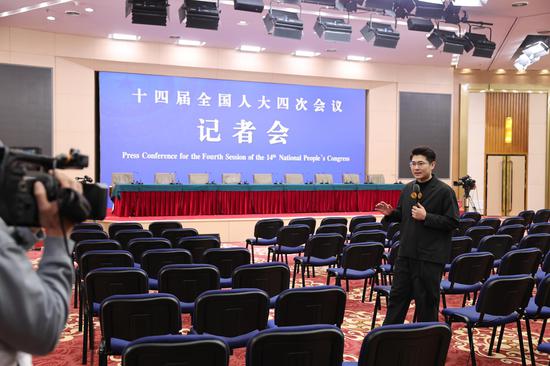
In the latest episode of the China Q&A program, during the 2026 two sessions, American Brian Linden, who runs a guesthouse in Dali, Yunnan Province, and is widely known as the "foreign village chief", raised these questions with Yang Baoling, an NPC deputy and Party branch secretary of the Huzhangzhuang Village.
Linden said he created the guesthouse as a platform for cultural exchange, allowing foreigners to better understand China through everyday life in rural communities.
He noted that Xizhou is a Bai ethnic group village, and that the warmth and hospitality he has received from local residents are "rare to find in many parts of the world today."
Linden also said China places great importance on rural development and is steadily advancing rural revitalization.
From his perspective, rural governance is highly efficient, and life in the countryside is becoming increasingly comfortable. He added that he is particularly interested in how Hu Zhangzhuang village has developed its grape industry to improve farmers' livelihoods.
Yang explained that grape cultivation is the village's pillar industry. Huzhangzhuang's soil is rich in potassium, and the village is located on roughly the same latitude as Bordeaux, France—one of the world's most famous wine regions—giving its grapes a particularly fragrant flavor.
She noted that beyond favorable soil and geographic conditions, the village has committed to green and organic cultivation methods, including the use of organic fertilizers, to improve product quality and brand value. Huzhangzhuang grapes have also received national Green Food certification, earning a reputable market recognition.
Today, the village has achieved full coverage of pension and medical insurance for its residents. "Huzhangzhuang Village is very stable, and the happiness index is very high," Yang said.
Linden echoed this view, saying that China's focus on rural development and steady efforts to advance rural revitalization have made life in the countryside increasingly comfortable.
However, the road to development has not been without challenges. Yang recalled that in the past, muddy field roads, limited sales channels, and frequent natural disasters once hindered grape production. During rainy harvest seasons, transport vehicles could not reach the fields, leaving grapes to rot grapes and reducing village incomes, which discouraged villagers from planting grapes.
To address these issues, Yang first focused on improving infrastructure, paving roads across 2,000 mu (133.33 hectares) of vineyard. At the same time, she reached out to wineries and other buyers beyond the village to expand sales channels, allowing grapes to reach broader markets. As sales stabilized, villagers' enthusiasm for planting increased significantly.
Facing the risks of natural disasters, Huzhangzhuang Village further promoted agricultural transformation by developing facility-based agriculture. By constructing greenhouses, the village gained precise control over temperature and growth conditions, improving grape quality. Today, the village has 68 greenhouses, covering about 400 mu (26.67 hectares), steadily increasing farmers' incomes.
As an NPC representative, Yang pays close attention to rural and agricultural issues. During this year's two sessions, she proposed a green development suggestion on recycling kitchen waste from restaurants and agricultural organic waste.
To prevent soil pollution from buried kitchen waste, she suggested converting the waste into soil for backfilling. Additionally, to avoid air pollution from burning grape vines, she recommended crushing the vines and returning them to the soil as fertilizer.
Yang said that she has devoted more than forty years to Huzhangzhuang Village. Having moved here from Shandong Province, she recalled that the village was once extremely poor. "We all helped each other, getting through with shared rice and flour", she said, expressing her deep affection for the villagers.
Today, the village has achieved full coverage of pension and medical insurance for its residents. "Huzhangzhuang Village is very stable, and the happiness index is very high," Yang said.
"As long as I can accomplish something for the farmers, as long as my fellow villagers can live better lives, I will feel especially satisfied," Yang added, "Looking back on these decades in Huzhangzhuang Village, I feel extremely proud."































 京公网安备 11010202009201号