


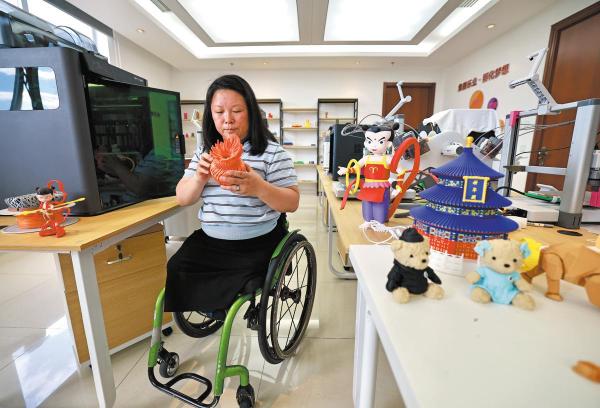
 Cao Qiuping checks a newly 3D-printed toy at a workshop in Beijing on May 28. ZHANG WEI/CHINA DAILY
On a late morning in May, the high-pitched whine of 3D printers filled a small workshop in Beijing's Chaoyang district.
Cao Qiuping, a former Paralympian who uses a wheelchair, had arrived early and was sorting piles of brightly colored plastic toys — stress-relief ribbons, Minecraft-style blocks and cartoon character figurines.
The souvenirs were destined for a Children's Day event in the nearby Sanlitun neighborhood.
The team's real goal was not just to make the children smile. They planned to give the toys away for free, while asking recipients to scan and join a WeChat group to become potential future customers for the workshop's other 3D-printed products.
For Cao and her two able-bodied partners, each free trinket is a small bet on a brighter future — one in which workers with disabilities compete in China's creativity market on the basis of their skill, not sympathy.
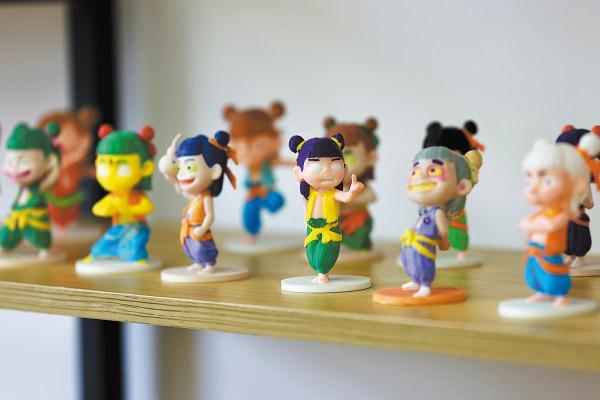 Some cartoon character figurines created by Cao's studio. ZHANG WEI/CHINA DAILY
Technology as a bridge
Cao runs the Sanlitun 3D Printing Digital Workshop for People with Disabilities, a venture that is barely a few months old. The idea is to use additive manufacturing to help people with disabilities — who often struggle for years to find steady jobs — become designers, producers or operators of small businesses.
This unique model that ensures people with disabilities get paid jobs in technology-driven industries has the support of charity groups and federations representing local people with disabilities.
The workshop has just delivered its first commercial order: 50 3D-printed blind boxes featuring the bear mascot of the Fairmont Beijing Hotel in Sanlitun. The boxes, which feature four seasonal designs and a hidden "hotel chef" figurine, were produced using about 30 printers donated to the Chaoyang district by CFDP-Leye — a social enterprise that helps people with disabilities gain employment — through the China Foundation for Disabled Persons.
Behind that milestone lies a story of reinvention, resilience and the hard work of turning high-tech tools into means of ensuring sustainable livelihoods.
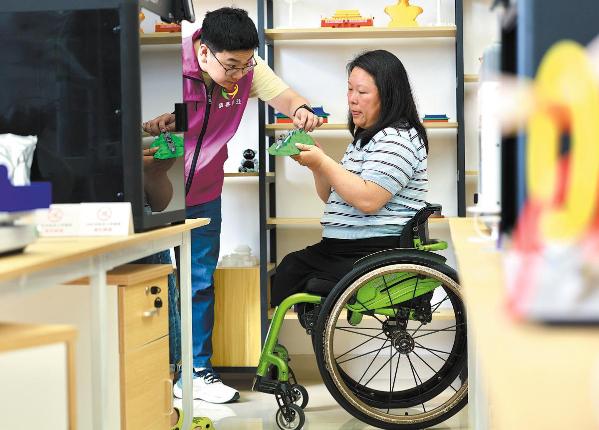 Cao Qiuping discusses design details with Li Changsen, an able-bodied team member who provides technical support, at the workshop in Beijing. ZHANG WEI/CHINA DAILY
Looking back
Cao, now 47, knows all about braving the odds. In 1997, when she was 18, she was in a car accident on her way to school that led to her two lower limbs being amputated. "I felt like I'd been thrown from the clouds to the ground," she recalled. "Before the accident, I had dreams like any other teenager."
Her father sawed off every doorstep in their rural Beijing home to ensure her wheelchair could move freely. But they had a squat toilet so her parents had to bodily lift her to the restroom and back daily.
Her luck changed in 2003, the year she discovered wheelchair basketball. A coach spotted her at a local sports event, remarked it was terrible for someone so young to be so badly injured and asked for her contact details.
That chance encounter led to her finding a place on the Beijing women's wheelchair basketball team. By 2005, she was winning national championships.
In 2008, she went on to compete in the Beijing Paralympics.
"For the first time, I wasn't alone anymore," Cao said. "I met other people who use wheelchairs. I realized I wasn't the only one. It felt like coming back to life."
After the Games, Cao met her future husband, from the United States. They married, settled in Beijing and had two children. For more than a decade, she focused on raising her family. But as her children grew older, she began feeling left out. "When you stay home for years, you lose touch with the world," she said. "At first, I thought it was because of my disability. But later I realized anyone who stays home for too long feels disconnected."
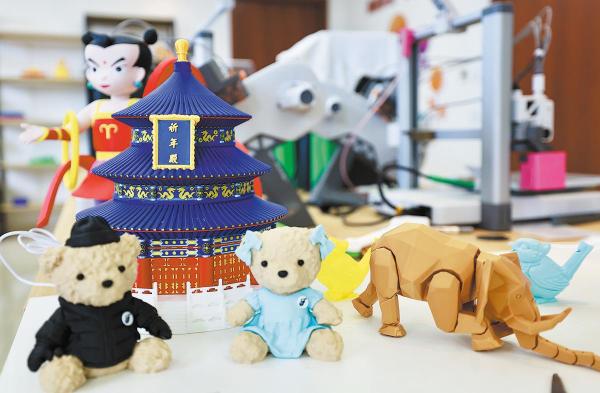 Toys created by artists at the studio who have some disabilities. ZHANG WEI/CHINA DAILY
Enter the 3D printer
Her way back to normal life was enabled by a strange gadget: a 3D printer.
Earlier this year, Cao visited Warm Home — a local community service center for residents with disabilities — and noticed the 3D printer. It had been donated as part of a technology empowerment initiative.
"I thought 3D printing was very high-tech, not for someone like me," she said. But with some training from CFDP-Leye, which had donated the machine, she began to learn the basics. "I realized it wasn't as difficult as I'd imagined."
Li Changsen, a technical trainer from CFDP-Leye who now works with Cao's team, said people with disabilities show exceptional focus when it comes to learning. "What I noticed is that they concentrate," he said. "They don't give up after just two days, like some able-bodied people might."
Cao had an idea which she shared with the Sanlitun subdistrict disabled persons' federation. Its chairperson, Zhang Xuechao, gave her the green light. A workshop was born this March.
Its core team comprises Cao; Wang Jing, a Tianjin Academy of Fine Arts graduate and mother of two; and Shen Liang, a programmer-turned-entrepreneur who volunteers as the workshop's technology strategist. Li Changsen provides technical support.
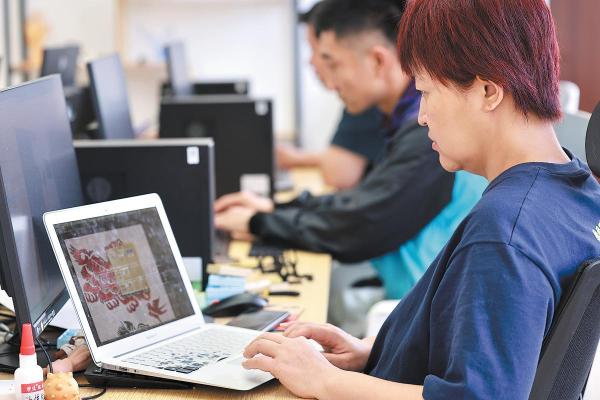 Wang Jing, a Tianjin Academy of Fine Arts graduate and mother of two, works on 3D modeling on her laptop at the workshop. ZHANG WEI/CHINA DAILY
First order
Their first real test came sooner than expected. The Fairmont Beijing Hotel placed an order for 50 blind boxes featuring its bear mascot. The order was small — worth only about 1,500 yuan ($221.74) — but the stakes felt enormous.
"We spent around 80 hours on just the design," said Wang, who met Cao years ago through their children, who were classmates. "Turning a flat mascot into a 3D-printed figure was completely new. We had to revise it again and again."
Li Siwei, a 38-year-old technician, was among the first apprentices at Li Changsen's training sessions last July and one of the program's best graduates. A former soldier, Li was injured in a car accident in 2016 that left him with spinal injuries. "I'd heard about 3D printing for years but never had the chance to try it," he said. "Now, sometimes when certain things break down at home, I just design and print a replacement."
While Li Siwei did not himself work on the Fairmont blind boxes, he helped the team with other custom designs.
For the Fairmont project, the complex modeling was handled by Li Changsen while the core team focused on design iteration, assembly and post-processing. Because they were still learning advanced 3D modeling, they relied on Li Changsen to refine the digital files and ensure the bear mascot could be printed as separate pieces that could be assembled.
Shen said the Fairmont order proved a point. "That order barely covered the cost of materials," he said. "But it showed we could deliver professional-quality work. The hotel said the final product exceeded their expectations of what 3D printing could achieve."
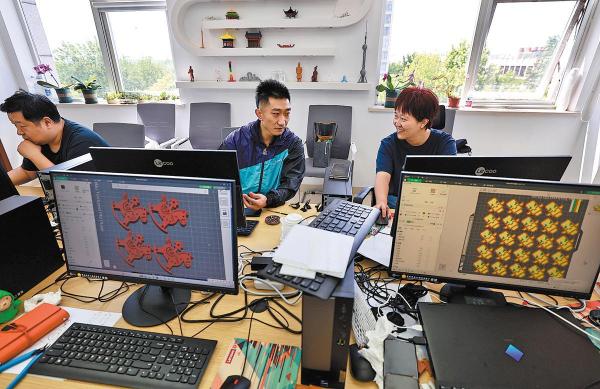 Wang exchanges ideas on the designing of toys with technician Li Siwei at the workshop. ZHANG WEI/CHINA DAILY
Profitability
Despite the early success, the workshop is far from profitable.
"We're compromising on profit to build a reputation first," Cao said. "The Fairmont order covered the cost of raw materials, but that's it. No labor. No design fees. We're paying for credibility."
The team's business model is still taking shape. They have received small orders — toys for a weekend market and customized figurines for a piano teacher's students — but nothing steady. "Most people don't even know we exist," Cao said.
Technical dependence is a major challenge. While the workshop's members have mastered basic printing, complex modeling still requires outside help from Li Changsen.
"Our goal is to become independent," Shen said. "We want to train our people to become teachers. Li Siwei could be one of them."
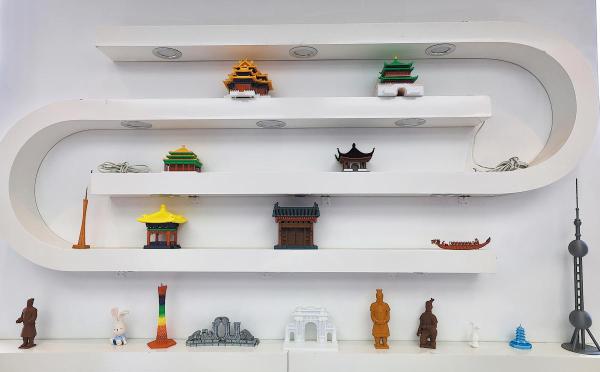 Some 3D printed models based on traditional Chinese architecture and Terracotta Warriors on display at the studio in Beijing. ZHANG WEI/CHINA DAILY
Neighborhood strategy
Late last month, the team was preparing for a Children's Day event. Their plan was to print small toys and give them away to children and parents who scanned a QR code to join a WeChat group.
"It's about building a community," Shen said. "Once people are in our group, they'll know we exist. Maybe next time they need a custom-made gift, they'll think of us."
The strategy reflects a broader shift in Chinese cities: using training and technology to move people with disabilities from charity-dependent roles into market-driven employment.
"We don't want sympathy," Cao said. "We want equal opportunities. If a customer has a choice between us and an able-bodied competitor, we want them to choose us, not because they feel sorry for us, but because our quality is better."
For Cao, the immediate goal is modest: keep the printers running, find the next order and prove her team can survive on its own.
Small orders continue to trickle in, and Cao welcomes each one."The orders are small, but they haven't stopped," she said. "They're still coming. We're always working on something. I'm not afraid of small orders — I'm only afraid of having none at all.




























 京公网安备 11010202009201号