


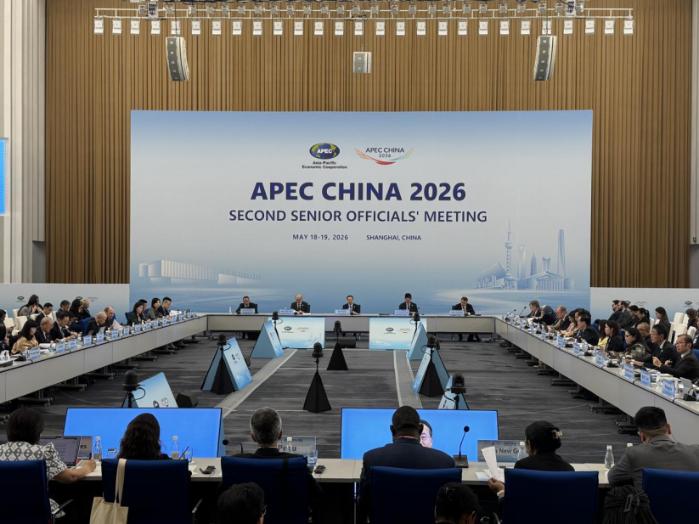
 The plenary session of the second Senior Officials' Meetings, or SOM2, of APEC 2026 opens in Shanghai on Monday. (Photo: Luo Bin/China Daily)
As the plenary session of the second Senior Officials' Meetings, or SOM2, of APEC 2026 opened in Shanghai on Monday, delegates from across the Asia-Pacific region are urging stronger collaboration on artificial intelligence, trade resilience, and multilateral cooperation in the face of global uncertainty.
The meetings, hosted by China, have drawn representatives from the 21 APEC member economies to address pressing regional and global challenges.
AI as a public good
Tan Khee Giap, a delegate from Singapore, proposed that China take a leading role in democratizing access to artificial intelligence technology.
"I suggested that China should treat AI as a public good," Tan said, "creating a platform to allow more countries to participate, broaden their horizons, and understand how it can be applied in various fields, including education and university reform."
Tan also highlighted Shanghai's strategic importance as a global financial hub, particularly for technology company listings, positioning the city as a critical bridge between capital markets and tech innovation.
Digital tools for smarter trade
Julio Chan, representing Peru, outlined his country's focus on integrating artificial intelligence and digital technologies into trade systems.
"We are working mostly in the areas of trade, and how we can use artificial intelligence and digital world in order to make trade more efficient, which means quicker, more secure and more resilient," Chan said.
Navigating global turmoil
Santo Darmosumarto of Indonesia emphasized the need for APEC economies to unite amid ongoing global conflicts and economic pressures.
"From the perspective of APEC, it's how the countries, some of the large economies in the world, are here at the moment to ensure that whatever is happening around the world, be it conflict, be it difficult situations, will not have that much of impact on the livelihoods of our people," Darmosumarto said.
He praised China's commitment to strengthening the multilateral trading system, adding that "Indonesia is very much in support of China as the host of APEC and our common eagerness to continue supporting this vision of stronger and freer trade and cooperation in the region."
Adapting global supply chains
Jose Alberto from Mexico identified the rapidly evolving international economic landscape as the primary challenge facing APEC economies.
"The main challenge is to adapt the new international economic situation in the world, develop and to be resilient for regional and global value chain, and to establish new regional supply chain in order to face the challenges we have," Alberto said.
The Senior Officials' Meetings and Related Meetings, which started on May 11 and will run through Tuesday, set the stage for the APEC Economic Leaders' Meeting later in the year. Delegates are expected to continue negotiations on digital economy frameworks, sustainable trade practices, and inclusive growth strategies.
























 京公网安备 11010202009201号