



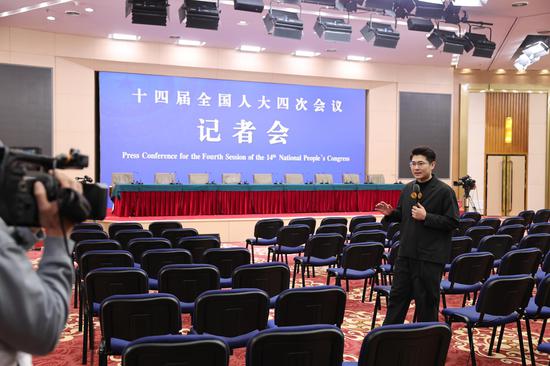
(ECNS) -- Head of China's National Development and Reform Commission Zheng Shanjie shared three stories about a drone delivering takeaway, robots performing on the Spring Festival Gala stage and trains traveling across the country during Friday's National People's Congress in Beijing, illustrating a people-centered picture of China's economic development.

In Nanjing City of Jiangsu Province, a waterborne takeaway delivery station at Shangyuanmen has begun operations, becoming the fifth such site along the Nanjing stretch of the Yangtze River. After crew members place orders through a mobile app, drones locate the vessel and complete delivery within about three to five minutes.
Nabjing media reported that around 1,200 to 1,500 ships pass through the Nanjing section of the Yangtze River daily, while roughly 2,000 vessels operate at Nanjing Port each day, generating strong demand for daily supplies among crews. So far, five drone delivery points cover a 50-kilometer river stretch, with more than 55,000 drone flights delivering about 390 metric tons of supplies to over 15,000 ships.
At the 2026 gala, several domestic humanoid robot companies appeared on stage with martial arts, skits and interactive performances in a technology showcase. The lifelike facial expressions and fluid movements of humanoid robots turned the technological imagination into reality.
Zheng highlighted two directions for their development. First, they will become increasingly human-like, opening up broad application scenarios. Second, they will evolve according to industrial needs, including perhaps with six or eight fingers, or even five or six arms.
Zheng said China's high-speed rail network now exceeds 50,000 kilometers in operating mileage and accounts for about 70% of the global total, enabling passengers to travel from the icy northeast to the spring-like south within a single day.
By the end of 2025, the Xi'an-Yan'an High-speed Railway opened to traffic, which belongs to a greater high-speed rail artery network consisting of eight vertical and eight horizontal lines across China. Earlier this year, Yan'an in Shaanxi Province launched its first direct high-speed rail service to Beijing. New lines are gradually forming an interconnected national network.
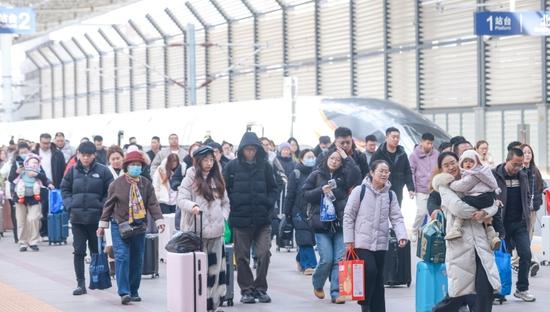
Slow trains in the Daliang Mountains in Sichuan Province are heartwarming to local residents, while the green-carriage trains operating during the Spring Festival travel rush help people reunite, Zheng said.
Train No. 5633, running from Puxiong via Xichang to Panzhihua in Sichuan Province, covers 376 km in more than nine hours, stopping at 25 stations with an average speed of about 40 kph Tickets cost just 26.5 yuan for the entire journey, with the cheapest fare at only 2 yuan, a price unchanged for decades.
Inside the train, Yi ethnic villagers often carry baskets of mountain produce, while chickens, ducks and other livestock crowd the aisles. Some call it a "mobile marketplace," while others refer to it as a "moving school bus."
Even in the era of high-speed rail, these public-service slow trains continue to run serve mountainous regions. China's railway network is not only a transport artery but a symbol of vitality and warmth.
Whether it is the efficiency of drone deliveries, the imagination of robots entering households, the speed of high-speed rail, or the perseverance of slow trains, behind every technological leap lies a deep concern for people's livelihoods.
This reflects the most vivid side of Chinese modernization: the ability to move fast while preserving the warmth of moving slowly.
(By Gong Weiwei)





























 京公网安备 11010202009201号