


The partnership between United States-based chip company Nvidia and Chinese humanoid robot maker Unitree Robotics underscores China's growing influence in the sphere of cutting-edge artificial intelligence technologies, experts said.
They highlighted that China now accounts for eight out of every 10 humanoid robots shipped globally and said the collaboration serves as a compelling example of how the respective industries of China and the US can leverage their unique strengths and work closely together in the AI sector to deliver inclusive products to the world.
The comments came after Nvidia announced on Monday that it is partnering with Unitree to launch its first-ever robotics system, which will be sold to researchers at institutions such as Stanford University.
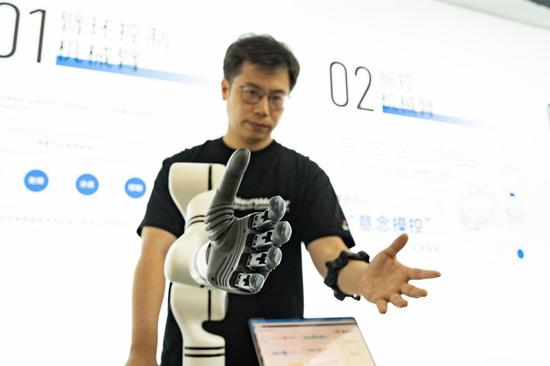
The system features Unitree's H2 humanoid robot, which is nearly two meters tall, and is integrated with Nvidia's Jetson Thor hardware, including its advanced Blackwell GPU, which is designed to power on-device AI.
"Today, we're announcing the Nvidia Isaac GR00T — a reference humanoid robot, fully integrated, with 25 degrees of freedom in each hand … 31 degrees of freedom in the robot itself," Jensen Huang, CEO of Nvidia, said during a keynote speech in Taipei on Monday.
The partnership also underlines China's growing expertise in humanoid robots. According to a report jointly released by CCID Media and China Electronics News in March, China is home to more than 140 humanoid robot manufacturers, with annual shipments reaching 14,400 units in 2025, which was 84.7 percent of the global total.
Zornitsa Todorova, an analyst at British multinational financial institution Barclays Investment Bank, said, "The decade of robotics belongs to China," adding that the logic is simple: the country possesses a majority of the minerals and materials needed for the mass production of humanoid robots. China supplies 91 percent of the world's demand for refined magnetic rare earths and accounts for 45 percent of battery exports and 22 percent of actuator exports. All these materials are crucial for producing humanoid robots.
More importantly, an analysis of data from the European Patent Office showed that China holds around 70 percent of the global patents for robotics filed since 2000. By comparison, the US holds just 4 percent. In 2023 alone, China filed more than 30,000 new robotics invention patents — almost 30 times more than the US.
China accounts for about 75 percent of all relevant patents in the field of humanoid robots worldwide. The company with the most humanoid robot patents globally is not the well-known US company Boston Dynamics. It is China's UBTech, with 812 patents, dwarfing Boston's 119.
Sean Stein, president of the US-China Business Council, said, "The US and China are the only two real players at the AI table. Ten years ago, people would ask, 'Can China innovate?' Fifteen years ago, maybe you could sort of ask that question. But you can't ask that question today. China is innovating incredibly rapidly.
"That's why the interactions, engagements and exchanges between the Chinese and the US governments and companies matter," said Stein.
In May, Foreign Ministry spokesman Guo Jiakun said that China and the US had agreed to initiate intergovernmental dialogue on AI.
In another development on Monday, Unitree Robotics received approval from the Shanghai Stock Exchange's listing committee for its planned initial public offering on the STAR Market. The move was one of the fastest IPO reviews in China this year, as investors continue to pour into the rapidly growing robotics sector.






























 京公网安备 11010202009201号