



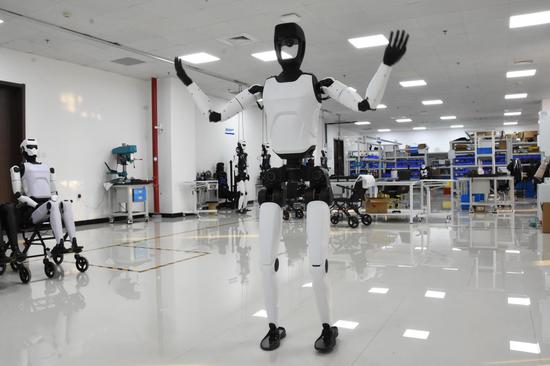
 Staff members adjust and test humanoid robots inside the pilot-scale validation facility of the Beijing Innovation Center of Humanoid Robotics on Thursday. Photo/China Daily
A newly established pilot manufacturing and validation platform for humanoid robots in Beijing marks a significant transition aimed at shifting the industry from small-batch prototyping to large-scale production.
Launched by the Beijing Innovation Center of Humanoid Robotics on Thursday, the first of its kind facility in the capital is fitted with 500 sets of production and testing equipment, and has an annual pilot production capacity of up to 5,000 embodied humanoid robots.
The center provides one-stop services including prototyping, performance and process validation, module and whole-robot assembly, and testing.
The launch comes as the global humanoid robotic industry moves beyond research and development toward commercial trials. However, the transition from innovation to industrialization remains a significant challenge due to a lack of standardized and efficient pilot manufacturing infrastructure.
"Across the industry, the main bottlenecks lie in pilot manufacturing readiness, standardized production and testing, and the lack of data continuity from development to scale-up," said Liu Yizhang, head of the pilot platform.
Liu noted that research institutes and startup ventures typically rely on self-developed trial lines that are costly and inefficient. Gaps in standardization make it difficult to ensure consistent quality, while incomplete testing systems can leave risks unaddressed before products reach real-world applications.
These concerns reflect a broader shortage of pilot manufacturing capacity across emerging industries. In November 2025, the Ministry of Industry and Information Technology identified humanoid robots as a priority area requiring faster construction of validation platforms to convert technological advances into productive capacity.
On Jan 4, the Beijing government stated that a tiered support system would be established for pilot testing platforms, with newly established facilities eligible for subsidies of up to 100 million yuan ($14.39 million).
The Beijing Innovation Center of Humanoid Robotics designed its new pilot platform as an integrated service facility. It features four core components: small-batch pilot lines, whole-robot and joint manufacturing demonstration lines, and specialized testing laboratories.
Digitization is a central feature of the facility. Built around a unified master data platform, an integrated digital operation system connects information and logistics, enabling data tracking from the design phase through production and test feedback. This digital framework is intended to shorten iteration cycles from prototype validation to small-batch production.
The center, which covers approximately 9,700 square meters, was commissioned and completed last year. It is located in Beijing's Economic-Technological Development Area, also known as E-town.
The center plans to further expand the platform's capabilities by undertaking national research and development projects.
According to data from the Beijing Municipal Bureau of Economy and Information Technology, the revenue of Beijing's robotics industry grew by nearly 40 percent in the first half of 2025.
The city also ranks first in the country for the number of "little giant" enterprises — small and medium-sized enterprises recognized for being specialized and innovative — within the robotics sector.


































 京公网安备 11010202009201号