



US President Donald Trump announced on Wednesday that he had "formed the framework" of a future deal over Greenland in a meeting with NATO's chief in Davos, Switzerland, and that he would call off the threat of tariffs on eight European countries that had opposed his quest to acquire the Danish territory.
Trump wrote in a post on his Truth Social platform on Wednesday that he and NATO Secretary-General Mark Rutte had "formed the framework of a future deal with respect to Greenland and, in fact, the entire Arctic Region".
"This solution, if consummated, will be a great one for the United States of America and all NATO nations," he said.
After the announcement, Trump told reporters huddled on the sidelines in Davos that the deal gave the US "everything it wanted" on Greenland.
"It's a deal that everybody's very happy with. It's the ultimate long-term deal, and I think it puts everybody in a really good position, especially as it pertains to security and minerals and anything else," he said.
Michael A. Allen, the political science program lead in the School of Public Service at Boise State University in Idaho, said the US can "increase its military presence in Greenland and work with NATO partners to achieve its goals".
However, Danish Prime Minister Mette Frederiksen said on Thursday that Rutte cannot negotiate on behalf of Denmark over Greenland.
"The position of Denmark and that of Greenland are the same, and no negotiations were held yesterday with NATO about our sovereignty," she told Danish television.
The US and Denmark will renegotiate a 1951 defense pact on Greenland, a source familiar with the talks between Trump and Rutte told Agence France-Presse on Thursday.
Further details about the talks were limited immediately after Trump's announcement. But the US' planned 10 percent tariffs on goods from the United Kingdom, Denmark, Norway, Sweden, France, Germany, the Netherlands and Finland, due to start on Feb 1, were dropped.
So too was the threat of a 25 percent tariff increase from June 1 if no arrangement was made for the US to acquire Greenland.
Trump told CNBC that the deal had "no time limit" and that it would last "forever".
He also hinted that it could involve the US having rights to minerals and providing support for the Golden Dome missile defense system.
News of the surprising breakthrough was met with widespread relief by European nations, where many had openly derided Trump's threats to take over Greenland. It sent shock waves throughout the EU as Denmark is a member of NATO, the defense alliance founded in 1949.
US Secretary of State Marco Rubio and Trump's special envoy Steve Witkoff will "report" to Trump on the progress of negotiations.
Meanwhile, the European Parliament has decided to suspend its work on the European Union's trade deal with the US in protest against Trump's demands to acquire Greenland and tariff threats.
Bernd Lange, chair of the parliament's International Trade Committee, said in a statement on Wednesday that the Parliament would suspend work on two legislative proposals related to the deal.
"Given the continued and escalating threats, including tariff threats, against Greenland and Denmark, and their European allies, we have been left with no alternative but to suspend work on the two legislative proposals," Lange said.
"By threatening the territorial integrity and sovereignty of an EU member state and by using tariffs as a coercive instrument, the US is undermining the stability and predictability of EU-US trade relations," he added.
Under the trade deal reached in July, the EU would suspend tariffs on all US industrial products and introduce tariff-rate quotas for a wide range of US agri-food products entering the EU market.
In return, the US would apply a 15 percent import levy on most EU goods. The European Commission subsequently published two legislative proposals to implement certain tariff aspects of the agreement.
Preparedness handbook
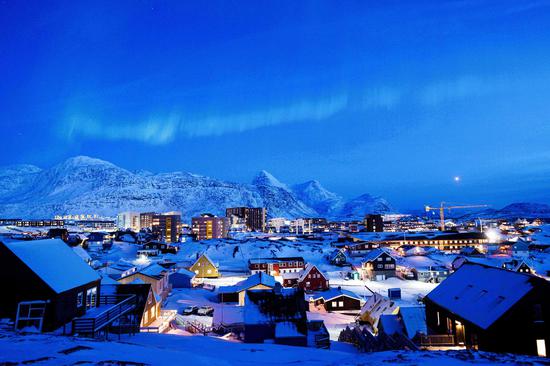
In Greenland, the government has issued an emergency preparedness handbook advising households to stock at least five days' worth of basic supplies, including drinking water, food and sanitary products, in preparation for potential crises, local media reported on Wednesday.
The minister for fisheries, hunting, agriculture and self-sufficiency, Peter Borg, said at a news conference that the handbook recommends that each person store 3 liters of water per day, a five-day supply of food, and essential items such as toilet paper.
Also on Wednesday, The New York Times cited sources as saying that NATO members met with top military brass from all the alliance's member states.
They said that one possibility in the fine print of the agreement was that Denmark may have to give up some, but not all, of its territory to the US.
This would allow Washington to build military bases, but nothing has been officially confirmed yet.
Trump notably did not say whether the US would own Greenland outright when asked by reporters.
In an earlier speech before the World Economic Forum in Davos, the US president ruled out the use of force to acquire Greenland, alleviating fears among many European allies.
"We probably won't get anything unless I decide to use excessive strength and force, where we would be frankly unstoppable," Trump said.
"But I won't do that. That's probably the biggest statement, because people thought I would use force. ... I won't use force. All the United States is asking for is a place called Greenland."
He also reminded the European Union of prior US tariffs on their goods and derided their dependence on the US for security, dubbing it a contrast to their former glory.
"Without us, most of the countries don't even work," Trump said.





















 京公网安备 11010202009201号