




The Millennium City Park in Kaifeng, Henan province, is a re-creation of the ancient scroll Along the River During the Qingming Festival. (Photo/China Daily)
The ancient city of Dongjing, the capital of the Northern Song Dynasty (960-1127), continues to resonate with modern-day people. Not only does it remain buried 8 to 10 meters beneath present-day Kaifeng, Henan province, but its influence is also evident in the designs of the city's contemporary tourist attractions.
I began learning about a park featuring an ancient structure from the Northern Song period through a mystery game that was popular on the internet. I decided to figure out why it was so appealing.
The Youguo Temple Pagoda, better known as the "iron pagoda", is now surrounded by a park named after it.
Entering the site, the staff members instructed me to choose my "tribe", be it a mouse, peacock, fox, or magpie. Each tribe had to complete different tasks in the park, and at the end of the day, the number of tasks each tribe completed would be tallied to determine the winner.
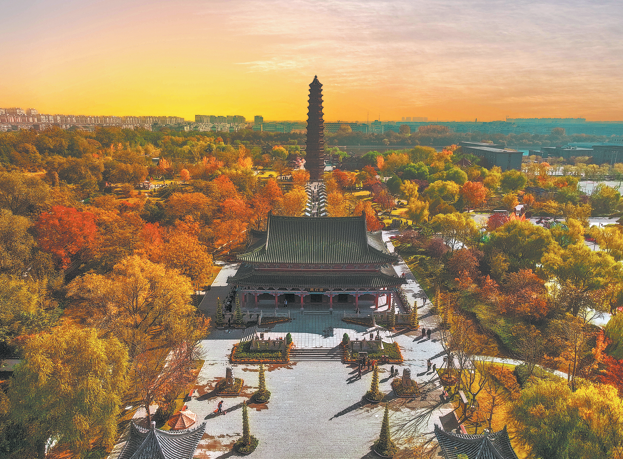
The iron pagoda stands in Kaifeng as a witness to its past glory.(Photo/China Daily)
I randomly chose the peacock tribe while other visitors made their choices. We were then given scorecards with grids. A staff member told me the game started last year and became popular, with new versions released every three months to keep repeat visitors feeling it was a fresh activity.
As I began the tasks, I saw a stone tablet with the words, "the No 1 Pagoda Under the Heaven", written by Northern Song calligrapher Mi Fu, who wrote these words on a plaque after ascending the pagoda. After that, I entered a courtyard called Fusheng, where we had to complete more tasks.
In the courtyard, I found a character in traditional costume who claimed to be a descendant of Mi. He said Mi appreciated ornamental rocks, a tradition that was popular during the Northern Song period. The criteria for this activity were "slim, wrinkled, perforated, and transparent", and the task was to find the four characters referring to the requirements in the courtyard.
Several young people rushed to complete the task.
I continued walking around the courtyard because the task didn't apply to peacock tribe members. I then found another task in a pavilion. I was required to make a rubbing of a stone tablet. I was instructed to spread a layer of paper onto the ink model and gently hammer it to make images appear. What I made was crude, but the instructor encouraged me and stamped my scorecard to show that I completed this task.
Leaving the courtyard, I returned to the main road, which led to the iron pagoda where a tour guide introduced the building.
In ancient China, pagodas were often built with temples, and this was no exception. The original temple dates back to the Northern Qi Dynasty (550-577), but the pagoda was initially built in the Northern Song period.
Seen from afar, it resembled an iron pagoda, though it was made of glazed tiles, earning it the nickname "iron pagoda" among the public as early as the Yuan Dynasty (1271-1368). After restorations throughout many following dynasties, the pagoda still maintains its Song Dynasty-era style.
On the way to the pagoda, I tried to complete many other tasks, such as making painted fans and burning incense, all popular activities during the Northern Song period.
To participate in these activities and do a good job, patience and precision are a must. I gained a deeper understanding of Song Dynasty elegance.
There were a few other tasks related to the pagoda, such as one that required visitors to find a glazed lion statue, notable for its Northern Song-era origins. To enhance appeal and make the tasks more engaging and enjoyable, stories were added to each task.
Visitors could spend over two hours completing the tasks, turning a tour of the park into a novel experience by engaging in the intriguing mystery game.
When I finally stood at the base of the pagoda, I realized it had many colors. The glazed bricks were full of patterns, like flying apsaras (celestial beings), flowers and auspicious dragons.
To protect the pagoda, entry was prohibited, allowing visitors to admire only its exterior.
In its history, it has withstood more than 40 giant earthquakes, six floods from the Yellow River and numerous wars. Yet, it still stands firmly, like a resolute soldier silently witnessing the passage of time.
Looking up, more than 1,000 years had left their mark on its body. Looking around, people were rushing to complete their assigned tasks, but at that moment, I felt a magical blend of history and the present, harmony and peace.



































 京公网安备 11010202009201号