



(ECNS) – Chinese scientists have directly observed the Migdal effect for the first time in experiments involving collisions between neutrons and atomic nuclei, confirming a quantum mechanics prediction made nearly nine decades ago.
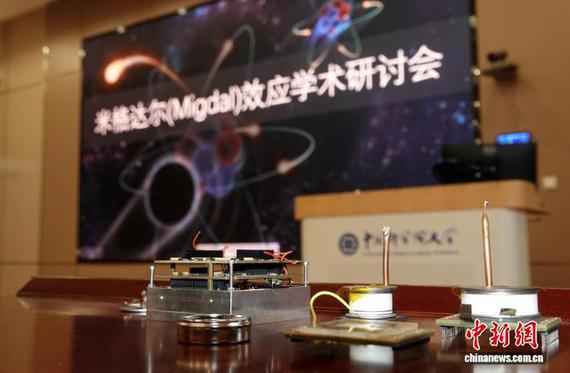
A joint research team led by the University of Chinese Academy of Sciences (UCAS) achieved the breakthrough using their own specialized gas detectors and microchips.
The discovery not only verifies an 87-year- old theoretical prediction in quantum mechanics, but also provides key experimental support for the search for lighter dark matter particles in the universe. The findings were published in the journal Nature on Thursday.
The Migdal effect was proposed in 1939 by Soviet physicist Arkady Migdal. It describes the quantum phenomenon for when particles strike atomic nuclei, where part of the energy may then be transferred to electrons outside the nucleus, potentially knocking them free from the atom’s binding. This process can convert otherwise undetectable weak signals into measurable electronic ones, which offers a promising method for detecting light dark matter.
The Migdal effect is considered a key theoretical pathway for lowering energy thresholds in light dark matter detection,” said Zheng Yangheng, a professor at UCAS and corresponding author of the study. “However, for more than 80 years, the effect had never been directly confirmed in experiments involving neutral particle collisions, raising questions about dark matter experiments that rely on this mechanism.”
Zheng said the new findings resolve a long-standing threshold bottleneck in light dark matter detection. Future international dark matter search experiments could harness the Migdal effect to improve signal identification accuracy and even allow experiments to be more sensitive to more possible kinds of dark matter than before, especially ones that were previously too hard to detect.








































 京公网安备 11010202009201号