


By Lin Zhuowei
(ECNS) -- The cicadas were deafening in Haizhu National Wetland Park on a sweltering summer morning. An electric buggy carrying a delegation of Chinese and international experts wound its way through unbroken groves of lychee and longan trees. Were it not for the distant silhouette of the Canton Tower, one could easily forget that this lush expanse sat squarely in the heart of a megacity of close to 20 million people.
"Wait, please stop the car." Stewart Maginnis, deputy director general of the International Union for Conservation of Nature (IUCN), leaned forward abruptly and asked the driver to pull over.
He pulled out his phone and aimed his lens at the lake, where the gleaming Canton Tower rose beyond a sweep of almost unbroken green, perfectly embedded in the city's skyline.
"I took that picture because I want to be able to show when I make presentations of how you can have a very rich, very vibrant, very biodiverse area well managed in the city for the benefit of people and nature," Maginnis later explained in an exclusive interview with China News Network. For him, that seamless marriage of urban landscape and natural beauty was both a living embodiment of China's ancient philosophy of "harmony between humanity and nature" and a reflection of the core idea behind Nature-based Solutions, or NbS.
That unscheduled stop opened the door to a far-reaching conversation about China's ecological transformation and its place in global environmental governance.
Green thinking: a real shift in leadership
"If you look back in the 20th century, a lot of the conservation thinking and leadership was more Western," Maginnis said, seated in the shade of a tree.
"I'm convinced that we're seeing a real shift to global leadership coming from this region, and particularly from China." The shift, in the eyes of Maginnis, one of the architects of the global NbS concept, transcends money or measurable environmental improvements. More important is that "China is bringing in really much-needed new conceptual framings for how we will undertake conservation on a planet with nearly 10 billion people."
The heart of that framing, he said, can be boiled down to a single word: coexistence.
"And specifically, I would actually say the whole concept of coexistence — that we don't separate one area here and then we can do whatever we want elsewhere, that we need to see nature conservation as a whole-of-society, a whole-of-planet approach."
Luo Ming, a research fellow at the Land Consolidation and Rehabilitation Center of China's Ministry of Natural Resources, sees that same logic running deep in China's own traditions.
"We have long embraced the philosophy of 'harmony between humanity and nature'," Luo said. "Stewart has been promoting 'coexistence' everywhere he goes, and that is exactly what this ancient idea means."
For Luo, this is no abstract concept. She pointed to the Dujiangyan Irrigation System, built more than two millennia ago and still functioning today. It uses a fish-mouth-shaped weir to split the flow of Minjiang River, the Feishayan floodgate to separate sediment, and the Baopingkou diversion passage to irrigate the Chengdu Plain.
"Of course, we cannot define Dujiangyan as an NbS project outright, because NbS is a modern concept. Nevertheless, its approach of leveraging natural processes to meet human needs is consistent with the core spirit of NbS." In China, she said, "we have this NbS gene."
A test bed at scale: from pilot projects to mainstream action
Maginnis rattled off the numbers of China's ecological restoration with the ease of someone who has been studying them for years. "If you look at the improvement in water quality, I think it's only in 10 to 15 years that we have seen an improvement of Grades Ⅰ to Ⅲ water from about 70 percent to well over 90 percent. And Grade Ⅴ has been reduced to almost nothing."
He also noted that China now has 28 sites certified under the IUCN Green List — "the country with the most green listed sites in the world at the minute."
What excites him most, however, is that China is moving beyond the perennial trap of pilot projects that never scale up. He described the country as "the engine room of developing and applying Nature-based Solutions."
"There is definitely a lot of interest in Nature-based Solutions, but people tend to be saying, 'We want to pilot-test Nature-based Solutions.' My response, in that case, is: 'Well, go to China. Nature-based Solutions are already being scaled up in China.'"
Why China? Luo offered a systematic explanation.
Beneath the NbS successes, she said, lies a profound intellectual evolution: from the ancient ideal of harmony to the modern vision of a "community of life" — mountains, rivers, forests, farmlands, lakes, grasslands, and deserts are all parts of a community of life. "Those who plant trees cannot focus merely on afforestation; those managing water cannot focus merely on water governance; those protecting farmland cannot focus merely on farmland conservation. This 'community of life' philosophy shifts our mindset from isolated, fragmented restoration towards holistic, systematic thinking. This is also the essence of NbS."
That philosophy has been locked in place by hard institutions.
The "Two Mountains" theory — "lucid waters and lush mountains are invaluable assets" — brings ecosystem services into the heart of development planning. It is backed by the world's largest ecological protection compensation program, channeling more than 200 billion yuan (about US$29.5 billion) a year from central funds.
Ecological red lines, permanent basic farmland boundaries and a unified national spatial planning map have turned NbS projects into something "verifiable, measurable and auditable" in China.
Luo noted that this approach meets the three prerequisites for NbS that the global community widely agrees on: high-level political commitment, collective coordinated action, and scaling up and mainstreaming.
A sanctuary in the city: what Haizhu reveals
The most persuasive evidence came from the very ground beneath their feet. Haizhu Wetland was once a flood-prone expanse of fruit orchards, a "10,000-mu orchard" that has been transformed into an ecological lung for the city. Park staff describe it with a local motto: "Step inside, and you are in nature; step outside, and you are in prosperity." Four metro lines reach the surrounding area, stitching the wetland into the fabric of daily life.
"In a different place in the world under less visionary leadership, Haizhu might have been converted to a prime development site, and it could have been converted to buildings and whatnot," Maginnis remarked. Instead, Guangzhou chose to protect the green space and then enhance it, removing invasive species and restoring habitats to create an intensely vibrant ecosystem.
It was Luo's first visit to Haizhu, but she read its landscape immediately. "Look at its ridges and furrows, the drainage and irrigation system; that's traditional wisdom." She observed that by preserving natural spaces and restoring natural processes, the wetland tackles multiple challenges at once. "When a rainstorm comes, it serves as a retention area. Its wetland area is large, so it can cope with extreme weather and climate change, and the biodiversity is very rich."
For her, this is the essence of NbS. "Nature-based Solutions are not about solving a single problem. In traditional flood control, we might channelize and harden a riverbed so that the water can flow away quickly. But the NbS approach is to restore the hydrological process, improve connectivity, slow the water down, and create more space for retention, so that it doesn’t cause disaster."
At the same time, she added, "the wetlands and green belts along both banks serve as buffer zones, providing purification, biodiversity, and places for people to rest and enjoy themselves. It can deliver multiple ecosystem services, not just a single service."
What struck Maginnis equally was the cultural dimension. Traditional farming practices are kept alive here as a living repository of local culture. More than 500,000 schoolchildren arrive each year by metro to plant rice and learn to become "green citizens." The wetland has even yielded three species never recorded before.
"This place is protected by law," a staff member explained. "Nobody has the right to demolish it. It can endure for generations and become a treasured part of their childhood memories."
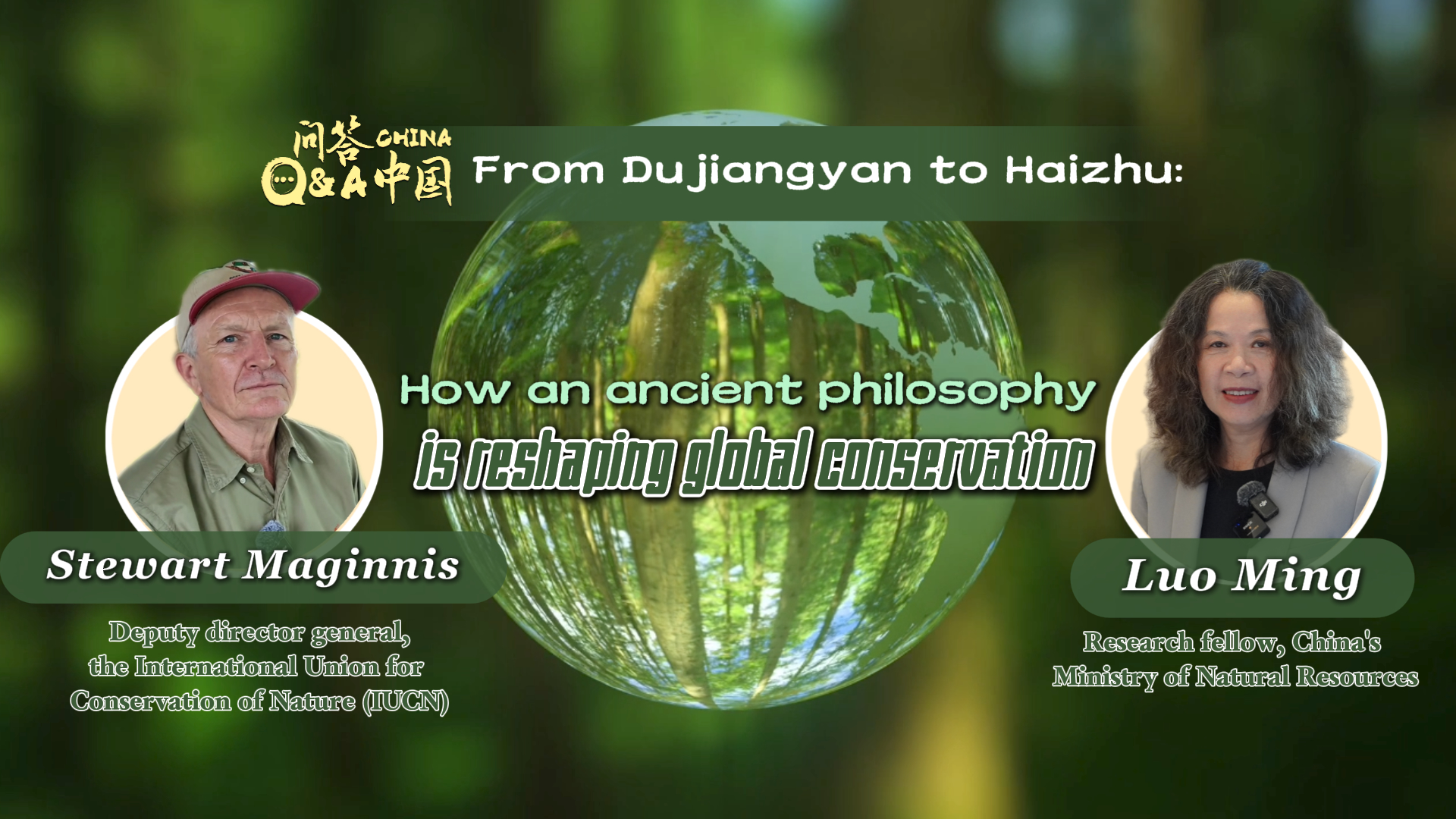
For Maginnis, that fusion of nature and culture is the key. "Our conservation objectives cannot be separated from our own culture and our own philosophy of how we move forward. That's part of the reason why I think China is so successful in having a nature conservation strategy based on coexistence."
Luo saw a still deeper layer. "Seeing the beauty of the water lilies, seeing the process of the wild rice stem from a seed to the root being used by humans, we can feel that we are indeed a community of life," she said. "You might say you are restoring nature, but perhaps it is nature that is healing and restoring you. Humanity and nature are indeed a community of life; it exists in every moment of our daily lives."
New pathways for a warming world
Faced with the triple planetary crisis of climate change, biodiversity loss, and land degradation, Maginnis believes China is no longer just offering a vision — it is handing over a practical toolbox.
He pointed to the restoration of the Loess Plateau and the removal of invasive Spartina from the coastal wetlands of Yancheng in Jiangsu. "One of the very first Nature-based Solutions we identified is the restoration of the Loess Plateau that was highly degraded, and brought back into vibrant biodiversity, vibrant productivity. It's the real coexistence of man and nature."
"I think there are multiple lessons down at the site level, how to do things, but then I think there is more from the governance perspective." The Chinese approach, he said, is not simply about creating isolated protected areas but about "bringing nature right through all of society and all sectors."
On the international stage, he noted that China's leadership in securing the Kunming-Montreal Global Biodiversity Framework is already having ripple effects. In Bangkok, drawing on sponge-city concepts and with advice from China, an old tobacco factory has been turned into an NbS wetland that buffers surrounding districts from floods while doubling as a public park.
Luo added a note of balance. China's NbS pathway, she said, is distinctly institution-driven, and it differs from the market-oriented pathways being explored internationally, such as carbon credits, biodiversity credits, and green finance instruments. "Of course, we should not judge which model is superior. Instead, we should learn from each other and draw on each other's strengths."
As the conversation turned to the future of the planet, Luo's tone grew heavier.
"Six out of nine planetary boundaries for Earth have already been exceeded. Climate tipping points are being breached, and many international agreements are advancing slowly. The future holds tremendous uncertainty."
She paused, but her gaze did not waver. "Yet precisely because of this, we must act. Humanity is part of a community with a shared future. No country can be left behind. And in this grand narrative, every single one of us is a protagonist."
She issued a call that was disarmingly simple: "Start from ourselves. Use one less plastic bag, drive (petrol) one day less, sort your rubbish. These are not slogans; they are the small things in daily life. If everyone does this, our planet will surely become better and better."
A breeze rippled across the Haizhu wetlands, stirring faint reflections of the Canton Tower on the water. In that quiet shimmer, the words of the experts seemed to hang in the air: whatever lies ahead, the green experiments taking root on this patch of land have already opened a window for the world.





































 京公网安备 11010202009201号