



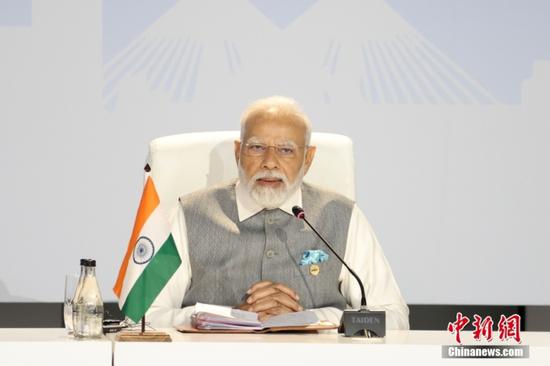
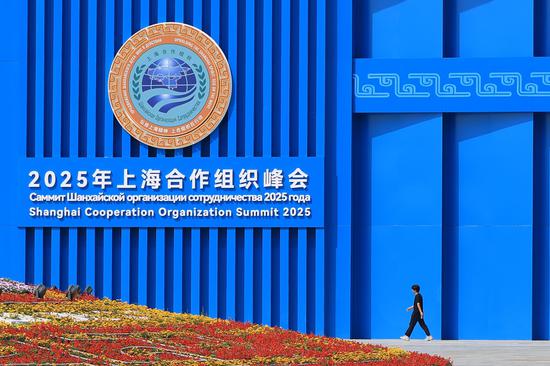
On August 31, Indian Prime Minister Narendra Modi visited Tianjin for the SCO Summit 2025. In talks with Chinese President Xi Jinping, the two leaders acknowledged fresh progress in bilateral cooperation. As two ancient Asian civilizations and emerging economies, China and India are expected to transcend differences and achieve mutual success amid a complex and shifting international landscape.
In recent years, China-India economic ties have demonstrated strong resilience. Bilateral trade hit $118.4 billion in 2023–2024, making China India’s top trading partner for the first time. Notably, India’s exports to China grew by 8.7% even as its trade with the U.S. contracted sharply. This structural shift highlights the deepening strategic interdependence of the two economies.
China supplies machinery and electronics that support industrial upgrading, while India exports pharmaceuticals, agricultural goods and minerals that anchor key segments of China’s supply chains. Together these two economies have further enhanced the cost advantages and supply resilience worldwide.
President Xi Jinping called on the two countries to expand exchanges and cooperation to achieve mutual benefit and win-win, accommodate each other’s concerns and get along in peace and harmony, and strengthen multilateral coordination to safeguard shared interests.
The recent agreement to reopen three traditional border trading markets— Renqinggang–Changu, Pulan-Gunji, and Jiuba-Namgya—signals the latest step toward easing bilateral tensions and balancing border management with economic cooperation, which is expected to uplift border communities, stimulate local logistics, and establish strategic nodes for future development. This will help foster greater consensus on regional economic connectivity and security mutual trust, among other aspects.
People-to-people exchanges continue to bolster long-term China-India relations. By facilitating visits to the Kailash Mansarovar Yatra, China has showcased its cultural openness while addressing Indian religious interests. Bollywood films have gained popularity in China, while Tai Chi and yoga similarly continue to foster cross-cultural engagement. These interactions have deepened mutual understanding and public affinity between the two nations. The resumption of tourist visas for Chinese citizens, along with the reopening of direct flights will further improve economic cooperation, deepen people-to-people ties and enhance strategic trust.
U.S. tariff policies and trade protectionism have indirectly pushed China and India closer togetehr, encouraging India to reassess its diplomatic strategy and adopt a more pragmatic approach. Both countries acknowledge the critical importance of enhancing cooperation as major global economies.
As Indian External Affairs Minister S. Jaishankar stated, “Differences should not become disputes, and competition should not lead to conflict.” This perspective offers a key opportunity to reassess the relationship through practical, interest-based dialogue. By deepening cooperation in areas of mutual benefit and prudently managing differences, both sides can enhance bilateral stability.
Yet a fundamental question remains: can external pressures truly resolve underlying China-India differences? As Sana Hashmi of the Taiwan-Asia Exchange Foundation argues that while U.S. tariffs have somewhat accelerated stabilization, “fundamental differences” between China and India remain. Moreover, she adds that the “Indo-Pacific strategy will continue to shape regional dynamics.”
In this way, China-India relations are less a “reset” than a prolonged effort to achieve dynamic balance.
If India treats warmer ties as a tactical response to U.S. pressure or leverage with the West, it may face recurring strategic vacillation in great-power competition. Instead, if it seizes this opportunity, rejects zero-sum thinking, and upholds the Five Principles of Peaceful Coexistence, both nations can better manage structural challenges and build a more stable bilateral relationship.
As British scholar Martin Jacques argued, “The 21st century will be the Asian century”. The realization of this vision is heavily reliant on bilateral collaboration. As ancient civilizations connected by the Silk Road, China and India possess the potential to align the Belt and Road Initiative with “Made in India” to forge a win-win path. By setting standards in AI and clean energy and championing the multilateral system, the two nations can transcend traditional development models and offer a more inclusive and resilient paradigm for the rest of the world.
If China and India rise above the constraints of geopolitical rivalry and prioritize common development, they will not only revitalize the Eastern principle of “harmony in diversity,” but also advance a multipolar world and a more equitable global governance system. The cooperative pas de deux of the dragon and the elephant favors dialogue over confrontation, demonstrating a new narrative of coexistence. Such a partnership would not only be a response to the concept of an “Asian century,” but also a firm commitment to building a community with a shared future for mankind.
Wang Hanyi, a lecturer at the School of Marxism Studies, a Deputy Director of the Course Center of Xi Jinping Thought on Socialism with Chinese Characteristics for a New Era, Shanghai International Studies University.



















 京公网安备 11010202009201号