


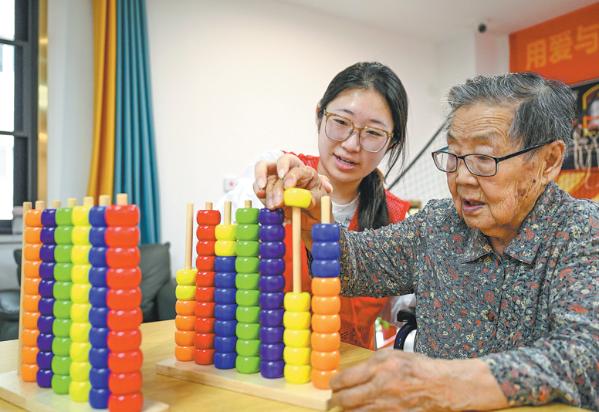
 An elderly woman uses a set of colored beads to train her thinking and motor skills in Hefei, Anhui province, last month. (ZHAO MING/FOR CHINA DAILY)
China's rapidly aging population is fueling a new consumer trend for "senior toys". With over 300 million citizens aged 60 or older, families are increasingly turning to specialized games, puzzles and therapeutic toys to combat cognitive decline and elderly isolation. However, industry insiders warn that the emerging market is still failing to meet the complex needs of older adults.
Guo Xiafei used to think her grandmother was fine living on her own. But during her rare home visits to Chengdu, Sichuan province, Guo noticed her grandmother's loneliness, filled with long hours of television, naps and silence.
"My grandpa can find joy in music. He plays the erhu and the bamboo flute, but my grandma's life is much more monotonous. I realized I've grown up, and it's time to look back," the 27-year-old said.
That realization led her to search for something that could bridge the distance. That's how she found senior toys.
To Guo's delight, after playing with a bead sorting and tweezing toy, her grandmother broke into a childlike smile, hugged and thanked her.
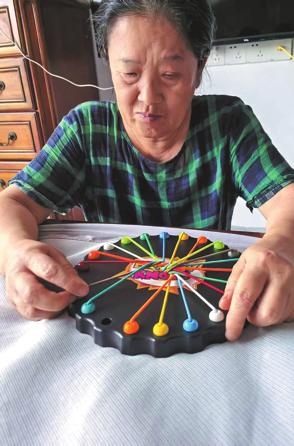 Chu Yue's mother trains her mind with a string puzzle game. (CHINA DAILY)
The 82-year-old, who has severe hearing loss, usually required the family to shout into her ear. Yet, sitting side by side with her granddaughter and taking turns playing a whack-a-mole game, her face was full of laughter.
"She told me the toys are so wonderful. That warm family vibe is the real point of the toy," Guo said.
For decades, China's massive toy industry focused exclusively on children. Now, e-commerce platforms are flooded with hundreds of products marketed as elderly toys — ranging from no-pick-up table tennis sets and color-sorting games to memory books and grip balls.
On the product pages, stores say the toys are designed to kill time and keep minds sharp.
Guo discovered them by accident while scrolling online.
"I saw a table tennis set with no need to pick up the ball. Since my grandmother needs help while walking outside and spends most of her time indoors, I thought: why not bring the fun inside?
"I wanted to let them experience a bit of what we young people are into. That's where it all started," she said.
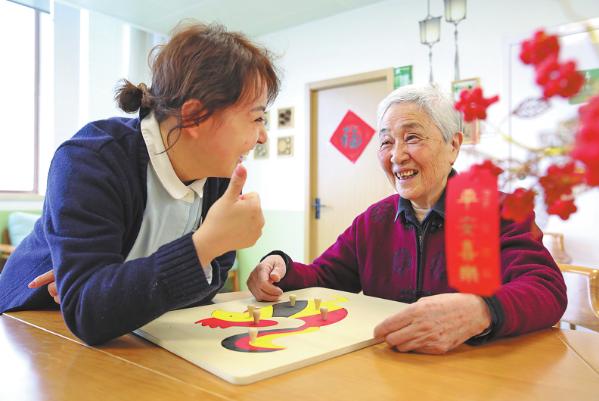 A social worker accompanies an elderly woman in solving a jigsaw puzzle at a senior care home in Huzhou, Zhejiang province, in January. (SHI WEI/FOR CHINA DAILY)
However, she quickly learned a lesson that no product description can teach.
"If I give them a toy and walk away, they won't play. They are like children. They need someone beside them and simple interaction.
"When I was little, they played with me. Now I play with them," Guo said.
Like Guo, a growing number of families are turning to toys not just for entertainment, but as tools for connection and cognitive care.
Besides medical treatment, Chu Yue provides toys for her 66-year-old mother, who has developed symptoms of memory decline.
The 41-year-old from Daqing, Heilongjiang province, said: "My mother had even gotten lost inside her own neighborhood. She was worried that she might have developed dementia."
Chu went online and typed a simple search: "Toys to prevent dementia for the elderly."
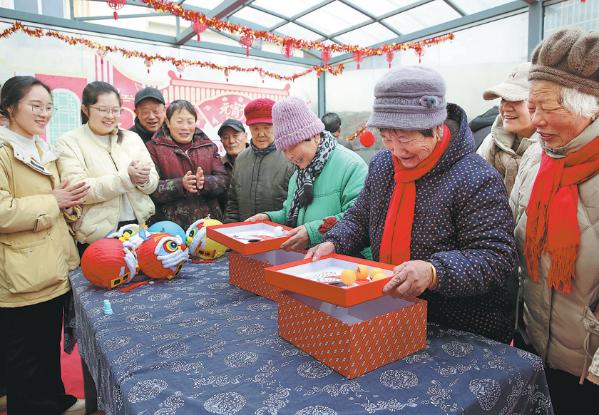 Senior residents play a balancing game for Lantern Festival on March 1 in Lianyungang, Jiangsu province. (CHINA DAILY)
What appeared was a flood of cheap, simple products on shopping platforms. She picked a string puzzle — a small board with holes and tangled cords — priced at less than 20 yuan ($2.93). The goal is to untie the knots and free the strings by moving them through the right holes.
"At first, my mother thought it would be too hard. So I showed her," Chu said. "Then she tried herself and realized that as long as she is patient, she can always solve it."
Within days, her mother was demanding more challenge.
"She told me to tie it tighter, twist it a few more rounds, and make it harder for her," Chu said.
The toy's appeal lay in its simplicity. Her mother soon started playing for hours. Then she asked Chu to buy the same toy for her elder sister.
"My aunt loved it too. And then she started playing with her own family, setting puzzles for each other. It brought the whole household together. Activities like watching TV are just input with no interaction. But with this toy, her brain is working," Chu said.
Yet, while such toys help some, others face more complex needs that off-the-shelf products fail to meet.
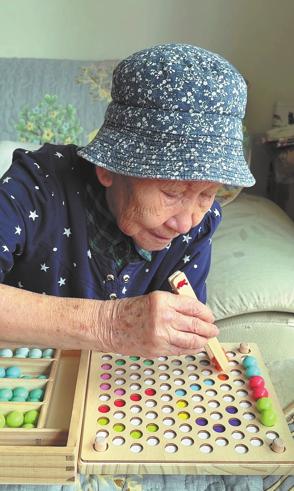 Guo Xiafei's grandmother trains her motor skills with a tweezing toy. CHINA DAILY
After a cerebral infarction affected her grandfather's speech and mobility, Tan Mengqian, 32, got creative. Her grandfather, a retired professor from Tai'an, Shandong province, could no longer walk steadily or communicate clearly.
"I needed to find things he could do with his hands while sitting down," Tan said. She started with large-print books and picture books, which he enjoyed. But she wanted more than just a pastime.
She then turned to the internet, searching for "toys for the elderly with dementia".
What she found were sensory touch toys for children. "He would touch and play with them to help develop his tactile perception," she said. But engagement was limited. "He couldn't get overly absorbed in it. He might play for half an hour, then not play seriously anymore."
The core problem is a lack of suitable products for those with more advanced needs, she said.
"The elderly toys I find on online shopping platforms are not right for his situation. We need something that uses the hands but doesn't require fine, detailed movements."
For Tan, the ultimate solution wasn't found in a shopping cart.
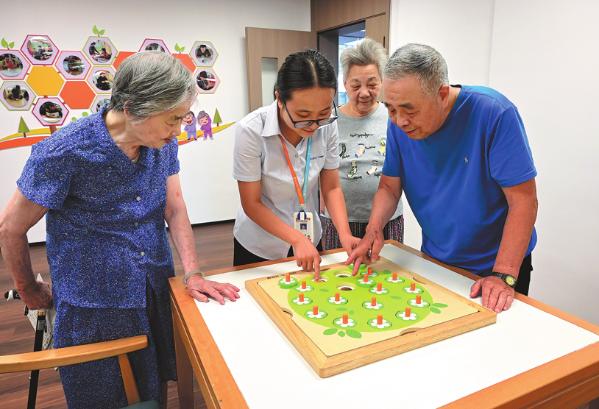 Seniors sharpen their memorizing skills by participating in the "remember the fruit" game at a community center in Fuzhou, Fujian province, in July last year. CHINA DAILY
"They don't fundamentally solve our problem. The core need still has to be met through companionship," she said.
The current market for senior toys often misses the mark, Ma Dafei, general manager of a Zhejiang toy company, told Tide News, a Zhejiang-based online media outlet, in January.
"Many products are just children's toys made larger, with colors and themes that don't resonate with older adults," he was quoted as saying, adding that they fail to address what seniors truly need or enjoy.
He said that toys for seniors should be designed to support health and social connection. A toy for a lively retiree is completely different from one for someone who is homebound. The market is still in its early phase, lacking this crucial segmentation.
"Many people simply don't realize that seniors can benefit from toys, or how play can support healthy aging," Ma said to Tide News, adding that this awareness gap has left a market need largely unmet.






























 京公网安备 11010202009201号