




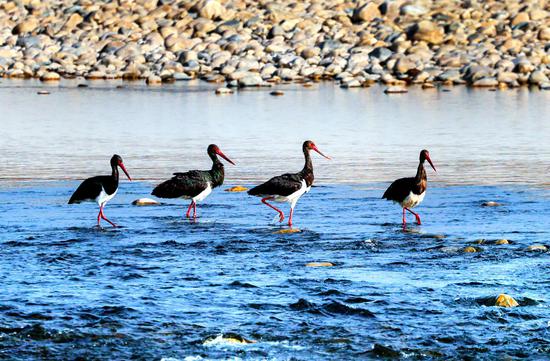
Migrant birds in Beijing through Terry Townshend's lens. During spring and autumn, the city experiences the spectacle of migration on a staggering scale. (Photo / China Daily)
When night falls in Beijing, and the world retreats into silence, Terry Townshend knows the predawn darkness is a migrant highway — an invisible river of wings, calls, and journeys spanning hemispheres every spring and autumn.
"As we're sleeping in our beds at night, there's this invisible miracle happening over our heads," he says. "Billions of birds move across continents. And most people never even know."
About 16 years ago, Townshend, a British environmentalist, never imagined this would be his life. Then working for a London-based nongovernmental organization, he arrived in Beijing in 2009 to assist drafting the environmental laws. When funding for his organization dried up two years later, he found himself jobless and "stuck in China", as he puts it. Rather than retreat, he leaned into a childhood passion: birds.
What began as an uncertain exploration transformed into a calling, one that has helped him glimpse into the wild side of one of the world's largest megacities and fall in love with it. As Senegalese conservationist Baba Dioum says: "In the end, everyone wants to protect what they love. But they can only love what they know."
Townshend's love led him to establish Wild Beijing, a website dedicated to celebrating the capital city's wildlife and connecting more people to nature. Beginning as a birding blog, the website grew into an ode to urban biodiversity. During his unemployment period, he spent months traveling across the country, including Yunnan and Sichuan provinces and the Xinjiang Uygur autonomous region. "I was shocked to see how much wildlife there was," he recalls.
"At that time, conservation wasn't a high priority here. I thought, maybe I could help."
Living off savings, he gave himself two years to meet people and start environmental projects. A breakthrough came unexpectedly: a birdwatching trip with Wendy Paulson, the wife of Henry Paulson, the former United States Treasury secretary. Their outing led to more birding trips, and eventually, a role with a sustainability-related institute in Beijing.
"The lesson for me is that when you're really passionate and committed, you find a way," he says.
Growing up in a coastal village in England, he found solace in nature, especially when he endured bullying at school. "I'd come home and watch yellowhammers in the dunes. That peace ... in nature helped me through."
That feeling returned during the pandemic lockdowns, when people worldwide turned to the birds outside their windows for solace. "It's a global phenomenon," he says. "When we slow down, we pay attention."
When Townshend first came to Beijing in 2009, many outsiders pictured it as a dense, polluted metropolis. Following the government's consistent efforts, the city changed dramatically over the past decade. In Townshend's eyes, the city is home to a mosaic of mountains, wetlands, rivers, and parks that host more than 500 bird species — far more than in the United Kingdom's capital city of London.
"Beijing has wild cats, 17 species of snakes, and four to five times the number of butterfly species found in the UK," he says. "It's the capital of a country of 1.4 billion people, yet it's full of wildlife. That's pretty incredible."
Some of the most compelling stories belong to migratory species, according to Townshend. The Beijing swift, for instance, nests in the city's ancient gateways and temples. Recent tracking studies revealed they fly all the way to southern Africa and back, a journey Townshend hopes to prove is made without landing — meaning the birds eat, drink and sleep while flying for months.
Another astonishing story belongs to the bar-tailed godwit, a shorebird that flies nonstop from Alaska to New Zealand. To prepare for the long flight, it shrinks its own digestive organs and doubles its heart size, transforming, in Townshend's words, "from an eating machine to a flying machine".
"These aren't just birds," he says. "They're stories of endurance and interconnection."
One of his key messages is that migratory birds are a shared natural heritage beyond nationalities and cultures. The swifts that nest in Beijing's Summer Palace may winter in Botswana. The godwits that stop in China's coastal wetlands connect indigenous communities in New Zealand and Alaska.
At an event last year, Townshend witnessed how a bird species could bring people together when Maori visitors from New Zealand and representatives from Alaska met and shared stories about the godwit, a bird their cultures have followed for generations."It was powerful," he says. "If we could do that for more species, imagine Beijingers meeting with communities in Africa who host their swifts; it would build such a sense of shared responsibility."
Townshend's work has taken on increasingly scientific and policy-oriented dimensions. With Peking University, he collaborated on a project recording the nocturnal migration calls of birds over Beijing, detecting more than 100 species in a single autumn. The findings were presented to city officials, who have said the results will inform policies involving habitat management.
In 2021, he was awarded a gold Beijing Citizen Award by Beijing News for services to the environment.
He is now trying to introduce artificial intelligence to analyze bird migration data, aiming to identify concentration zones where light pollution, a significant hazard for night-migrating birds, could be reduced. "If we know where birds fly most, we can suggest turning lights off or shielding them during peak migration," he says.
At the end of each month, Townshend takes students from Beijing Forestry University to the Wenyu River to record biodiversity. Over three and a half years, these surveys have created a living map of the area's seasonal changes. In his view, the country's environmental journey has been one of rapid changes. "When I first arrived, air pollution was obvious. Environmental laws were weak. Now, the direction is positive," he says.
Encouraged by the rise of local NGOs and youth involvement, Townshend is happy that many young people are becoming passionate about environmental protection. Still, challenges remain: overengineering of green spaces, habitat fragmentation, and a need for more scientific policies. But he is optimistic."We're learning," he says. "Beijing, with its migration spectacle, is a perfect place to teach the world about shared ecological responsibility."
For those looking to start birding in Beijing, he suggests the Olympic Forest Park or Summer Palace. "You learn something every time you go out," he says. He recently persuaded local authorities in his neighborhood to protect a rare dragonfly habitat after a previous site was demolished by landscaping. "They didn't know it was there. Now, they've put up educational signs. It's a small win, but that's how it starts.
"People think we know everything about nature. We don't. There are millions of species we haven't even discovered. Every day ... there's something to discover," he says.






































 京公网安备 11010202009201号