



1.Xi calls on China, Britain to jointly advocate, practice true multilateralism
Chinese President Xi Jinping on Thursday called on China and Britain, as supporters for multilateralism and free trade, to jointly advocate and practice true multilateralism.
Xi made the remarks in his meeting with visiting British Prime Minister Keir Starmer in Beijing, adding that international law can only be truly effective when all countries abide by it.
He also said that major countries should take the lead in particular, otherwise, the world would risk regressing into the law of jungle.

2.China cancels all flights on 49 routes to Japan
All scheduled flights on 49 air routes between China and Japan have been cancelled for February, according to DAST, a Chinese platform for traffic data analysis.
Data shows that in January, the cancellation rate for flights from the Chinese mainland to Japan stood at 47.2%, up 7.8 percentage points from December.
Chinese airlines have updated notices extending special ticket change and refund policies for Japan-related travel. Under the revised policies, passengers on flights involving Japan with departure dates before October 24, 2026, are eligible for free refunds or itinerary changes.

3.Last two giant pandas in Japan return to China
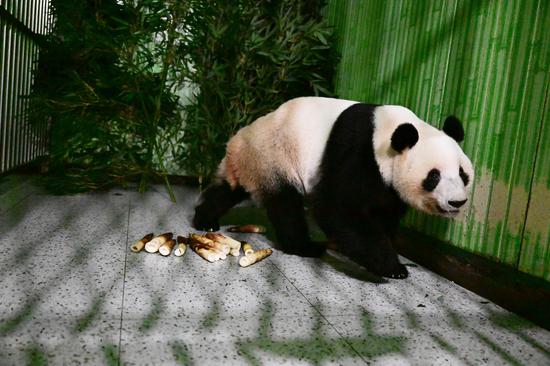
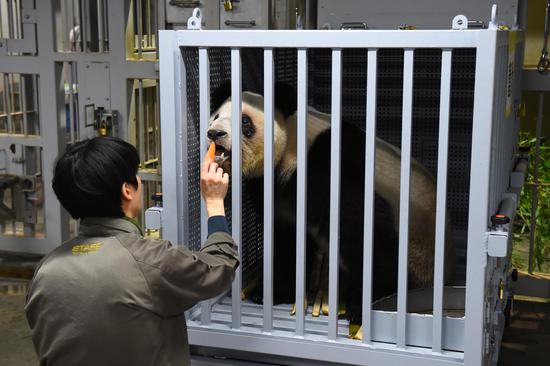
The final two giant pandas in Japan returned to China from a zoo in Tokyo on Wednesday morning, marking the end of over five decades of panda presence in Japan.
The pair, Xiao Xiao and Lei Lei, arrived at Chengdu in southwest China's Sichuan Province at 1 a.m., before they were sent to the Ya'an base of China Conservation and Research Center for the Giant Panda, where they will be quarantined.
Xiao Xiao and Lei Lei were born in 2021 to their mother Shin Shin and her mate, Ri Ri, which were returned to China in September 2024. Their elder sister, celebrity giant panda Xiang Xiang, returned to China in February 2023.

4.China executes 11 from northern Myanmar telecom fraud rings
China on Thursday executed 11 members of gangs operating in northern Myanmar, including key figures in telecom fraud rings.
The 11 were first sentenced to death in September 2025 by a court in Wenzhou, Zhejiang Province in eastern China, for crimes including intentional homicide, intentional injury, illegal detention, fraud, and operating gambling establishments.
They appealed the verdict, but the appeal was rejected in November 2025 by the Higher People's Court of Zhejiang Province, which upheld the original judgment and submitted the case to the Supreme People's Court (SPC) for review as required by law.

5.China to unveil policy to address AI's impact on jobs: ministry
China will roll out policy measures aimed at addressing the impact of artificial intelligence (AI) on jobs as rapid technological adoption has reshaped the country's labor market.
The Ministry of Human Resources and Social Security said on Tuesday at a press briefing that an official document will be released to respond to the AI's impact and promote employment.
Alongside the AI-focused policy, authorities will also introduce targeted employment support for key industries and expand assistance for priority groups, including university graduates and other young jobseekers, according to the ministry.

6. China's university launches new school to cultivate space exploration professionals
China on Tuesday unveiled its first School of Space Exploration to cultivate more leading talents in the aerospace field.
Established by the University of Chinese Academy of Sciences (UCAS), the school will focus on cutting-edge fields such as interstellar propulsion, deep-space communication and navigation, and space science, aiming to cultivate urgently-needed interdisciplinary professionals.
Zhu Junqiang, an academician of the Chinese Academy of Sciences (CAS) and the school's dean, said it aims to become a key base for foundational aerospace research to support major national projects, a hub for cultivating high-level talent capable of pioneering exploration, and a center for international academic exchange to share China's expertise through solid achievements.

7. Chinese scientists build first quantum network to hunt for dark matter
A team of Chinese scientists has created the world's first quantum sensor network designed to detect dark matter, connecting laboratories over 300 kilometers apart in the eastern Chinese cities of Hefei and Hangzhou.
Published in Nature on Thursday, the research achieved unprecedented sensitivity in searching for signals of axions -- a candidate of hypothetical particles that might comprise the universe's "missing mass." Comprising 26.8 percent of the cosmos, dark matter remains invisible, interacting only through gravity.
When Earth crosses these invisible boundaries, axions might briefly tug on atomic nuclei, generating signals fleeting as "a snowflake landing in a crowded square."
To capture these whispers, the scientists from the University of Science and Technology of China deployed five synchronized sensors across both cities. This distributed approach filters local interference by requiring signals to appear simultaneously at multiple sites.
Additionally, new quantum amplification techniques boost weak signals one-hundred-fold, while extended coherence times widen detection windows to minutes, according to the study.

8.'Very Chinese Time' meme exposes U.S. youth's anxieties and projections onto China: WIRED
A viral U.S. online trend dubbed "very Chinese time" reflects a blend of irony, curiosity, and unease among young Americans, revealing how dissatisfaction with domestic social and economic realities is increasingly projected onto perceptions of China, according to a recent WIRED magazine article.
The article, titled Why Everyone Is Suddenly in a 'Very Chinese Time' in Their Lives, describes how U.S. social media users have begun jokingly claiming they are in a "very Chinese" phase of life, often accompanied by stereotypical imagery such as drinking hot water, eating Chinese food, or wearing China-themed clothing. While the trend appears playful on the surface, WIRED argues it carries deeper cultural significance.
According to the report, the phenomenon is less about China itself than about how American frustrations are being externalized. The memes, the article notes, function as a way to externalize "the decay of the American dream," as young people grapple with deteriorating infrastructure, economic pressure and political polarization at home.

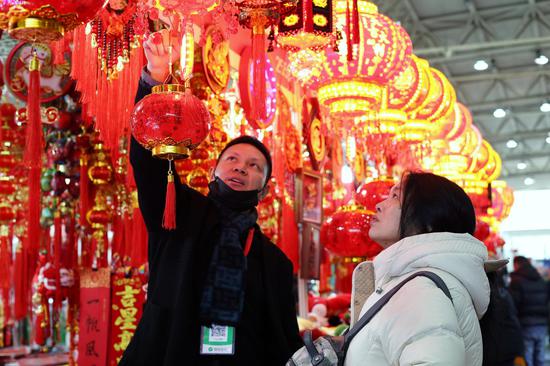
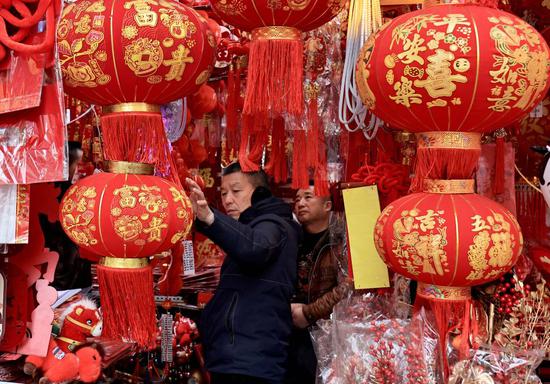
9.China expects record-high passenger trips during 2026 Spring Festival travel rush
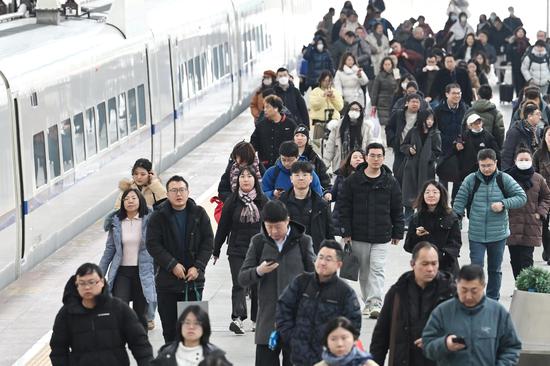
Inter-regional passenger trips across China during the 2026 Spring Festival travel rush, also known as chunyun, are expected to reach a record high of 9.5 billion, the National Development and Reform Commission (NDRC) said Thursday.
Self-driving trips will continue to dominate, accounting for about 80 percent of total travel, said Li Chunlin, deputy head of the NDRC, at a press conference.
Railway and civil aviation passenger volumes are projected to reach 540 million and 95 million, respectively, with both the overall scale and peak daily traffic expected to surpass historical levels, Li said.
This year's Spring Festival travel rush will run from Feb. 2 to March 13, lasting 40 days.

10.Chinese scientists identify oral drug VV116 as promising Nipah virus treatment
A new study by several Chinese research teams has found that the oral nucleoside drug VV116 possesses strong antiviral activity against the Nipah virus (NiV), offering fresh hope in the fight against this emerging highly lethal infectious disease, according to the Wuhan Institute of Virology, Chinese Academy of Sciences.
The research was led by professors Xiao Gengfu, Zhang Leike and Shan Chao from the Wuhan Institute of Virology, and Hu Tianwen from Vigonvita Life Sciences Co., Ltd.
Researchers reported that V116, a prodrug targeting the viral RNA-dependent RNA polymerase (RdRp), and its active metabolites significantly inhibited NiV replication in laboratory experiments. The drug was effective against both the Malaysian (NiV-M) and Bangladeshi (NiV-B) strains of the virus.
This breakthrough marks the first confirmation of VV116's therapeutic potential against NiV.































 京公网安备 11010202009201号