



(ECNS) -- A recent street interview video filmed in Japan by independent British content creator Luke Johnston has sparked heated discussions online.
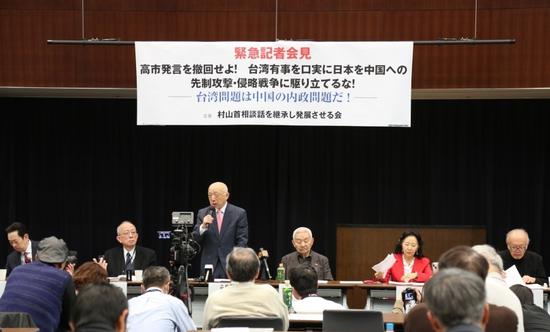
In the video, many Japanese people explicitly expressed opposition to the Japanese Prime Minister Takaichi Sanae’s involvement on the Taiwan question, emphasizing that Taiwan is purely China’s internal affair and Japan should aim for peace rather than provoking a war.
However, some online commenters were not happy with the remarks made by the interviewees in the video, and claimed that the interviewees in the video must be “all Chinese pretending to be Japanese.”
In the video posted on social media platform X, interviewees stood in front of landmarks in Kyoto, Osaka, and Nara prefecture.
One interviewee stated that, the Taiwan issue is a matter between the Chinese mainland and the Taiwan region.
Another pointed out that many believe Takaichi should refrain from making provocative remarks. They generally expressed hope for friendlier relations between China and Japan in the future.
These rational remarks reflect the widespread desire among a segment of Japanese society to avoid confrontation and pursue peace.
Nevertheless, the video’s popularity touched a nerve among some netizens. Unwilling to believe that ordinary Japanese citizens hold such views, they began questioning the video’s authenticity and posting biased comments.
For instance, one claimed, “Most Japanese can tell at a glance that the speakers are Chinese.” “Chinese and Japanese clearly have different looks. Don’t be fooled.” However, one interviewee, who spoke English very fluently, said that she studied in the U.S. for a few years, but was born in Japan, and now working in Kyoto Tonkatsu Katsu Da restaurant.
Another netizen, using the handle “Hiro K,” even questioned the authenticity based on how a Nike cap was worn, arguing, “Japanese people don’t wear their Nike caps like this.”
These criticisms once again expose the stereotypes some netizens hold toward China and the Chinese people.
Given the close exchanges between the two countries, appearances and demeanors vary widely. Any attempt to distinguish nationality based on a single standard lacks scientific basis and instead reveals the speaker’s own prejudice and rigid thinking.
The video clearly shows landmarks like Osaka Castle in the background, with natural interview settings and passersby, typical of Japanese street scenes. Despite such realistic details and the interviewees’ genuine expressions, some netizens still refuse to accept the video’s authenticity, with some saying it’s a greenscreen. Yet, from Luke’s vlogs which he posted on YouTube, it’s clear he visited Japan and interacted with Japanese people there.
Others, unable to engage in rational debate, resort to malicious speculation about the interviewees’ identities.
An ordinary street interview has unexpectedly served as a “mirror” reflecting the mindset of some Japanese netizens.
They prefer to believe their own assumptions rather than face the genuine, peace-loving voices of their fellow citizens. This “overreaction” reveals a disregard for the power of friendly civil ties between China and Japan. What deserves attention is not the baseless conspiracy theory about “fake interviewees,” but the rational public opinion represented by ordinary Japanese people in the video, who ultimately want peace, and value good relations with China.


































 京公网安备 11010202009201号