



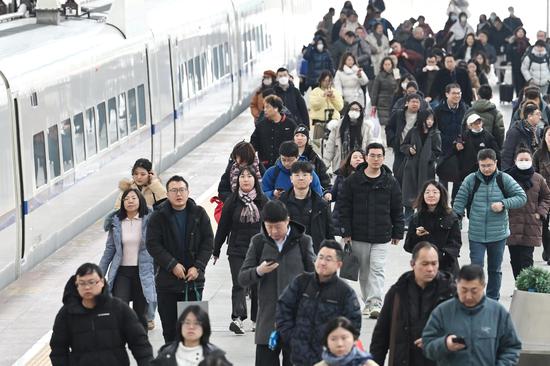
Record travel volumes were expected across China on Monday, the final day of the Spring Festival holiday, as highways, rail stations and airports nationwide filled with people returning to work and school after the Chinese New Year break.

Cross-regional passenger trips were projected to reach about 362.6 million on Monday, according to the Ministry of Transport on Monday, keeping travel demand high.
The surge followed Sunday's travel high, when nationwide mobility reached 380.35 million trips, the busiest day of this year's holiday period and among the highest single-day totals ever recorded during the annual Spring Festival travel season.
Passenger flows have climbed steadily since Thursday, with daily travel volumes exceeding historical levels for the same period for three consecutive days, reflecting a concentrated wave of post-vacation returns as the holiday drew to a close.
China's 40-day Spring Festival travel season, known as chunyun, passed its halfway mark on Saturday, 20 days after the travel rush began on Feb 2.
Widely regarded as the world's largest recurring movement of people, this year's travel season is expected to generate a record 9.5 billion cross-regional trips, including about 540 million rail journeys and 95 million air passenger trips, according to official estimates.
Travel demand became more concentrated during the nine-day public holiday that concluded on Monday, contributing to higher daily peaks in recent days.
Railways were expected to handle 18.5 million passenger trips on Monday, marking the peak of return travel by train, with operators scheduling 2,297 additional services nationwide to meet demand.
In Nanchang, capital of Jiangxi province, railway stations reported peak return passenger flows on Monday.
Stations in Nanchang, Fuzhou and Xiamen in Fujian province added security screening lanes and ticket service counters to manage surging arrivals, while additional workers were deployed in waiting halls and passenger service areas in cities such as Shangrao, Yingtan, Quanzhou and Longyan to assist travelers during busy periods.
"There were a lot of people today, but everything moved in an orderly way," said Wang Yulin, a passenger waiting at Nanchang Railway Station.
"There were staffers helping passengers with directions and luggage," she said.
Road travel continued to dominate holiday mobility, with highway traffic forecast to exceed 66 million vehicle trips, as self-driving travel remained the primary choice for many families. Air travel was expected to reach about 2.65 million passenger trips, while waterways were projected to carry roughly 1.6 million travelers.
In Beijing, the return surge brought sustained arrival flows at major railway stations and airports, with transport authorities extending late-night subway services and increasing bus and taxi capacity to accommodate passengers arriving throughout the evening, according to the city's transport commission on Monday.
Traffic pressure was reported around key transport hubs as travelers returned ahead of the first working day after the holiday.
With the public holiday ending at midnight, transport flows are expected to remain elevated into Tuesday as regular work and school schedules resume nationwide, the transport authority said.






























 京公网安备 11010202009201号