


Located in east China's Fujian Province, the coastal city of Xiamen is emerging as an important hub for marine science, ocean conservation and international cooperation on ocean governance.
The 2026 World Ocean Week, which kicked off in the city under the theme "Safeguard the deep blue together, foster human-ocean harmony" has brought together government officials, experts and representatives of international organizations to explore ways to advance global ocean governance and marine sustainability.
With marine ecological conservation at its core, the event highlights the importance of scientific research, policy coordination, local practices and public engagement in translating global commitments into concrete action.
 The 2026 World Ocean Week kicks off on Nov. 5, 2026 in Xiamen, east China's Fujian Province. (Photo provided by the organizer)
A report released during the 2026 World Ocean Week highlights China's contributions to global ocean governance and the conservation and sustainable use of marine biodiversity. Compiled by the China Institute for Marine Affairs under the Ministry of Natural Resources, the report details China's contributions to the Agreement under the United Nations Convention on the Law of the Sea on the Conservation and Sustainable Use of Marine Biological Diversity of Areas beyond National Jurisdiction, known as the BBNJ Agreement.
It outlines China's efforts to share marine expertise, bridge differences between developed and developing countries, and advance international cooperation.
According to the report, China has signed marine cooperation agreements with more than 50 countries and international organizations and jointly established over 40 marine research centers and laboratories.
International experts attending the event highlighted China's growing influence in the global ocean economy and its contributions to international marine conservation. They also pointed to Xiamen's strengths in marine research and its potential role in supporting global ocean governance.
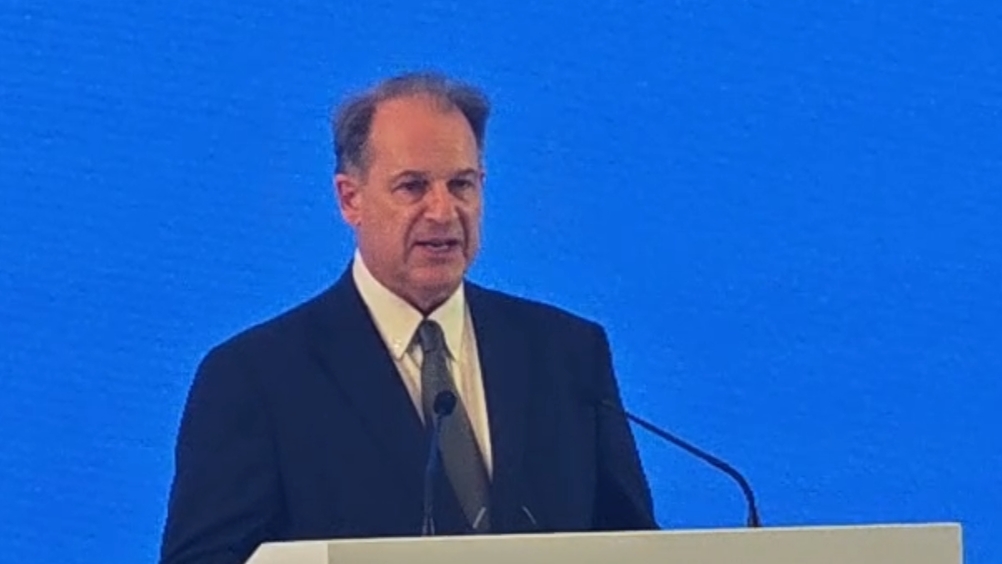
Vaipo Mataora, permanent secretary of the Ministry of Infrastructure of the Cook Islands, noted in his remarks at the opening ceremony of World Ocean Week that international cooperation is essential to addressing the challenges facing small island states in ocean governance.
"Small island states hold vast ocean spaces, but we have small populations and limited technical capacity. We need shared science, shared data and shared skills," he said, emphasizing the importance of sharing scientific knowledge, data and expertise to support marine conservation and sustainable development.
Alfredo Giron, director of the Ocean Agenda at the World Economic Forum's Centre for Nature and Climate, said in an interview with China News Network that China's influence on the global ocean economy is undeniable, given its significant role in sectors such as offshore wind energy and fisheries.
"It's undeniable that China is one of the major influences in the global ocean economy," he said, noting that China's development of marine-related industries has a considerable impact globally.
José María Figueres, former president of Costa Rica, said in an interview with China News Network that Xiamen has a strong foundation for contributing to global ocean governance, citing its ecosystem of universities, research centers and marine laboratories.
"Xiamen has an ecosystem of universities, research centers, ocean laboratories that no other place has," he said, adding that the city could make a significant contribution to the implementation of the BBNJ Agreement.
Figueres also spoke highly of China's efforts in advancing global ocean governance, particularly its cooperation with developing countries. He noted that China has worked with countries with fewer resources to conduct joint research and share knowledge.
"There is no other country in the world today that is doing the things that China is doing in working together with other countries to help understand better of the ocean and the potential that it has in our livelihoods," he said, highlighting China's role in helping bridge scientific gaps within the global community.
As the international community moves from negotiating agreements to implementing them, stronger scientific support, knowledge sharing and cooperation among countries will be essential to addressing the challenges facing the ocean.
Xiamen's experience in bringing together marine research, ecological conservation and economic development offers a local perspective on how coastal cities can contribute to these shared global goals.
By Xu Jiawen

































 京公网安备 11010202009201号