


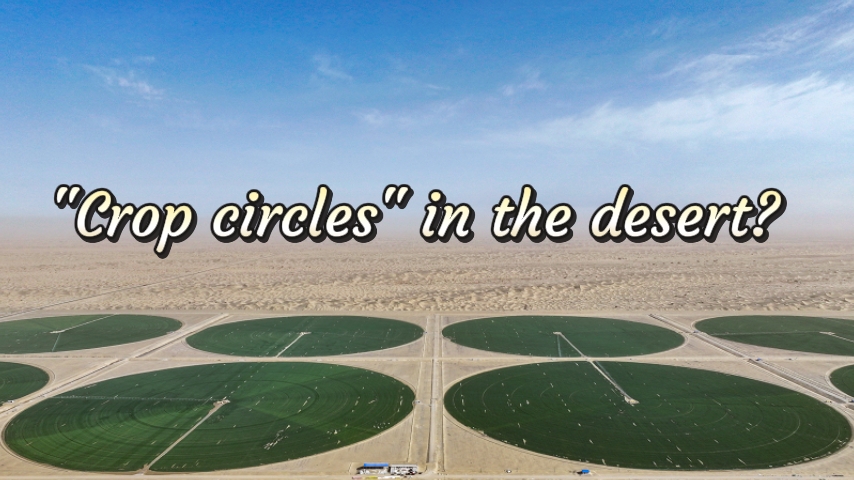
(ECNS)-- Twenty-five green “crop circles,” each measuring 800 meters in diameter, have appeared in Kunyu City on the southern edge of the Taklimakan Desert in Xinjiang Uygur Autonomous Region.
With no farmers in sight, there are only center‑pivot irrigation machines working leisurely in the circular wheat fields.
Viewed from above, the fields resemble giant clock faces, while the long irrigation arms sweep slowly like clock hands, rotating evenly around their central pivots.
Each arm spans more than 380 meters, with sprinklers suspended from overhead pipes spraying water evenly across the crops.
Along the outer edge of each circle, alfalfa is planted along key contour lines to form protective boundaries. Within these zones, oats and wheat are intercropped in an orderly pattern.
With its strong root system, alfalfa adapts well to poor, sandy soil and serves the dual purpose of stabilizing sand and improving soil quality.
Oats, which have a short growth cycle, quickly provide vegetative cover in spring, protecting young alfalfa seedlings from wind and blowing sand.
The two crops support each other, not only improving land-use efficiency but also helping establish a stable ecological system on sandy terrain.
Once the parameters are set and fertilizer is loaded, the system can be activated with the push of a button. Highly automated, it requires little manual intervention, saving both time and labor while improving efficiency.
Typically, it takes about nine hours for an irrigator to complete one full rotation.
“Watering and fertilizing are handled by the pivot irrigators, and field inspections are done with drones. I spend much less time in the fields, yet the crops are growing even better,” said Li Daoqing, administrator of the planting base, during an interview.
As the wheat grows taller, the frequency and amount of fertilization will be reduced. At that stage, one full rotation of the irrigator will take roughly 36 hours.
Back in 2024, the site was still covered by sand dunes.
Initial attempts using drip irrigation proved ineffective, as sandstorms buried seedlings and reduced yields. “Even the survivors grew stunted, with almost no yield,” said Cui Gangchuang, director of the planting base.
After studying farming practices in nearby Hotan Prefecture, Cui found that irrigation performed better than drip irrigation in arid, sandy regions.
Traditional linear move irrigators had to be plugged into different sockets along their path, requiring at least one worker to monitor the whole process.
“With center‑pivot systems, work that used to need 30 people can now be done by just four,” he noted.
The system also helps stabilize the environment. Moist soil created by the sprinklers reduces sand movement during storms, protecting most seedlings within the circular fields.
“The rotating sprinklers keep the soil moist, so when sandstorms blow in, the wet soil along the edges causes the sand to settle quickly. We may lose a few seedlings on the outer rim, but the vast majority inside the circle are protected,” Cui explained.
The sprinklers also serve another purpose. At the desert’s edge, frequent wind‑blown dust coats the plants. The continuous spray acts like a shower, washing away the dust so the wheat can absorb more sunlight and enhance photosynthesis.
Dry, hot winds can also disrupt the water balance of wheat and impair grain filling. The fine mist produced by the sprinklers helps raise air humidity in the field, improving the local microclimate.
As the irrigation arms rotate continuously, green wheat fields unfold in perfect circles, standing in vivid contrast to the surrounding desert landscape.
Local operators say the project reflects how irrigation technology is being used to improve agricultural conditions in arid areas and the experience gained in the Taklimakan Desert may offer a reference for similar efforts in other dry regions.






































 京公网安备 11010202009201号