



By Lin Zhuowei, Guan Na, Lin Mengnan
(ECNS) -- Ne Zha 2 has topped the global animated box office chart; Designer toy Labubu has become a worldwide sensation; Chinese short dramas are rapidly gaining popularity overseas...
As Chinese cultural products continue to gain global attention, exchanges between China and the rest of the world are also becoming increasingly vibrant.
El Batoul Nejjaoui, a Moroccan student currently studying at Beijing International Studies University, is both a witness to and participant in this wave of cultural interaction. During her eight years in China, she has taken part in several China–Arab cultural exchange initiatives, including Arabic translation work for the poverty alleviation-themed TV drama Minning Town and the documentary series Understanding China.
Living and studying in China has strengthened Nejjaoui’s sense of responsibility as a cultural bridge. She hopes to share authentic stories about China with the world, allowing international audiences to see a more vivid and nuanced picture of the country.
“Many foreigners often have stereotypes about China. They often see it as a developed country today, but they don’t know much about the journey China has gone through,” Nejjaoui said. She hopes that through her work, more people in Arab countries will gain a deeper understanding of China’s development approach and draw inspiration from China’s experience for their own development.
In her view, cultural exchange is fundamentally a two-way process, and language serves as a vital bridge for mutual understanding. “When I translate books, TV dramas, or participate in related projects, I’m making people get closer to another culture, another group of people, and another country.”
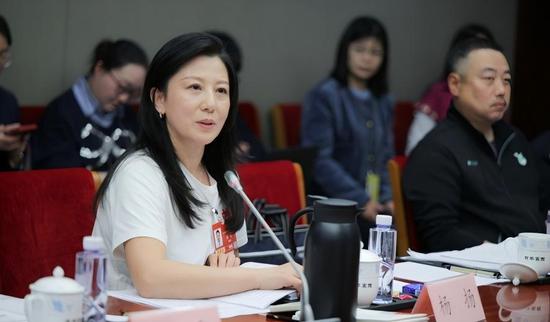
Drawing on her own experience, Nejjaoui raised a question to Guo Yuanyuan, a member of the National Committee of the Chinese People’s Political Consultative Conference (CPPCC) and associate dean of the Academy of Metropolis Economic and Social Development at Capital University of Economics and Business: in today’s global context, how can Chinese culture and Chinese solutions be better understood by people from other regions? And how can young people from different countries strengthen exchanges, deepen mutual understanding, and build genuine friendships?

Guo responded with three key phrases: mutual appreciation, personal engagement, and embracing the future.
“I strongly agree that cultural exchange should be a two-way process,” Guo said. She noted that traditional Chinese ideas such as “harmony and coexistence” and “mutual appreciation among civilizations” offer valuable wisdom for cross-cultural dialogue. With openness and inclusiveness, people can better respect differences and promote meaningful cultural interaction.
Guo also stressed that cultural exchange requires a “DIY” spirit—direct participation and firsthand experience. “Only by stepping into environments that were once unfamiliar and learning about the stories unfolding there can people truly feel the warmth of cultural exchange and build sincere emotional connections.”
“The future of humanity belongs to the younger generation,” she added. To bring the civilizations of the world closer together, young people from different countries should work together to deepen cultural understanding and co-create cultural products that resonate across borders.















 京公网安备 11010202009201号