



By Guan Na, Gan Tian
(ECNS) -- The year 2026 marks the beginning of China's 15th Five-Year Plan (2026–2030) period. And the world anticipates a China striding confidently forward on the path of high-quality development. Amidst the turbulence of profound global changes and as the world navigates uncertainty with difficulty, the certainty emanating from China is increasingly seen as a "ballast stone" for maintaining the international order.
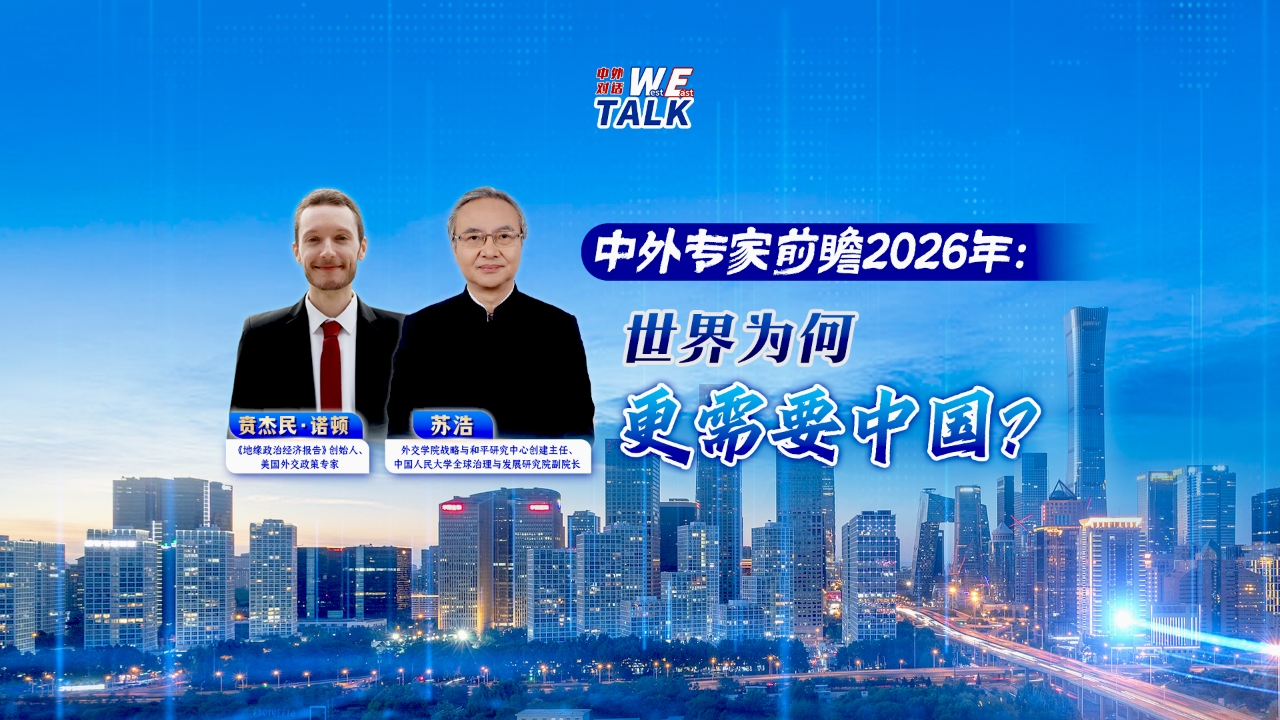
Looking ahead to China's development in 2026, the China News Network's W.E. Talk invited Su Hao, founding director of Center for Strategy and Peace Studies from China Foreign Affairs University, and associate dean of the Institute of Global Governance and Development of Renmin University of China, and Benjamin Norton, founder of the Geopolitical Economy Report, U.S. foreign policy expert, for an in-depth analysis.
The beginning of the 15th Five-Year Plan: "China's development benefits the world"
The year 2026 marks the inaugural year of the 15th Five-Year Plan, placing China's economic development in the spotlight.
"The recently concluded Central Economic Work Conference set the general tone for 2026 economic work as ‘Seeking progress while maintaining stability,'" Su stated, believing that the Chinese economy still has substantial room for growth in the coming five years.
Su noted that as the world's second-largest economy, China's stable growth not only lays a solid foundation for its own development but also provides momentum and stable support for global economy.
"With the advancement of high-tech, emerging industries, and new energy sectors, China's overall economic structure will be further optimized amid the new wave of economic globalization, Su said. He added that China's contribution to world economic growth has exceeded 30% for many consecutive years. As a key engine for global economic development, China plays a vital role in optimizing the global economic structure.
Norton shares this view. He remarked, "In its 15th Five-Year Plan period starting in 2026, it's clear that China has committed to deepening economic development and technological progress. This is very important not only for China but for the world."
Norton pointed out that China's breakthroughs in technological research and development are evident, with related achievements improving the lives of people both domestically and globally. This value is particularly prominent given the increasingly prominent issue of climate change.
"China has become the world's leader in green energy technology. Chinese solar panels and wind turbines and other technologies -- electric vehicles are helping people to transition away from fossil fuels, to reduce carbon emissions and also they're helping countries in the Global South to reduce their dependency on the imports of oil and natural gas. So these are very positive contributions, not only to the people of China but to countries around the world," Norton stated.
He further pointed out that the 15th Five-Year Plan emphasizes continuous advancement and efficiency improvement through scientific development. Guided by this, China will continue to move up the global value chain while resolutely defending its technological sovereignty.
Norton believes this direction is particularly crucial at a time when trade is being weaponized by a few major powers. "China is now more and more able to defend its own technological sovereignty and reduce the impact of the weaponization of trade by other parties."
U.S.-China relations "expected to maintain relative stability"
In 2025, four phone calls between the heads of state of China and the U.S. and five rounds of economic and trade consultations not only set the tone for bilateral relations but also solidified the foundation for cooperation and stability. The China-U.S. summit meeting in Busan at the end of October further showed the world the possibility of positive interaction between the two major powers.
In this regard, Su believes that high-level engagements, especially head-of-state diplomacy, have played a crucial "anchoring" role, "calibrating the course and injecting momentum" into U.S.-China relations, enhancing the predictability of their future development.
On U.S.-China economic and trade issues, Su said the U.S. government's unilateral actions have impacted the world economy. In 2025, the economic and trade teams of the two countries held five rounds of consultations, reaching a consensus on resolving issues. "The stability of economic and trade relations has also created a favorable atmosphere for the overall stability of U.S.-China relations."
Looking ahead to 2026, Su stated, "U.S.-China relations are expected to maintain a relatively stable posture, and institutionalized interactions between the two sides will strengthen." On the other hand, he also noted that the sustainability of this situation still faces potential variables.
He analyzed that China has always maintained the willingness to promote the stable development of U.S.-China relations. However, the U.S. approach to several major sensitive issues, including the Taiwan question, U.S. alliance relations, and changes in U.S. domestic politics, could affect bilateral relations.
For his part, Norton said that as an American, he is always happy to see improvements in U.S.-China relations. He pointed out that many U.S. politicians blame China for their own domestic problems that have nothing to do with China. Their accusations are purely politically motivated.
Norton stated that the U.S. government has realized its tariff policies have harmed its own economy. The U.S. side has realized that "China possesses leverage and the U.S. has overstated its own power and influence."
He expressed concern that after the 2026 U.S. midterm elections, the U.S. government might adjust its tariff policies. However, Norton believes that in the short term, U.S.-China economic and trade relations will remain stable. "I think the best we can hope for is that they don't continue to get worse over time."
China injects positive energy in turbulent global times
"We're in a dangerous moment in the world where we see the rise of protectionism and militarism and even imperialism," Norton pointed out. This is evident from U.S. actions in Latin America to Japanese Prime Minister Sanae Takaichi's recent provocative remarks on China's Taiwan.
Su also stated, "The emergence of unilateralism, trade protectionism, and neo-militarism has brought great uncertainty to the world." He believes this trend is likely to continue in 2026, exacerbating the division and fragmentation of the global system, thereby increasing risks of geopolitical tensions or even conflict.
Experts unanimously agree that in the turbulent times, a series of major initiatives and actions proposed by China point the way for the world to respond to the changes of our times.
In Norton's view, China has always been an important force in the international community, committed to defending true multilateralism and pursuing a peaceful foreign policy.
Norton expressed his hope that in 2026, China can continue to deepen its relations and cooperation with Global South countries in Asia, Africa, and Latin America, to defend this more multi-polar international system." He said that this system will also create more economic opportunities for Global South countries.
He further emphasized: "This can be done through win-win cooperation, I think China is helping to build that path."
Su believes that in the new year, China will contribute a positive force to the construction of a new type of international relations and a community with a shared future for mankind from multiple aspects.
He cited examples: China will continue to take concrete actions to promote the implementation of the Global Governance Initiative (GGI), the Global Development Initiative (GDI), the Global Security Initiative (GSI), and the Global Civilization Initiative (GCI), helping countries achieve common development based on mutual benefit and win-win cooperation.
In Su's view, China will also continue to promote the reform of the global governance system, practice peace-promoting diplomacy, and safeguard world peace and stability.
Furthermore, on issues concerning comprehensive human well-being, such as non-traditional security challenges like climate change, China will continue to play an active role, providing Chinese wisdom and solutions for human welfare, Su noted.
China will further play a positive and active role in the international community in 2026: injecting positive energy into international relations, providing support for world peace and stability, and offering momentum for global development and comprehensive globalization, he concluded.































 京公网安备 11010202009201号