


Xuancheng — a city in Anhui province best known for producing quality paper — is experiencing a mini tourism boom thanks to a stray dog and a group of kindhearted taxi drivers who came to its rescue.
The story of "Chief Huang" a gentle rural mutt that had made Xuancheng Railway Station its home, has captured the country's imagination with tens of millions of online views.
On one platform, Douyin, a local animal rescue blogger Wang Mingxuan posted a video he filmed about the rescue, which received 368,000 likes and 100,000 shares and comments.
The dog was nearly killed after being hit by a car in mid-April, but was eventually saved by a group of local taxi drivers who banded together to pay the medical bill.
In what they have dubbed "boomerang love" tourists traveled to Xuancheng, a city of some 2.7 million people, during the May Day holiday, to return the act of kindness.
"It brought tears to my eyes," wrote one netizen. "In this fast-paced society, it's already a touching story that there's a group of people willing to stop and help a little dog. Moreover, these are people who rely on every minute to earn a living for their families. I'm grateful that there is such goodness in this world."
 Visiting tourists pose with a cardboard image of Chief Huang at the station on Friday. (Photo: Wen Qin/ China Daily)
Little yellow dog
Taxi driver He Wei said he first noticed the little yellow dog hanging around the railway station in August or September of last year.
"At that time, it was very small and skinny, sometimes staying in the taxi waiting area, sometimes wandering around the square, quiet and gentle, never barking or running around," He said. "Over time, this little dog became fixed in many people's hearts."
Taxi drivers coming and going often played with it and brought it eggs and sausages to eat.
"As soon as one of the drivers called it, it would happily run over, wagging its tail," said He.
At first, the drivers called the puppy Xiaohuang, literally "little yellow". But as it grew, they gave it a more majestic name — Chief Huang.
By January, some of the local taxi drivers had pooled enough money to have the female dog spayed in a pet hospital. If the stray dog got pregnant, her life would become harder, the drivers reasoned.
"Chief Huang was a ray of light in my gloomy days," said He, who runs a poster design business online during the day, and drives for a ride-hailing service at night.
"One night, I parked my car near the square, lit a cigarette in frustration, and Chief Huang came to sit beside me. We sat quietly together for a long time," He said.
Every time he drove a taxi, He would go to the square to find the dog. Only after seeing it and playing with the dog, "just like an old friend," would he feel at ease.
On the evening of April 15, He went to look for the dog but couldn't find it. He went back the next day but couldn't see Chief Huang.
"We wait for passengers at the station every day. Chief Huang quietly keeps us company. Over time, it has become like family to us," said Fan Bin, a taxi driver.
"Seeing it there each day gives us peace of mind; if we don't see it for one day, everyone starts asking each other about it," said Fan.
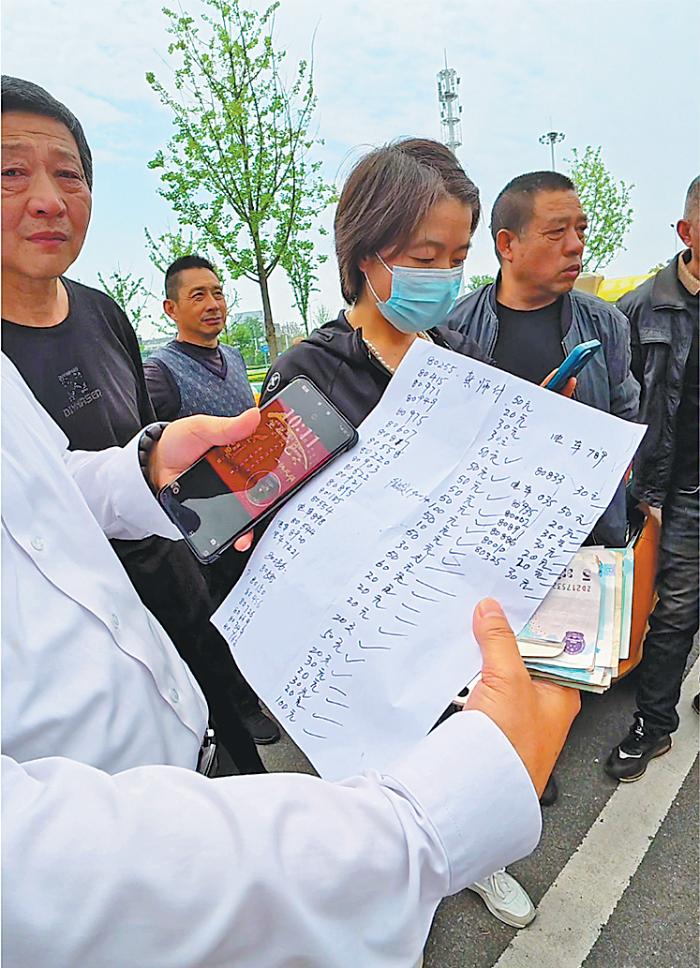 Another screenshot from the video shows the list of donations made by taxi drivers with their license plate numbers and donation amounts.(Photo: Wen Qin/ China Daily)
The accident
On April 17, Wang received a message online asking for help: a yellow dog near the Xuancheng Railway Station had been hit by a car and was unable to move, eat or drink.
"On April 18, I arrived at the station and was surprised by the scene," said Wang.
On the station square, a row of taxis was parked beside a traffic island covered in green shrubs. Dozens of drivers had gathered, not waiting for passengers, but anxiously discussing the little yellow dog curled up in front of them.
At one point, Fan took out a stack of cash and a handwritten donation list. The list had no names, only a series of license plate numbers and donation amounts varying from 20 yuan ($2.94) to 1,000 yuan ($147.10).
Several days earlier, the dog had been hit by a passing vehicle. After the taxi drivers found it, they took it to a pet hospital and were told it needed immediate surgery, costing more than 10,000 yuan.
"(It had) three fractures in the front and hind limbs. The right hind leg was the most severely injured, with bone dislocation requiring immediate surgery, or it would face amputation or even death," said taxi driver Zhang Xinming.
One of the initiators of the donations, Zhang personally gave 1,000 yuan. His monthly income from operating a taxi is about 3,000 yuan.
In the taxi waiting area at the west square of the railway station, two pieces of paper were eventually posted on the bulletin board, recording total donations of more than 4,000 yuan by 48 taxi drivers and eight generous individuals.
"Despite these donations, it was still not enough for the treatment, so after a simple anti-inflammatory treatment, we took the yellow dog back to the train station and continued to find ways to help," Zhang said.
The dog was in so much pain that it wouldn't eat or drink. The drivers were afraid it would be hit by another car, so they moved it into the shrubbery.
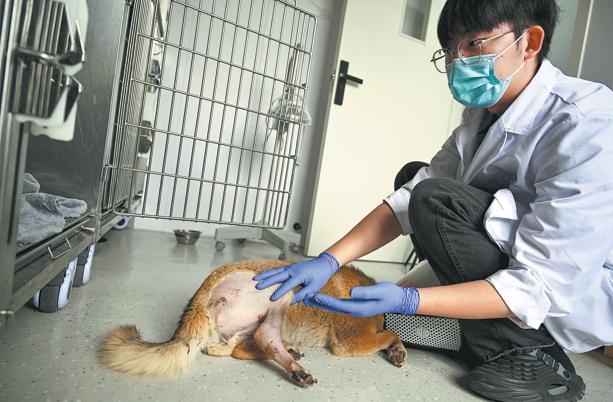 A vet examines recovering Chief Huang at Xuancheng Chongfuxin Pet Hospital on Friday.(Photo: Wen Qin/ China Daily)
Deeply moved
Wang had contracted pneumonia and was worried that sudden coughing might stress the yellow dog, so he asked a friend to remove the dog from the shrubs. He recorded the entire rescue with his phone camera and posted it online.
Wang and his friend took the dog to another animal hospital — Xuancheng Chongfuxin Pet Hospital — with a group of taxi drivers following closely behind.
Because there were too many people on-site, they finally selected four driver representatives to enter the hospital.
Upon learning about the donations raised by the taxi drivers, hospital director Zhu Jun was deeply moved and decided to do everything possible to treat the dog.
"We have been in pet medical care for many years, and this is the first time we have seen so many taxi drivers spontaneously raise money and wait outside the hospital for a stray dog," Zhu said.
The hospital decided not to charge more than 4,000 yuan for the operation. The subsequent treatment and recovery costs were all covered by the hospital.
On April 20, after two days of being treated with anti-inflammatories, Zhu and his colleague performed orthopedic surgery on Chief Huang. They successfully repaired three fractures and implanted an artificial ligament in the severely injured right hind leg.
After the surgery, the drivers left the hospital.
"In the following days, we drivers took turns visiting the hospital, bringing Chief Huang's favorite food, and quietly staying by her side, afraid she would feel lonely," Zhang said.
Spreading kindness
Chief Huang is still recuperating in the hospital, but her popularity has rocketed. Many people have not seen her online again.
He Wei has used his design expertise to make refrigerator magnets, key chains, and ornaments with images of the dog at his own expense. Initially, he gave them away for free to local taxi drivers and tourists who showed concern for the dog. But as more people asked for the merchandise, he started selling them at cost.
During the May Day holiday, many people came to Xuancheng and chose taxis as their preferred mode of transportation.
"A young passenger said he was touched by the story of this city. When he reached his destination, he was supposed to pay 13 yuan, but he quietly paid 20 yuan when getting out. When I reminded him, he ran off with his suitcase," said Fan.
The drivers said business during this year's May Day holiday was much busier than last year. It is roughly a three-hour drive from Shanghai, Hangzhou, and Nanjing, and its proximity makes it ideal for micro vacations.
To show their appreciation to local taxi drivers, some scenic spots offered them and their families free admission during the holidays.
Tourists who took taxis to scenic spots like Jingting Mountain and Shibawan Scenic Area were allowed to enter for free with a taxi receipt from the same day.
A number of restaurants and hotels offered discounts or reimbursed tourists' taxi fares. At the local Longquan Cave Scenic Area, taxi passengers had their taxi fare deducted from the ticket price.
From April 30 to May 5, Xuancheng Railway Station averaged 21,000 passengers per day, an increase of nearly 5 percent year-on-year.
The Xuancheng City Planning Museum received a total of 19,701 visitors from May 1 to May 5, with a single-day peak of 4,946, setting a new holiday record.
Serious considerations
Wang continues to rescue stray dogs almost every day. He said he did not intend to produce videos updating Chief Huang's condition, but is responding to enthusiastic requests from his followers about the dog's well-being.
"My original intention was to rescue stray animals, not to chase fame. The fame from Chief Huang's story belongs to our city," said Wang.
The dog's celebrity status has also posed some tough questions for the taxi drivers who love her so much — the chief one being someone's proposal to adopt her and their reluctance to part with the animal.
"She has been with us for so long, like family," Zhang said.
His life story is one of struggle and change. He was once a teacher, later worked for a State-owned enterprise, and after the enterprise went bankrupt, became a taxi driver.
"Adoption is possible, but the adopter must guarantee to treat Chief Huang well for her whole life," Zhang said.
Wang believes that if people want Chief Huang to return to the railway station, they should complete the adoption procedures, obtain a dog license, and comply with regulations.
Meanwhile, some government insiders revealed that after the May Day holiday, cultural and tourism proposals related to Chief Huang's fame had been stopped due to concerns about her welfare and overall stray dog management.
Some netizens have suggested the city should capitalize on Chief Huang's fame. "This is more effective than however many advertisements Xuancheng's cultural and tourism department could run. Who could resist such a warm city?" wrote one.
Another said: "Put Chief Huang's logo on the cars of these kindhearted drivers. From now on, choose them when you need a ride!"
Wang said there is a deeper issue to be addressed in the management of the city's stray animals. According to the Xuancheng government's dog management regulations, urban management departments are responsible for supervising and managing dog shelters and capturing stray dogs.
Stray cats and dogs caught by city officers should be neutered and then placed in appropriate institutions, such as stray animal placement centers cooperating with the government, to reduce the explosive growth of stray cats and dogs caused by uncontrolled breeding, Wang said, adding the government should establish public pet hospitals.
"In fact, the proliferation of stray cats and dogs largely stems from abandonment," Wang said, adding that the government should impose a stricter ban on abandoning domestic cats and dogs and raise the threshold for pet ownership as fundamental solutions to the problem.
































 京公网安备 11010202009201号