



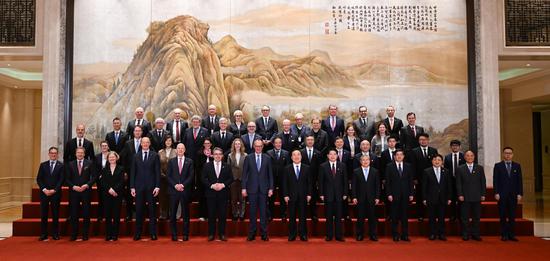
A series of dialogues between CEOs of multinational corporations and senior officials of Beijing took place on Friday, setting the stage for a new model of future cities.
During the event, Beijing Mayor Yin Yong said: "Over the past five years, the number of foreign-invested enterprises in Beijing has increased by more than 9,000, and this growth trend remains strong. Driven by its global pioneering presence in artificial intelligence, the city has consistently maintained an average 5 percent GDP growth rate, and this robust performance is expected to continue over the next five years."
The CEOs offered insightful recommendations on Beijing, to which the mayor and vice-mayors responded positively and constructively.
These interactions are part of Beijing's significant initiatives to deepen reforms and expand openness, thereby enhancing confidence in investing in Beijing and China.
Pascal Soriot, CEO of pharmaceutical company AstraZeneca, which announced a new 20 billion yuan ($2.9 billion) investment in Beijing last year and a combined 100 billion yuan investment in China through 2030, hailed the city's accelerated steps in new drug trials but expressed hope that Beijing could expedite reforms in "private investment and commercial insurance in medical care".
Jin Wei, vice-mayor of Beijing, said: "The Beijing Municipal Medical Insurance Bureau has begun tests with commercial insurance companies' involvement in insurance reimbursement for local residents in Haidian district, and supportive measures will be in place to create more opportunities for the medical and healthcare sectors."
Mohamed Kande, global chairman of global accounting company PricewaterhouseCoopers, expects that AI could "move (the city) toward a greater commercial reality with its already strong digital foundations, deep research talent, and the ability to test policy in practice, thereby boosting Beijing's presence in industrial AI — systems that operate factories, manage supply chains, and improve energy networks."
Echoing his recommendations, Jin said the city is intensifying efforts to upgrade its infrastructure. "Currently, AI has been particularly effective in hydrogen energy demonstrations, with the Beijing-Tianjin-Hebei region showing the best results so far, including commercial developments such as buses and trucks. Looking ahead, Beijing plans to accelerate the development and application of AI, leveraging it to enhance the efficiency of local businesses."
Olivier Charmeil, interim CEO of global drugmaker Sanofi Group, noted: "Beijing has the opportunity to transition from being a city of concentrated innovation resources to becoming a city of institutional leadership — and a key node in the global pharmaceutical innovation network."
Recommendations were also made by global CEOs or presidents from Arup, Baker McKenzie, the Hong Kong Trade Development Council, HSBC, and Veolia, who were appointed as advisers for the 17th Meeting of International Business Leaders Advisory Council for the Mayor of Beijing.
The previous 16 sessions of the council have been conducted with 141 top executives from 49 Fortune Global 500 multinational companies serving as advisers.


















 京公网安备 11010202009201号