



Xi stressed importance of future industries for boosting new quality productive forces
Inside a humming factory in Hefei, Anhui province, a 1.66-meter-tall humanoid robot dubbed Lingshu steadies its grip, pivots and places a wafer-thin semiconductor onto a moving line, an extremely high precision task where an aberration of just a fraction of a millimeter could spell failure.
The scene, once confined to research labs, is now moving rapidly onto Chinese factory floors, offering a glimpse into China's efforts to develop future industries using embodied artificial intelligence as a strategic pillar of economic growth.
During this year's first group study session of the Political Bureau of the Communist Party of China Central Committee in January, President Xi Jinping emphasized that cultivating future industries is of great significance for developing new quality productive forces, building a modernized industrial system, improving people's quality of life, and promoting people's well-rounded development and all-around social progress.
In February, Xi, who is also general secretary of the CPC Central Committee, visited Beijing's E-Town — a hotbed for emerging and future industries, where he took a look at a national information technology innovation park, once again turning his attention to representative scitech innovations.
China's national policy signals are reinforcing the momentum.
The 2026 Government Work Report pledged to establish mechanisms to boost investment in future industries, including embodied AI, future energy, quantum technology, brain-computer interface and 6G technology.
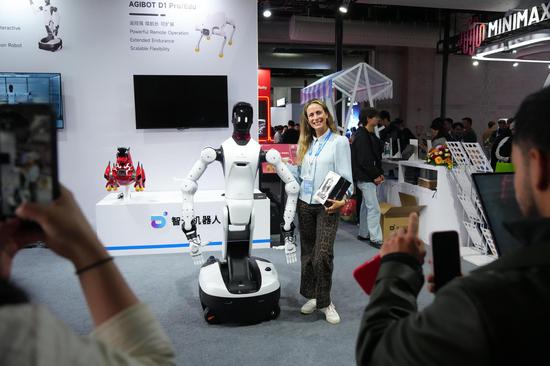
It marked a renewed effort to develop embodied AI after the concept was first elevated as a national priority in 2025. Embodied AI refers to the integration of AI into physical systems, enabling them to interact with the physical world. Humanoid robots represent the most advanced form of embodied AI at the current stage.
Yao Qizhi, a Turing Award winner and an academician at the Chinese Academy of Sciences, said, "Over the past five years, China has made rapid progress in embodied AI, especially humanoid robots, reaching the top international tier and even taking a leading position in some areas."
Yao added that embodied AI represents a convergence of computing power, algorithms, hardware and real-world data. "For China, it is not a single technological breakthrough, but a systematic project," he said.
Zhang Zhaohui, founder and CEO of Youibot, the developer of Lingshu, said that unlike traditional industrial robots working on programmed tasks, humanoid robots allow a single AI system to control different types of robotic bodies, which is more efficient.
"Lingshu, for instance, has already been deployed in electronics factories and logistics centers in cities including Hefei, Suzhou in Jiangsu province and Chongqing," he said, adding that one such robot can work as efficiently as eight to 12 human workers per shift while operating 24 hours a day.
Zhang said that the company is also testing tea picking using humanoid robots. As tea leaves are extremely fragile and grow in irregular patterns, robots would be required to identify and pick leaves with extremely high precision.
Tangible results
The Development Research Center of the State Council forecasts that the domestic embodied AI market could reach 400 billion yuan ($55 billion) by 2030 and surpass 1 trillion yuan by 2035, driving productivity gains across logistics, manufacturing and services.
China's manufacturing scenarios, in particular, give embodied AI an edge. Early adopters are already reporting tangible results.
At carmaker Nio's smart manufacturing plant, embodied AI technology is being used to navigate automated storage systems, retrieve parts and assemble vehicle bodies. Nio said the technology has boosted production efficiency by more than 30 percent, cut labor costs by 25 percent and reduced defect rates by 40 percent.
Meanwhile, robot company UBTech's Walker S2 humanoid robots are being deployed in factories across South China. The company said it has secured orders worth over 100 million yuan and plans to deliver more than 1,000 units in 2026.
Data from International Data Corporation show that global shipments of embodied AI industrial robots reached 18,000 units in 2025 and were expected to exceed 50,000 in 2026, with China accounting for more than 45 percent of the market.
Public attention on embodied AI has also surged. During this year's Spring Festival Gala, humanoid robots performed complex stunts including flips, martial arts and synchronized group movements — a sharp leap from the simpler demonstrations seen just a year earlier.
Li Lecheng, minister of Industry and Information Technology, said: "Such performances showcase more than entertainment. They reflect China's advances in translating AI into real-world applications, a vivid display of the country's growing innovation capacity."
Hurdles, however, remain. Lin Yonghua, chief engineer at the Beijing Academy of Artificial Intelligence, said, "More efforts are needed to achieve stable, high-quality control of humanoid robots, improve dexterous manipulation capabilities and overcome constraints in power supply and heat management of the robots."
Lin added that global competition is also intensifying with the United States, Japan and Germany ramping up investment in embodied AI. "For China, such efforts are also about securing industrial resilience and supply chains," she said.
He Xiaopeng, CEO of electric vehicle maker Xpeng, called for greater national-level R&D funds and standardized frameworks — similar to autonomous driving classifications — to accelerate the commercialization of embodied AI.





























 京公网安备 11010202009201号