



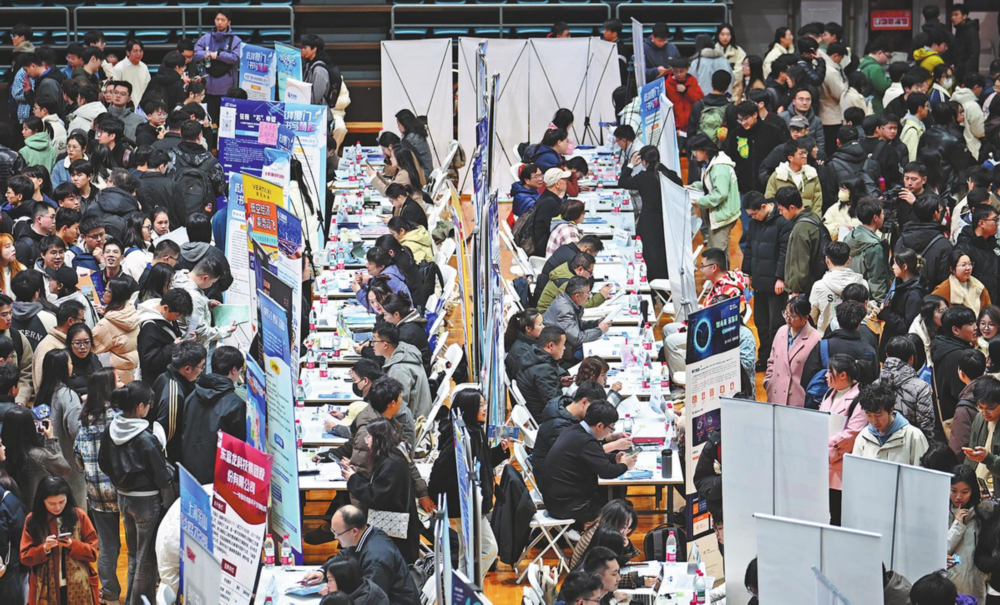
College students look for employment opportunities at a job fair on March 14 at Nanjing University of Aeronautics and Astronautics in Nanjing, Jiangsu province. More than 500 companies from across the country in fields such as artificial intelligence, low-altitude economy and new energy offered positions. YANG BO/CHINA NEWS SERVICE
Hua Yilian, a 28-year-old based in Beijing, witnessed the full force of technology's impact on the employment market after securing a job in the AI industry in 2024.
As a business developer at a large model company, she had overseen the launch of an artificial intelligence translation system. But the celebration ended almost instantly. A language expert who had worked beside her day after day to train the system was laid off the moment it went live.
"I understand it will happen that AI will take over many jobs. But it's a shock when you experience it yourself. You see a dedicated and meticulous colleague you've spent every day with suddenly become a victim of the very project they helped to succeed," Hua said.
Her experience reflects the sharp edges of China's shifting AI job market — tremendous opportunity on one side, and the rapid erosion of traditional roles on the other. Many workers are anxious to find their place in the changing job landscape, yet what is emerging holds both promise and uncertainty.
According to a report by consulting firm McKinsey&Company, China will need up to 6 million AI professionals by 2030, but the domestic talent pool is projected to fill only about a third of those roles — leaving a shortfall of roughly 4 million workers.
Data from the Chinese recruitment platform Zhaopin highlights this growing demand. During the first three quarters of 2025, AI job postings on the site rose 3 percent year-on-year, while applicant numbers surged 39 percent.
Globally, the transformation is even more sweeping.
The International Labour Organization warned in May that a quarter of the world's jobs could be affected by generative AI. Meanwhile, the World Economic Forum's Future of Jobs Report 2025 estimates that 22 percent of roles will be reshaped — with 170 million new positions created and 92 million eliminated, resulting in a net gain of 78 million jobs.
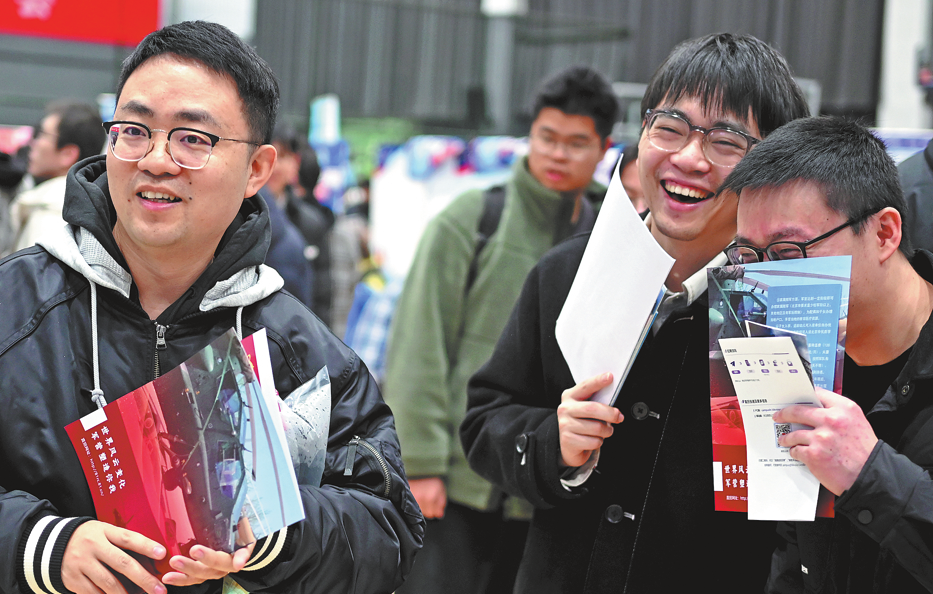
Students make inquiries at a recruitment booth during the job fair in Nanjing on March 14. (YANG BO/CHINA NEWS SERVICE)
Peking University researchers found jobs such as accountants, editors and junior programmers faced higher exposure to automation, while many blue-collar jobs were less affected. "AI excels at repetitive, rules-based tasks," researcher Zhang Dandan said. "Mid-skill jobs are most vulnerable."
As the AI wave accelerates, many young people are asking the question: if AI is rewriting the future, how do I position myself to thrive?
Lin Xiao, a social sciences graduate from Tsinghua University, represents another case in point. After two career shifts — from the civil service to international education — she joined an AI startup in March. Like Hua, her decisions were straightforward, aimed at ensuring she was positioned for the next wave of opportunity.
While still a student, Lin interned at an autonomous driving company where she enjoyed the tech-focused marketing work. After leaving her position at the end of 2024, she entered the AI recruitment boom now underway in China. "I wanted a dynamic role where I could keep learning and connect with more people," Lin said.
At her new company, she manages everything from social media, content, and community operations to key opinion leader, or KOL, collaborations, while also coordinating with product teams on strategy and improvements.
For Lin, technology represents "the core force changing the world in this era". Working in AI keeps her at the forefront of that change — a continuous learning experience that is shaping both her career and her outlook.
Neither Hua nor Lin comes from a STEM (science, technology, engineering and mathematics) background, yet both have carved out critical roles in China's fast-moving AI landscape.
Hua said sales and marketing teams serve as the "front line" of AI, translating complex technical capabilities into tangible value for customers. She spends her days explaining AI solutions to enterprises, while Lin identifies early adopters for her startup's products across global markets.
Their hybrid skill sets — combining technical literacy, product insight, market strategy and cross-team communication — are increasingly prized as AI moves from research labs into real-world applications, industry insiders said.
Every applied AI scenario — from medical imaging to personalized learning systems — depends on turning "technical potential" into commercially viable products, according to Zhaopin. Among these front-line roles, AI product managers are among the most sought-after, with an average of 68 applicants for each opening.
Wan Wan, an HR manager at a Chengdu-based AI startup in Sichuan province who asked for anonymity, said the company prioritizes hands-on experience. "We don't work on the programming of the model, but on model applications," she said. "We look for candidates with experience in prompt engineering and intelligent agents, especially if they've used them in projects or coursework."
Her company receives roughly 800 resumes for each position, with about 80 percent from experienced backgrounds and 20 percent from campuses or interns.
In contrast, the "second-line" roles — algorithm engineers and model researchers — form the technical backbone of the industry. According to a report from Wise Talent Information Technology, 47 percent of such postings require a master's degree or above.
Chen Xiaobao, a large-model algorithm engineer at a leading tech firm, describes hiring as intensely selective. Candidates must fit the team's research direction, and more than half of his colleagues hold doctorates. Minimum qualifications often include a master's degree from top institutions such as the University of Chinese Academy of Sciences.
As AI undergraduate programs were only introduced in 2019, most professionals in these roles come from related fields, including computer science, software engineering, electronics and mechanical engineering.
"Employers focus on relevant technical ability," the report noted. "Algorithms are central, involving mathematics, statistics and computer science. Deep learning demands expertise in neural networks and programming skills."
As product and engineering teams build the AI tools of tomorrow, another vital workforce is teaching them how to think. Often called AI trainers or data labelers, their task is not to code, but to educate — turning raw data into algorithmic understanding.
Just five years ago, much of this labeling work was outsourced to teams in smaller cities or rural areas, where workers tagged basic elements in vast image datasets such as cars, traffic lights, and street signs, which required less experience. But as AI models have grown more capable, they can now generate and refine some of their own data, reducing the need for humans to do the routine tasks.
"The competition is no longer about who has the most data, but who has the best data," explained Chen. "The real advantage now lies in high-quality, domain-specific information."
As a result, companies are shifting their focus. "More firms are now hiring trainers with professional expertise," Chen said. "Only carefully curated, expertly labeled data can make AI truly reliable in specialized fields — like medicine, law, or finance."
Cui Xian, 23, a finance graduate based in Shenzhen, Guangdong province, now works as an "AI data annotation specialist" at a major tech company. His role is to train AI to reason like a subject matter expert.
"I present it with complex questions it can't yet answer, then evaluate and guide its responses," he said.
"In a way, I'm not just feeding it data — I'm teaching it how to think through problems, understand concepts, and arrive at better solutions."
Yet Cui sees this work as a starting point, not a career. "The day the AI 'graduates' from your training could be the day your job disappears," he said. "The real skill isn't just teaching AI — it's learning how to use AI to elevate your own work."
He has since left the role to pursue a graduate degree, aiming to move into AI product management.
"Training AI taught me how the industry thinks," Cui said. "The true value isn't in teaching the machine — it's in learning to work alongside it."
As more workers engage with AI, many are discovering its potential not just as a tool but as a catalyst for personal growth — unlocking possibilities that once felt out of reach. Yan Qing, a 40-year-old Android developer, now runs his own AI-generated-content social media account, fueled by that same sense of possibility.
He recalls generating his first AI image in 2022 — a lighthouse by the sea. The rendering took more than 20 minutes. Yet the slow pace revealed something profound: a glimpse of a technology capable of reshaping creativity and efficiency. "It felt like witnessing a technological leap in history," he said.
As the technology matured, image-generation times shrank from minutes to seconds, producing crisp, high-quality results — a shift that helped Yan build and grow his platform.
Today, he sees himself as a "functional node" in an increasingly digitized world, curating and sharing new tools and techniques with a growing community of creators.
With AI agents spreading across industries, the idea of a "one-person unicorn" is edging closer to reality.
Zeng Ming, former chief strategy officer of Alibaba Group, has predicted that intelligent organizations — no more than 100 core employees with their abilities magnified by AI — could become mainstream within a decade. Management in such firms, he said, will shift from "people managing people" to "founders managing AI agents".
With AI support, small teams or even individuals can now carry out complex projects, said Lin, the marketer. "One developer plus several AI agents can handle product design, content creation and promotion — closing the loop from idea to execution," she said. That allows people to focus on exploration rather than repetition.
For Lin, an individual's mindset is what matters most. She suggested always asking how AI can help, whether in building mini-apps, making videos or even everyday tasks like cooking. Such habits can prepare people not only for entrepreneurship but for an era of greater personal freedom, she said.
Yan said: "There's no escaping this wave. Only by diving in can you learn its limits and potential. Even without a formal job, you can build experience through projects — laying the groundwork for what's next."
Chen, the algorithm engineer, sees AI as a foundational productivity tool — much like the steam engine. "AI is not only a job taker but also a job creator," Chen said.
Short-term disruption is inevitable, he said, but history shows that technological leaps ultimately create more jobs and more specialized forms of work. The real question, he added, is whether society can respond with openness and initiative.
China's education system is already adjusting. In 2024 alone, more than a dozen major institutions — including Tsinghua University, Harbin Institute of Technology, the University of Science and Technology of China and Wuhan University — have created or restructured AI schools.
More than 70 universities nationwide now host dedicated AI colleges, highlighting the rapid expansion of China's AI education landscape.
Yan believes AI will take over vast amounts of repetitive labor, pushing humans toward tasks once considered out of reach. "Low-quality work goes to AI. Humans must think more," he said. "Ultimately, AI is pushing work toward creativity and higher value."
































 京公网安备 11010202009201号