



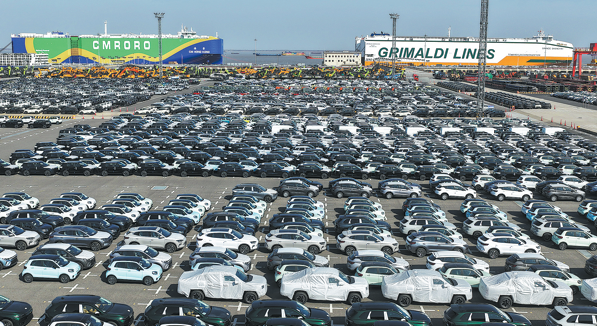
 Lines of vehicles wait to be loaded for export at Taicang port in Jiangsu province on Dec 9. Photo/CHINA DAILY
China's auto market is entering a period of high volumes but slowing growth with future expansion increasingly dependent on NEVs and overseas markets, according to forecasts from China EV100, an industry-backed think tank.
Domestic vehicle sales are expected to edge up by 2 percent to hit around 28 million units in 2026 and stabilize at around 30 million units by 2030, marking a mature market with limited incremental growth, said Zhang Yongwei, president of the think tank.
NEVs will account for a growing share of that total. Their sales, including exports, are forecast to surpass 20 million units in 2026, accounting for 57 percent of new car sales in the year.
This will bring the domestic NEV fleet to more than 60 million vehicles, roughly 15 percent of all vehicles on China's roads.
Overseas markets are expected to become a key growth engine. China's auto exports could exceed 8 million units by 2026, with overseas sales reaching about 10 million vehicles by 2030, according to the forecast.
Europe and emerging markets in the so-called Global South are set to be the main targets, while export strategies are expected to evolve toward localized production, said Zhang.
Chinese carmakers are pursuing overseas expansion with local production. They either build their own plants or make use of local assembly lines.
Auto supplier Magna is rolling out XPeng G6 and G9 SUVs at its plant in Austria, which also produces the Mercedes G-Class 4x4.
"The opportunity increasingly depends on who has the capability to explore overseas markets," said Zhang. "Domestic demand will be around 28 to 30 million vehicles, but overseas markets could add another 10 million units."
Zhang said future export growth is likely to be driven largely by electric vehicles, noting that current overseas EV volumes remain relatively small. Companies that can establish a stable presence abroad while remaining competitive at home will be more resilient, he said.
"Relying only on overseas markets is risky, and relying only on the domestic market makes sustainable profitability difficult," Zhang said. "Enterprises that can operate in both markets and allow them to complement each other will be the most stable."
He also encouraged cooperation between Chinese and foreign companies as they go global.
Zhang said discussions with European auto associations and manufacturers during a recent trip highlighted a shift in attitudes toward cooperation with China, particularly in electrification and intelligent vehicle technologies.
"In the past, there was more resistance. Now there is a strong willingness to cooperate, especially in electric and intelligent vehicles," he said, adding that Europe's auto industry is seeking access to Chinese technology to support its own transformation.
China's overseas push should extend beyond vehicle exports to deeper industrial cooperation, Zhang said.
Localized production and technology partnerships can help upgrade host-country industries while allowing Chinese firms to globalize their manufacturing and technology base.
"We need to move from a zero-sum mindset to one of mutual development," Zhang said. "Helping others upgrade their industries is also a way to secure our own long-term growth."









































 京公网安备 11010202009201号