



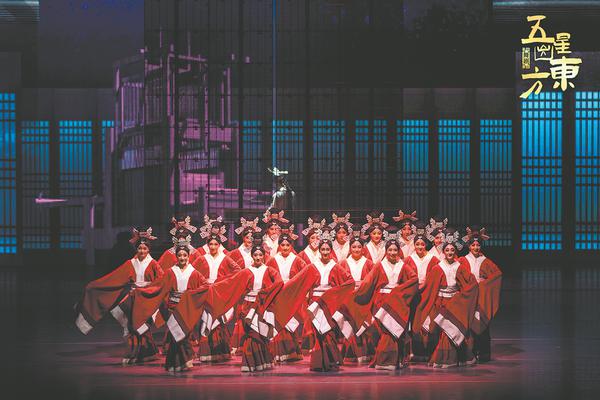
Dance drama Oriental Legend, inspired by a brocade relic, embarks on its first international tour, bringing its message of unity and peace to Canadian audiences. (Photo / China Daily)
In the heart of China's largest desert, the Taklimakan, beneath the golden sands of the Niya ruins site in the Xinjiang Uygur autonomous region, a discovery was made in 1995.
The relic — an intricately woven brocade arm protector — emerged from the depths of the desert, its colors as vivid as if it had been made yesterday. Its discovery was nothing short of a revelation, a testament to the advanced craftsmanship and artistic vision of the Han Dynasty (206 BC-AD 220) over 2,000 years ago.
From the dusty tombs of the Niya ruins to the stage of modern-day performance, the brocade has found new life in a dance drama titled Oriental Legend, a vivid reimagining of its story.
This production, first performed in 2021, brings the brocade to life with sweeping choreography, powerful music and stunning costumes, transporting audiences into a historical world where different cultures meet and unite.
With over 100 performances across China and acclaim from audiences and critics alike, Oriental Legendhas become a cultural phenomenon.
The dance drama is now set to travel beyond China's borders, marking a significant cultural milestone in the ongoing effort to share China's rich heritage with the world. This December, Oriental Legendis embarking on its first international tour, bringing its message of unity and peace to Canadian audiences.
The production will present seven performances, starting in Toronto at the Elgin Theatre from Dec. 12 to 13, and moving on to the Canadian Museum of History in Gatineau, near Ottawa, from Dec. 18 to 20.
Yue Feng, former director of the Xinjiang cultural heritage bureau, recalls the moment the artifact was unearthed.
"When we first saw it, the brilliance of the colors, the quality of the craftsmanship — it was as if we were looking at a piece of art from today, not two millennia ago. The dyes had not faded, and the fibers remained intact. It was astonishing," he says.
The brocade, which bears the phrase "wuxing chu dongfang li zhongguo" ("five planets rise in the east to bring fortune to the central plains"), is a rare artifact that blends both cultural and historical significance. Its imagery, featuring mythical creatures of Chinese culture, such as phoenixes and qilin, speaks to the high level of artistic achievement during the Han Dynasty.
"This piece embodies the sophisticated techniques of Han textile artistry, with its dense, high-quality weaving that was once used for ceremonial and imperial purposes," Yue notes.
Beyond its artistic value, the inscription on the brocade also offers a glimpse into ancient Chinese cosmology and its philosophical outlook, according to Yue.
"Wuxing" reflects the Han people's understanding of astronomical phenomena, while "zhongguo", a word that first appeared in an inscription from the Western Zhou (c. 11th century-771 BC) period, marks an early reference to the concept of the central plains, the heart of ancient Chinese civilization.
"These dance performances will introduce Canadian audiences to a story that has been preserved for over 2,000 years. It is a story of peace, understanding and shared human experience. In a world where history often feels distant, we have the opportunity to bring that history to life, to show how cultures across time and space can come together," Yue adds.
Yan Daqiu, a fan of the dance drama, has seen it 33 times since its premiere. She is impressed by the delicate flow of the performance, particularly the dancers' eyes lowered in quiet grace and their light, measured steps that move with gentle elegance.
"Each pause and each turn is infused with power and rhythm, conveying a sense of restrained beauty imbued with a unique classical charm," she says.
One dance segment brings the spirit of the Han Dynasty to life through its costume design. Inspired by the Han-era terracotta figurines seen during the creative team's visit to the Xinjiang Museum in Urumqi, where the brocade relic is displayed, the costumes evoke romantic elegance, beautifully merging simplicity with the grandeur of Han aesthetics.
In their appearance and makeup, the dancers also embody the aesthetics of the Han period. Their headpieces, crafted with Han-style white jade patterns, are dignified and graceful. Their faces, adorned with the era's signature makeup, which features the bold use of crimson beneath the eyes and across the cheeks, evoke a sense of grandeur.
"Through these designs, the dance drama offers a profound visual experience that immerses the audience in the timeless elegance of Han aesthetics, allowing the spirit of the ancient world to breathe anew," Yan says.
Through dance, music and the enduring legacy of the brocade relic, the dance drama has become not only a testament to China's past but also a vibrant expression of its future — a story of culture, resilience and unity that continues to resonate across borders, bringing people together through the power of art, says Dong Ning, the show's producer.
The Oriental Legendshow marks the closing performance of the China Arts and Entertainment Group's "Image China" series for 2025.
Since its establishment in 2009, the series has sent over 30 Chinese art troupes and more than 40 stage productions to perform in the Americas, Europe and Oceania, with over 600 performances.






























 京公网安备 11010202009201号