

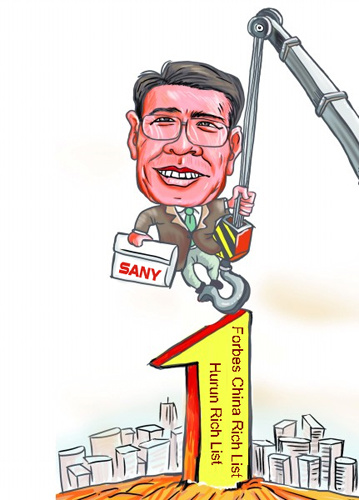
Liang vowed to "build a first-rate enterprise, cultivate first-rate talents, and make first-rate contributions" at the very beginning when the start-up was established.
In 1991, his factory, with an output value exceeding 100 million yuan ($15.7 million), grew to be the city's biggest private company.
However, Liang was not satisfied with such small success. After analyzing the market in the early 1990s, Liang concluded that the market share in construction machinery was big, and decided to become engaged in related businesses.
He moved the headquarters to Changsha in 1993 and renamed the company Sany Group.
Yet, life could never be all rosy. The new strategy soon frustrated him. With monetary policy tightened and products overstocked, the Sany Group was once on the edge of bankruptcy.
Thanks to the help of Yi Xiaogang, another partner in Sany, Liang and his company survived.
"At that time, I always saw him, probably vexed, walking back and forth in the rain with rain boots and pondering over issues. But I knew he wouldn't be beaten down, no matter how difficult the situation was," recalled Yi, who later gave up a comfortable life in Beijing and joined Liang.
It turned out that Yi made the right decision. Liang did not let his partners down by listing two subsidiaries, Sany Heavy Machinery and Sany International, on the stock market in 2003 and 2009, respectively.
Liang's small factory has now grown into world's largest construction machinery maker with an output value totaling 50 billion yuan ($7.8 billion).
Sharing
In fact, not only Liang, but also another six senior managers of the Sany Group have been listed on the Forbes World's Billionaires 2011 list, which is largely because Liang's philosophy of sharing in his fortune and success.
In 1994, when Liang and his partners first divided ownership shares in his factory, Liang, as the founder, only took 21%,leaving the majority for his fellows.
"We thought Liang should own 50%. He wasn't concerned about personal interests in the factory," said Tang Xiuguo, one of Liang's partners.
Instead of enjoying the profits himself, Liang prefers to keep sharing them with other contributors of the company.
By now, members of Sany's core management team are still as cooperative as before, with more senior managers constantly joining them.