

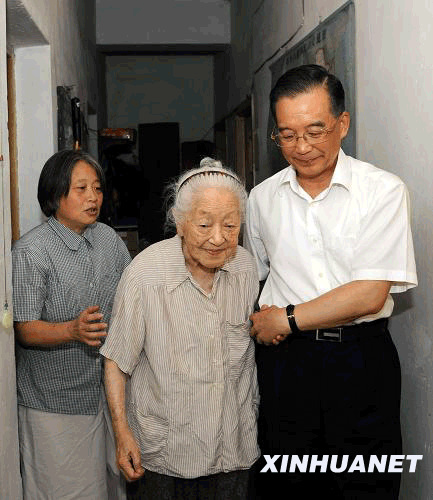

It was an ordinary early summer day when an elderly lady passed away quietly on her sickbed in a rundown apartment in Haidian District of Beijing.
Smiling humbly, one can see her in a portrait placed at the center of an altar set up by her family. In her office, other than several blue uniforms hanging on a clothes stand, all she had was some simple office stationary: a pen, paper, books and a pebble used as a paperweight.
"My mother was a simple, ordinary old lady, who lived a low-key life," Qian Minxie, the daughter, told a reporter.
However, this "ordinary old lady" was depicted differently by the national media: "Renowned nuclear physicist, senior academician of the Chinese Academy of Sciences and executive member of the Space Science Academic Society, Prof. He Zehui passed away from sickness on Monday (June 20) in Beijing, at the age of 97 years old," read a report at Chinanews.com.
Chinese Madame Curie
He Zehui, dubbed by the media as the Chinese Madame Curie, was the wife of late physicist Qian Sanqiang (1913-92), known as the father of China's A-bomb .
She was born on March 5, 1914, in Suzhou of the eastern province of Jiangsu. She graduated from the Physics Department of Tsinghua University in 1936, and received a Doctoral degree from the Technische Hochschule in Berlin in 1940.
Stranded in Germany due to the outbreak of World War II, she worked in Siemens Werner Werk from 1940 to 1943, engaged in the research of magnetics in the weak-current laboratory. In 1943, she joined the Institute of Nuclear Physics of K.W.I. in Heidelberg, working under the supervision of Prof. W. Bothe.
While studying the positron spectrum of Mn-52, she observed for the first time the elastic scattering of electrons with positrons in a magnetic cloud chamber. Her collaboration with Qian Sanqiang, her former classmate, and two graduate students resulted in the discovery of the ternary and quaternary fissions of heavy nuclei.
After returning to China in 1948, He Zehui served as research professor of physics at the Institute of Atomic Physics (part of the Institute of Modern Physics), head of the department of Neutron Physics of the Institute of Atomic Energy, and deputy director of the Institute of Atomic Energy and the Institute of High Energy Physics.
As one of the pioneers in nuclear science and technology in China, she made substantial contributions to neutron physics and the physics of nuclear fission, and trained many qualified scientists in these fields. During the 1950s, she started the research and development of nuclear emulsions, which advanced to an international level rapidly.
She then directed the experimental research of neutron and fission physics at the first nuclear reactor and cyclotron in China, and made outstanding achievements in supporting the national program of nuclear weapons development. In the 1970s and afterwards, she made significant efforts in laying the foundation of cosmic ray physics and high energy astrophysics.
Her achievements are not the only thing she shared with Madam Curie, but also her work ethic. He Zehui worked every day, even after retirement, which was the reason her fellow researchers called her He Xiansheng, or Master He.
The master as a child
Despite all her success, the retired He remained simple and humble to her colleagues.
"The National Cosmic Rays Convention was held in southwest Yunan Province," said Ma Yuqian, a researcher at the Chinese Academy of Sciences. "The 82-year-old master did not ask for any special treatment, and sat on a bus with us from the capital city of Kunming to Dali, where the convention was held."
When the high-altitude balloon project started in 1979, the 65-year-old traveled by jeep, and jolted and rattled over the rough road for three hours to Xianghe County in Beijing's neighboring Hebei Province, Ma recalled.
"Flying those balloons was risky for a person her age," Ma said. "But the master insisted on going there every time. She said, ‘no risk, no gain for science'."
Contrary to her meticulousness in physics, He was a bit careless in her appearance. She once wore a worn out pair of shoes with several patches to an international convention, recalled Wang Huanyu, incumbent deputy director of the Institute of Physics at the Chinese Academy of Sciences.
"She was holding a bag with a broken strap," Wang said. "She was a scientist who once studied and worked in western countries, but she did not have a snobbish attitude."
"Sometimes she could be a child," said Ma, remembering when they went to see China's Shenzhou-2 spacecraft in 2000, in which master He happily discussed becoming an astronaut. "She said she was small and could easily fit into the control room. She sounded just like a child."