


By Lin Zhuowei
(ECNS) —With the 31st UN Climate Change Conference (COP31) well underway in Antalya, Türkiye, Erik Solheim, former UN under-secretary-general, former executive director of the UN Environment Programme (UNEP), and Co-Chair of the Europe–Asia Center, shared his insights with China News Service's "News Lounge" on the country's ecological governance and global climate cooperation.
"If you ask about China, I would just give one advice: please don't trust me; please go and see for yourself." On his many trips across China, Solheim has witnessed once heavily polluted waterways clear up, with fish and birds returning to the rivers.
He has met ordinary residents by West Lake in Hangzhou, Zhejiang Province, who have volunteered to clean the lake at 5 a.m. every day for more than a decade and followed the Yangtze River basin's ecological recovery delivered by the river chief system and a decade-long fishing ban. In his view, many perceptions of China's green progress fall short of what people can see with their own eyes on the ground.
A miraculous turnaround: collective power behind river restoration
The restoration of the Yangtze River basin serves as a powerful case study for understanding China's environmental governance. Reviving such a vast river system cannot be achieved by a small group alone, Solheim said.
He highlighted coordinated action between central and local governments: removing small hydropower facilities that hinder fish migration, curbing pollution discharges, enforcing a 10-year fishing moratorium, and breeding endangered fish in captivity before releasing them back into the wild. The river chief system assigns specific officials to take charge of each stretch of waterway. Success also relies on industrial transformation, public understanding and community participation.
"Unless everyone is moving in the same direction, you cannot achieve it."
He noted the model is rooted in China’s centuries-old governance traditions, making it hard for other nations to copy outright, yet its core lessons are worthy of global learning.
From long-term volunteers protecting West Lake in Zhejiang to cross-provincial river cleanup work in the Pearl River Delta, he said, these real-life examples show that China's ecological conservation is a collective effort involving governments, businesses and local communities.
"Green is gold": market-driven industrial transformation
"And for me that was a starting point for a beautiful China, for a beautiful China cannot be truly beautiful without common prosperity."
Solheim said the steep drop in solar, wind and battery storage costs over the past decade is reshaping the global energy landscape. Countries are moving away from coal not only out of environmental conviction, but for solid economic gains.
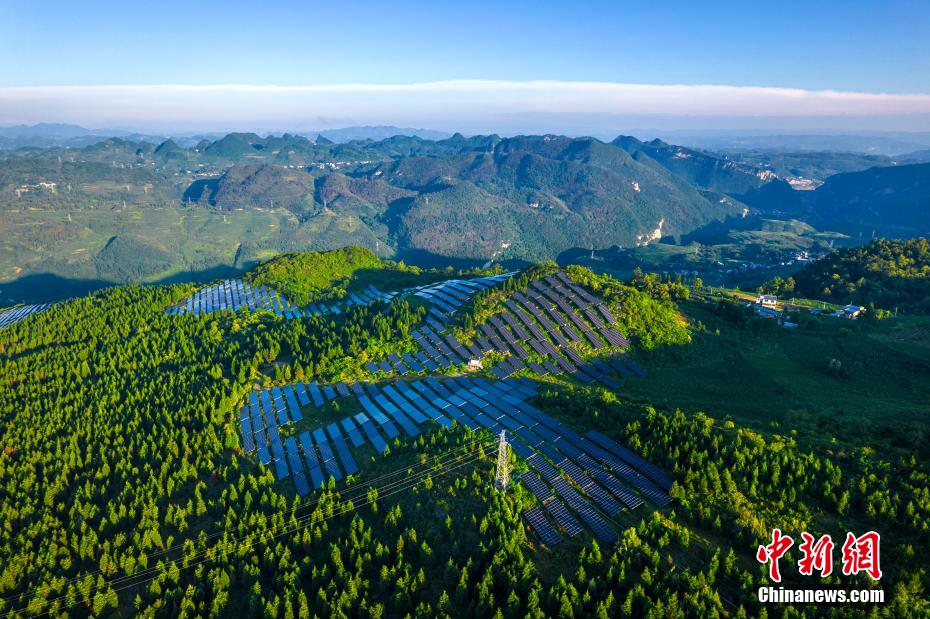
"The fact that the price of solar energy, the price of wind energy, and the price of battery storage have fallen by ninety percent in the last decade — that's what's driving the change. Because everyone's switching from coal to solar: now they save money. In the past, this was a huge cost; now it's a cost saving. So, it's business and political decisions rather than the promise that is driving the change."
Solheim has been deeply impressed by China's green industry leaders. In Ningde, Fujian Province, he watched how a modest firm has grown into a global power battery giant. In Chengdu, photovoltaic maker Tongwei produces more solar cells annually than the United States has produced in its entire history. A growing number of Chinese firms have made major breakthroughs in energy storage, photovoltaics, electric vehicles and high-speed rail, delivering cost-effective green technology solutions worldwide.
"Civil society groups can do good pilot projects, but they cannot do it at this massive scale," he said.
In his view, large-scale commercial enterprises can deliver the massive capacity needed to tackle the climate crisis. He said the idea that green development can go hand in hand with prosperity opens pathways for better livelihoods and new jobs.
Global climate governance calls for joint efforts
Looking to COP31 and broader global climate action, Solheim said ocean and energy issues deserve priority on the climate agenda.
"What we expect is that ocean issues and energy issues will be put at the top of the agenda."
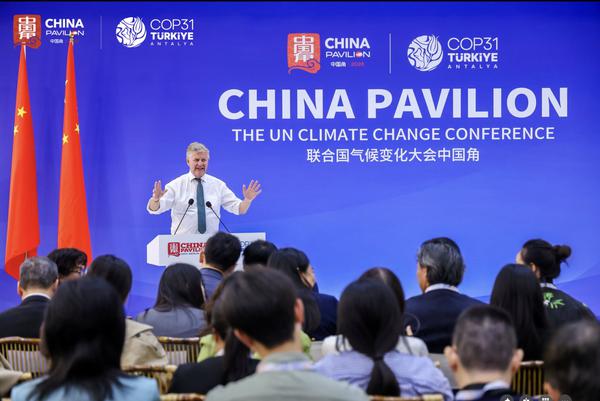
No single country can tackle the intertwined challenges of climate change, biodiversity loss and land degradation alone, he continued.
"The United States is not playing ball at this point… But even in the U.S., remarkably, markets speak: nearly all new electricity in the United States is now also coming from solar, because simply it's the cheapest energy in the United States. And even if you're not an environmentalist in Texas, well, you may be close to your money — since solar is cheaper, well, you will go solar."
Solheim called for closer coordination between China, the rest of the Global South, and Europe to advance the global green transition. He invited foreign officials, researchers and practitioners to visit China, witness river restoration and renewable energy development firsthand, and bring relevant ideas, technologies and governance practices back home.







































 京公网安备 11010202009201号