


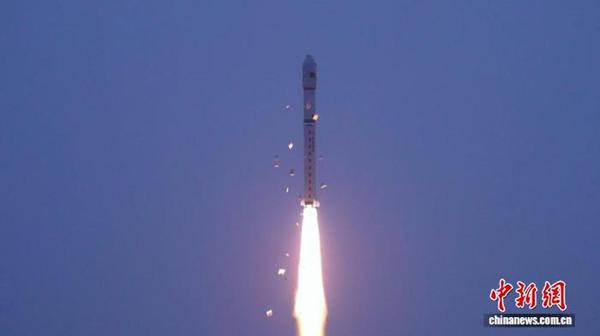
(ECNS) -- China launched four PIESAT-2 satellites aboard a Long March 2D carrier rocket from the Taiyuan Satellite Launch Center in north China’s Shanxi Province at 6:50 p.m. on Saturday, according to GalaxySpace, a Beijing-based private satellite company.
The four satellites were equipped with high-resolution synthetic aperture radar (SAR) and on-board intelligent processing and mission-planning payloads. They can process remote-sensing data in orbit in real time, improving processing efficiency.
GalaxySpace has launched 53 independently developed satellites so far, including more than 10 SAR satellites.
Duan Xiao, chief designer of GalaxySpace’s SAR satellites, said many satellites developed by the company have achieved large-scale in-orbit data processing.
He noted that the satellites can process and extract information from remote-sensing data in orbit, reducing data backhaul pressure on satellite-ground links and speeding up data processing and service response.
The Long March 2D rocket, developed by the Shanghai Academy of Spaceflight Technology, is propelled by liquid propellants. It can send a 1.3-metric-ton spacecraft to a sun-synchronous orbit with an altitude of 700 kilometers.
The mission marked the 668th flight of the Long March rocket series.
(By Helen Mo & intern Liu Shuangjing)









































 京公网安备 11010202009201号