


By Zheng Yuntian
(ECNS) -- Western headlines warn of a theoretical "Chinese robot army", but battlefield deployments in Ukraine and procedural blockades at the UN conferences point to where the real push to militarize AI is coming from.
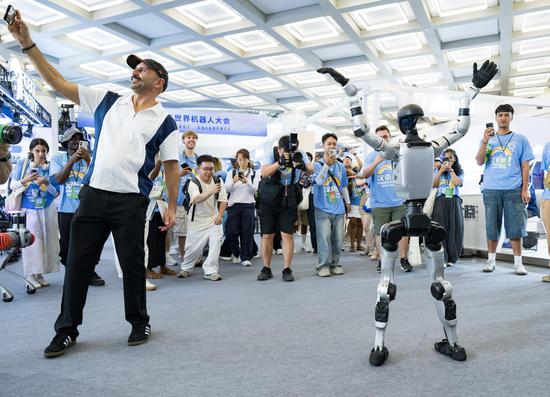
In a recent report titled "From dance floor to war: China readies humanoid robots for combat," Reuters asserted that Beijing is "accelerating research into the military applications of humanoid robotics and planning their deployment in war." Coverage of this kind hypes the military potential of Chinese-made humanoid robots, giving Western politicians yet another talking point to revive the "China Threat" playbook.
The pattern behind these narratives is as predictable as it is deliberate. On one level, it exploits deeply ingrained cultural fears—tapping into sci-fi tropes popularized by films like "The Terminator" and "I, Robot," which depict rogue AI and robotic massacres—to stoke public alarm. On another level, it casts routine industrial development in national security terms, even linking China's advancing robotics sector directly to geopolitical rivalry.
The objective of this framing is clear: to whip up irrational panic among Western populations over a hypothetical "Chinese robot army," thereby manufacturing consent for technological containment barriers and advancing anti-China political agendas.
While Western outlets aggressively link China's humanoid developments to military ambitions, there remains a stark divide between basic technical exploration and actual combat capability.
In high-intensity war zones, humanoid platforms still face severe engineering constraints: including high power consumption, short battery life and vulnerability to electromagnetic interference. In fact, in its report, Reuters noted that there is no evidence China has ever deployed armed humanoid robots to combat units.
Yet while Western media outlets hype a theoretical "China threat," they systematically downplay a far more concrete reality: the U.S. is currently shipping humanoid robots to real-world frontlines for live combat evaluation.
According to a March 2026 report by TIME magazine, two Phantom MK-1 military humanoid robots—developed by a San Francisco tech startup—were delivered to the frontline of Ukraine in February 2026 for real-world testing, including high-risk reconnaissance operations.
A company spokesperson confirmed that it is actively preparing robots for the Pentagon for future combat integration. The Department of Defense also stated that it continues to explore prototype military humanoids designed to operate alongside warfighters in complex, high-risk environments.
Furthermore, the company revealed it is in "very close contact" with the U.S. Department of Homeland Security to explore deploying these platforms for autonomous border patrol—shifting the technology from overseas warzones to the surveillance of undocumented migrants along the U.S. southern border.

The military use of humanoid robotics involves far more than technological capability; it touches on the fundamental legal boundaries and accountability governing the use of force. In this context, Washington's conduct on the international stage raises serious questions.
At negotiations under the United Nations Convention on Certain Conventional Weapons concerning Lethal Autonomous Weapons Systems, China's position has remained consistent and responsible: Beijing maintains that "human operators must retain ultimate control over weapon systems" and supports a legally binding global ban through international treaties.
In contrast, the U.S. has repeatedly resisted efforts in Geneva to negotiate a binding international treaty on lethal autonomous weapons. Washington has instead promoted non-binding "codes of conduct," while publicly arguing that autonomous weapons can "improve targeting precision" and offer "humanitarian benefits."
By aggressively advancing military robotics while systematically blocking binding international oversight, Washington faces a glaring paradox. It must answer: Can existing frameworks adequately manage the risks of AI warfare? How will miscalculation and system failures be prevented? And when autonomous systems inflict unlawful harm, where does legal liability lie?
A consistent standard should not mean that when the U.S. ships humanoid robots to Ukraine, it is hailed as "life-saving defense innovation," while China's research into humanoid platforms for emergency response and manufacturing is branded a "threat to world peace."
Yang Zhen, a professor at the Shanghai University of Political Science and Law and deputy director of the Shanghai University Students National Defense Education Research Center, noted in an interview with China News Network that although China possesses massive industrial and manufacturing capacity for autonomous hardware, putting combat robots into operation presents serious legal and ethical hurdles—including questions of accountability, the erosion of human-centered norms, and the delegation of life-or-death decisions to machines.
Yang emphasized that China, as a responsible power, approaches the use of military force with immense caution. He argued that the international community should instead remain vigilant toward countries using "countering China" as a pretext to build up their own robotic forces while riding roughshod over international law and ethics.





































 京公网安备 11010202009201号