


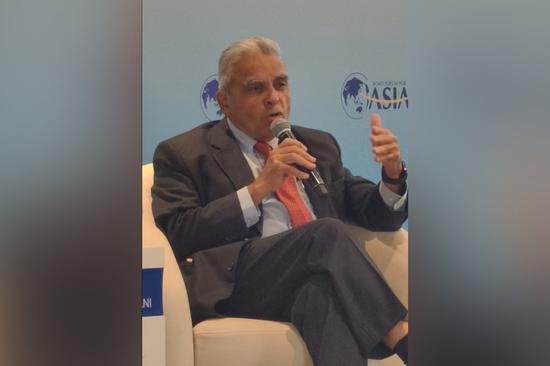
China's imports and exports of goods exceeded 7.7 trillion yuan ($1.12 trillion) in the first two months of 2026, registering an 18.3 percent year-on-year increase. Chong Quan, China's former deputy international trade representative, spoke to National Business Daily about the challenges and opportunities for China's foreign trade. Below are excerpts of the interview.
These figures demonstrate the resilience and vitality of China's foreign trade, a cornerstone of the country's growth. Final consumption expenditure added 2.6 percentage points to China's GDP growth in 2025, while gross capital formation and net exports of goods and services added 0.8 and 1.6 percentage points respectively.
This shows that the fundamentals sustaining China's sound economic growth in the long run remain unchanged, and the economy will continue to be resilient, possess great potential and operate with full vitality.
But domestic demand remains insufficient, and the recovery in consumption and investment needs to be further boosted. Meanwhile, China is replacing old growth engines with new ones. All these factors will inevitably affect market expectations and confidence in the short term.
The Government Work Report says domestic demand should be a priority. But this does not mean that exports are no longer important.
In 2025, China's foreign trade surplus exceeded $1 trillion. This figure shows that China has turned from a major trading country into a strong country in trade.
China's foreign trade has the ability to remain resilient in 2026, and exports are likely to grow at a reasonable pace.
The focus of China's foreign trade policy is shifting. Instead of merely pursuing growth in export volumes, efforts are now aimed at protecting and upgrading the industrial system amid external pressures.
On the one hand, the profound changes in the external environment are the main risks for China's foreign trade. The demand by overseas markets is volatile, geopolitical risks are escalating and protectionism is on the rise, expanding from isolated tariff measures to restrictions covering the entire supply chain.
On the other hand, there are also some favorable aspects. In recent years, China's exports to the Association of Southeast Asian Nations, Africa, and countries participating in the Belt and Road Initiative have risen steadily. The country's economic and trade cooperation with countries in the Global South has also deepened. This diversified layout has effectively enhanced China's ability to hedge against the fluctuations in the demand of developed economies.
China's export structure is upgrading at a faster pace. The share of the country's technology-intensive products has increased in the global market, exports of knowledge-intensive services have emerged as a new growth driver, and the potential of trade in services is being unlocked more rapidly.
In addition, new forms of business, such as cross-border e-commerce, are growing vigorously. The island-wide special customs operations in the Hainan Free Trade Port will likely inject new momentum in foreign trade.

























 京公网安备 11010202009201号