


The U.S. military carried out new strikes in Iran, targeting a military site that officials believed posed a threat to U.S. forces and commercial shipping in the Strait of Hormuz, a U.S. official said, hours after President Donald Trump dismissed an Iranian report of a deal to restore traffic through the strategic waterway.
The U.S. official, who requested anonymity to speak candidly about military operations, told Reuters on Wednesday the military also intercepted and shot down multiple Iranian drones that posed a threat. The comments followed an Iranian media report that three explosions were heard east of the Iranian port city of Bandar Abbas at around 1:30 a.m. on Thursday.
At a cabinet meeting attended by media, Trump dismissed an Iranian state TV report that it had obtained an unofficial draft of an agreement to restore commercial shipping through the strait to prewar levels within a month, with Iran and Oman jointly managing traffic.
Trump said no single country would have control over the waterway, and appeared to threaten Oman, a country with which the United States has decades-long military and economic ties.
"Nobody's going to control (the strait)," Trump said. "It's international waters and Oman will behave just like everybody else or we'll have to blow them up. They understand that, they'll be fine."
Trump also said that Iran would not receive sanctions relief in exchange for giving up its stockpile of highly enriched uranium.
"They're gonna give up their highly enriched uranium not for sanctions relief. No, no, not at all," the president added.
He added that he will not rush into a deal with Iran because of midterm political concerns, warning that Washington remains prepared to resume military action if ongoing negotiations fail to produce an agreement favored by the United States.
The Iranian TV report of a framework deal said the U.S. would also have to lift its blockade of Iranian ports and withdraw military forces from Iran's vicinity.
But Trump's comments and reports of new U.S. military action showed that the two countries remain far apart even after suggestions from the White House in recent days that an initial deal to end the war could be imminent.
Iranian media said that air defenses were activated for several minutes early on Thursday.
Ebrahim Azizi, head of the Iranian parliament's national security committee, said Trump's "rhetoric" would not force Iran to back away from its demands to enrich uranium, wield authority over the strait and see sanctions against it lifted.
"It is obvious Trump, seeking a way out of this strategic deadlock, alternates between issuing threats and appealing for an agreement," Azizi said in a post on X.
Trump has repeatedly said that a deal is close at hand since a ceasefire took effect in early April.
The strait, which handled a fifth of the world's oil and liquefied natural gas traffic before the war, the dismantling of Iran's nuclear capacity and ongoing sanctions are the sticking points in talks seeking to end the three-month-long conflict.
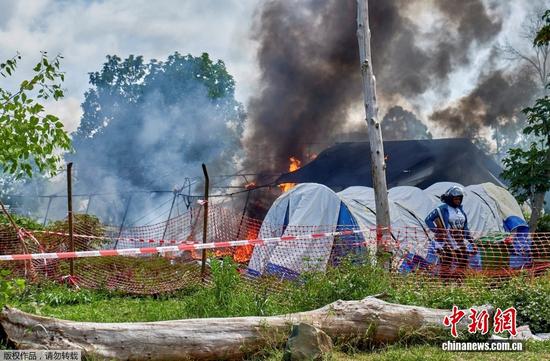
Separately, Israel continues, even intensifies its strikes across southern Lebanon. Lebanon's Health Ministry said the toll from Israeli attacks since March 2 had risen to 3,269 killed and 9,840 wounded as of Wednesday.
On Thursday, Israel's military issued an evacuation warning for residents of the city of Tyre in southern Lebanon, saying it would operate against Iran-backed group Hezbollah in the area.
"The IDF is compelled to take forceful action against it," the Israeli military's order said, in reference to Hezbollah.
Li Zixin, assistant researcher at the China Institute of International Studies, said the U.S.-Iran ceasefire talks may be the fuse for an escalation of Israeli military operations.
Noting Iran explicitly regards a simultaneous ceasefire across all fronts in the Middle East as a necessary condition for the U.S. and Iran to reach a ceasefire agreement, Li said by escalating its military operations across multiple fronts, Israel can effectively constrain the U.S. and Iran from reaching an agreement that Israel does not want to see.
Besides, Li added that Israel is also very concerned that if the U.S. and Iran overcome multiple obstacles and actually sign an agreement, the U.S. will most likely increase pressure on Israel to ensure the ceasefire holds and the agreement is implemented.
Therefore, Israel needs to expand its military advantage across multiple fronts beforehand, consolidate its sphere of influence, and create faits accomplis to permanently alter the regional balance of power, Li said, adding that from this perspective, Israel must seize the current final window to intensify its military operations.
























 京公网安备 11010202009201号