


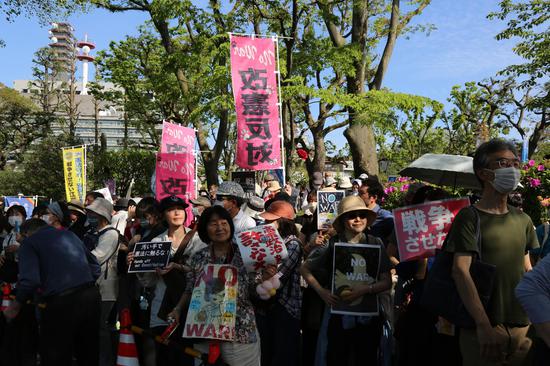
Driven by a neo-militarist agenda, Tokyo revised the Three Principles on Transfer of Defense Equipment and Technology and implementation guidelines on April 21, lifting the ban on lethal weapon exports.
This change came exactly six months after Japanese Prime Minister Sanae Takaichi took office. Earlier, Japan had quietly eased restrictions on weapons exports, but this decisive move signals a clear, systemic shift toward becoming a military-industrial power profiting from arms manufacturing. The international community must remain vigilant and firmly oppose this development.
In 2014, the then Shinzo Abe administration introduced the three principles that focused on "relaxing restrictions". This allowed the export of non-lethal weapons for five purposes, including rescue, transport, surveillance, reconnaissance and mine-clearing, to security partners, while tacitly encouraging arms exports.
Later, in 2023 and 2024, the then Fumio Kishida administration loosened limitations further. Now, under the new rules, Japan can export lethal weapons, including fighter jets, destroyers, frigates, submarines, and related components, technology, and maintenance services, to any country with which it has signed a defense equipment and technology transfer agreement.
The revision also liberalizes the transfer of non-lethal weapons.
Tokyo can now supply non-lethal weapons, along with related components, technology, and maintenance services, to any country, except those involved in armed conflicts.
The third major change is green-lighting outbound defense-industry investment, mergers and acquisitions, which were until now subjected to "strict restrictions".
The new rules allow these activities, as long as they are managed in accordance with the spirit of the three principles.
Furthermore, a dedicated agency will be established to promote foreign arms sales, bringing together senior officials from related government ministries and agencies.
This agency will act as a "command post" to coordinate government and corporate efforts, enhance the competitiveness of Japan's defense industry, and boost weapons exports.
Tokyo's lifting of arms export restrictions aims to revitalize the domestic defense industry, strengthen ties with key strategic partner countries both within and beyond the region, contain "strategic rivals", and expand its military influence abroad.
This move lays the groundwork and creates momentum for a neo-militarist agenda that includes constitutional revision, military expansion, alliance-building and external intervention.
The underlying objective of enhancing military-industrial production is to develop the "capability of waging war".
With defense spending increasing for 14 consecutive years, Japan's defense industry has experienced a distorted form of prosperity.
Unrestricted arms exports will further inflate the sector, solidify the foundation for radical military expansion, and foster military-industrial complexes that intertwine political and business interests, locking the country into a long-term right-leaning trajectory.
Tokyo also seeks a broadened network of allies interested in militarization. According to Japan's Ministry of Defense, so far it has signed defense equipment and technology transfer agreements with 17 countries, including the United States, Australia and the Philippines.
Similar agreements are expected with Spain and Finland. Weapons exports will significantly enhance Tokyo's military "interoperability" with these nations, binding them with Japan's military policies. This could pave the way for Japan's overseas troop deployments, the use of force and assertive interventions in regional affairs.
There is also the danger of fueling conflicts. Japan's primary target clients for arms are largely strategic partners in the "Indo-Pacific" region. Through both external and internal collusion, Japan can exacerbate hot spot issues, roil regional dynamics and ultimately exploit the ensuing chaos to reap gains from turmoil.
In this case, to mitigate the growing vulnerabilities of homegrown production induced by its dangerous meddling, another implicit goal is to preposition backup defense supply chains for "sustained warfare capability".
Drawing on lessons from prolonged conflicts such as the Ukraine crisis, Japan wants to build a distributed network of military supply chains across allied and partner countries through defense-industrial cooperation, licensed production and outward investment.
Although Takaichi is wishfully rattling her neo-militarist calculus — building a military economy to feed the military machine and profiting from external conflicts — the strategy is likely to backfire.
Many clear-eyed observers, both within Japan and internationally, have criticized this approach. Besides its destabilizing effect on the fragile regional security landscape, this move is a major strategic blunder for Japan itself. It's akin to drinking poison to quench thirst.
The strategy sacrifices several long-term benefits for short-term expediency. Exporting weapons at the expense of normal trade will undermine Japan's broader interests.
First, weapons can be sold only to allies and partners, whereas civilian products can be marketed globally. Moreover, technologies in areas such as materials, software, and precision manufacturing, which have broad applications in civilian sectors, will face severe usage restrictions once they are channeled into the defense industry and classified as dual-use. This would inflict lasting damage on economic growth.
Also, weapons are directly linked to national survival and security, prompting recipient countries to explore every possible way to break free from Japan's technological control.
Tokyo's arms exports are therefore unlikely to lock in long-term alliances and partnerships, and may well end up being one-off deals.
Furthermore, the defense industry lacks the innovation and dynamism seen in civilian sectors. Focusing too much on this sector ultimately hinders the country's overall technological progress.
In fact, drawing on the bitter lessons of Japan's militaristic rampage before World War II, some postwar Japanese leaders had a clear-eyed understanding of these negative consequences. The Yoshida Doctrine propounded by Japan's first postwar prime minister Shigeru Yoshida prioritized economic development over military buildup.
It was the nation's overarching policy guideline, partly meant to prevent Japan from repeating historical mistakes.
In the 1970s, Kiichi Miyazawa, then foreign minister in the Takeo Miki Cabinet and later a prime minister, stated unequivocally during a parliamentary hearing that even if weapons exports could generate trade surpluses, Japan was not in such dire straits as to rely on arms sales.
With these cautionary lessons still fresh in memory, the Takaichi government's determination to lead Japan down the militaristic path is a dangerous folly. The international community must firmly oppose this trajectory with concrete actions to bring Tokyo to its senses.

























 京公网安备 11010202009201号