



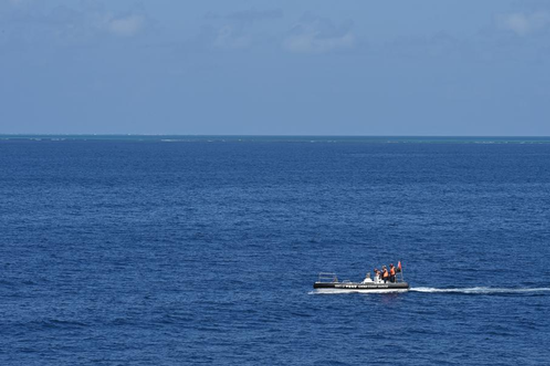
 The first stage of the Long March 10 carrier rocket is fished out and retrieved from the sea on Friday, marking China's completion of its first-ever rocket first-stage booster maritime salvage and recovery mission. Wang Yulin/Xinhua
China has successfully recovered the first-stage booster of the Long March 10 heavy-lift carrier rocket used in a significant test flight earlier this week, said the China Manned Space Agency.
The agency announced in a news release that the booster was retrieved Friday morning from its splashdown site in the South China Sea, marking the first time China has recovered rocket parts from the ocean. A photo published by the agency shows a crane lifting the booster out of the water and placing it onto a ship.
The agency has not yet disclosed details about what will be done with the recovered booster and other aspects of the recovery operation.
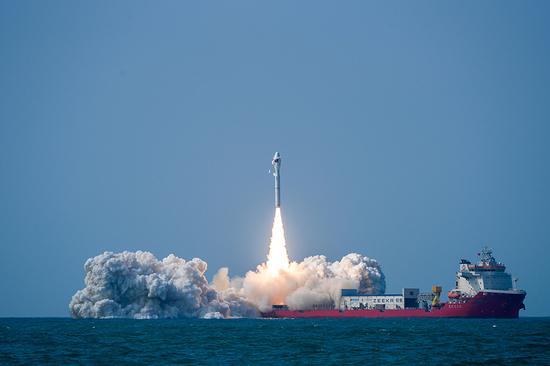
China conducted a key flight test on Wednesday of the Long March 10 first-stage booster and the Mengzhou crewed spacecraft, a combination intended for the nation's ambitious manned lunar mission planned for around 2030. During the test, the booster flew back to Earth using its engines and grid fins, gently splashing down in a designated area in the South China Sea.
The test marked the first successful attempt by a Chinese rocket to return to Earth safely, a historic achievement in China's efforts to develop reusable rockets. Currently, only the United States has operational reusable rockets.
Both the Long March 10 rocket and the Mengzhou spacecraft are in the final stages of research and development at China Aerospace Science and Technology Corp, the country's leading State-owned space contractor. They are among the key components of China's ambitious plan to send astronauts to the moon before the end of the decade.
The Long March 10 is a new launch vehicle designed by the China Academy of Launch Vehicle Technology. The model consists of a core booster and several side boosters. It is 92.5 meters tall and five meters wide, with a liftoff weight of 2,189 metric tons and a thrust of 2,678 tons. This rocket model can transport spacecraft weighing at least 27 tons to an Earth-moon transfer trajectory, according to its designers.
The Long March 10 will also have a shorter variant without side boosters. This version will be 67 meters tall and have a liftoff weight of about 740 tons. With a carrying capacity of 14 tons, it will be used to send astronauts or cargo to the Tiangong space station in low-Earth orbit.
Designers said that the first two stages of the core boosters in both configurations are essentially identical, and that the first-stage booster of both configurations will be reusable. The moon-mission variant includes a third-stage booster, while the shorter variant does not, they added.


































 京公网安备 11010202009201号