
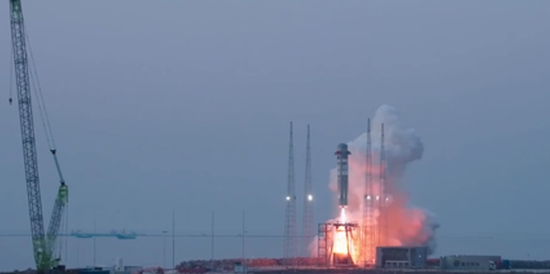
China breaks ground on its first sea-recovery reusable rockets plant
China has begun construction on its first "super plant" for reusable rockets that can be recovered at sea in the eastern city of Hangzhou.
The 5.2 billion yuan ($740 million) project, led by Beijing-based space launch company Space Epoch, got underway on January 7. According to Hangzhou Daily, it will produce medium-to-large liquid-fueled rockets capable of reuse, high payloads, low cost and sea recovery. The facility, when ready, will manufacture up to 25 of these rockets a year.
"A reusable rocket is like a taxi, satellites are the passengers, and a constellation of satellites is a busload of tourists," Wei Yi, founder and chairman of Space Epoch, told local newspaper Hangzhou Daily.
The cost of space launch vehicles for mainstream rockets in China is approximately 80,000 to 100,000 yuan per kilogram, Wei Yi explains. With Space Epoch's "stainless steel + liquid oxygen and methane" solution, the cost is expected to be slashed to 20,000 yuan per kilogram, he adds.
Commercial space travel ready for lift-off
This marks a key step toward large-scale manufacturing and production capabilities in commercial reusable launch vehicles, highlighting the growing role of private aerospace firms in the global space sector.
The project reflects the efforts of Chinese private firms to scale up launch capacity and industrialize operations, in line with global trends in reusable rocket technology. In addition to Space Epoch's "Yuanxingzhe 1" test rocket completing its first sea recovery flight in May, multiple other Chinese commercial space companies have conducted reusable rocket experiments since late 2025.
Chinese space actors, including LandSpace's Zhuque 3, the state-backed Long March 12A, and other private firms such as Space Pioneer and Galactic Energy, have conducted tests covering vertical takeoff and landing (VTVL), near orbit recovery, and key propulsion demonstrations.
Although not all efforts were fully successful, they demonstrate that China's commercial space sector is advancing on multiple fronts, transitioning from isolated technical demonstrations to systematic, engineering-driven development, according to 21st Century Business Herald.
Internationally, SpaceX has established and operates its Starbase in Texas for Starship assembly and testing, positioning it at the forefront of exploration.