
Beyond raw speed: Global NEV sector chases resilience as China explores practical solutions
By Lin Zhuowei
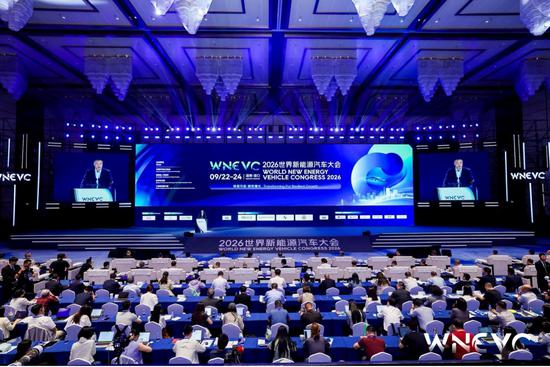
(ECNS)-- At the end of September 2026, the World New Energy Vehicle Congress (WNEVC) — one of the world’s highest-profile new-energy-vehicle events — convened in Haikou, Hainan.
This was the first edition of the congress since Hainan Free-Trade Port became fully operational. Against this distinctive backdrop, what signals has this high-level gathering of industry leaders sent for China and the global NEV community?

The conference's theme, "Transforming for Resilient Growth," goes straight to the heart of the industry’s biggest challenges.
As electrification and intelligent mobility sweep across the globe, whether to shift to new energy is no longer in doubt among the industry. Yet a practical question hangs over participants: amid breakneck tech iteration, geopolitical frictions, and diverging national-market demands, how can the sector balance three imperatives, namely safety, commercial viability, and long-term sustainability?
Speeches from senior Chinese and international guests offer deeper insights. Broad consensus exists around the overarching goal of green transition. But when discussions turn to real-world implementation and the pitfalls of global cooperation, perspectives overlap, resonate, and reveal meaningful differences.
Wan Gang, president of WNEVC, laid out the baseline framework for the conference’s debates. According to him, the global NEV sector has firmly entered mass-market adoption. In the first half of 2026, worldwide NEV sales hit 11.23 million units, with a 24% market penetration rate. To deliver tangible transition outcomes, three priorities emerge: advance electrification, expand hydrogen applications, and upgrade intelligent mobility.

Wan argued that operators must keep refining existing lithium-ion batteries while resolving bottlenecks in semi-solid or solid-liquid-hybrid batteries—an intermediate step toward full solid-state cells. Fuel-cell solutions ought to be prioritized for long-haul heavy-duty commercial vehicles. For intelligent driving, the "vehicle-road-cloud" collaborative framework should be rolled out, with safety validation and risk assessment embedded into every cycle of technical updates.
Working toward the shared carbon-neutrality target, different economies are pursuing distinct approaches.
Akira Matsunaga, vice-chairman of the Japan Automobile Manufacturers Association (JAMA), put it plainly: there is no universal, one-size-fits-all blueprint for carbon neutrality. He explained that nations vary widely in available energy resources and existing on-road vehicle fleets. There is no need to copy a single model. Hybrid, battery-electric, hydrogen and synthetic-fuel pathways can all advance in parallel.
Jochen Goller, member of the board of management of BMW AG, largely endorsed this open-technology stance. At the same time, he issued a sober reality check: do not fixate purely on how fast innovation moves. Speed must align with product quality, safety, and business survivability. It is not enough for a technology merely to function; it must sustain a viable business model. Full-lifecycle carbon-footprint assessment offers a practical yardstick for judging real-world transition performance.
Moving past debates over technical pathways, one tough-minded subject kept resurfacing: how to safeguard global supply chains and make cross‑border cooperation function.

Hildegard Müller, president of the German Association of the Automotive Industry (VDA), analyzed the landscape from a European industry vantage point. She said that China and Germany hold highly complementary industrial strengths: China excels in batteries and fast-evolving digital-mobility ecosystems, while Germany draws on deep-rooted engineering-manufacturing heritage. Huge, untapped potential exists for joint work covering batteries, autonomous driving and hydrogen mobility.
Yet substantial risks loom. Amid geopolitical shifts, export controls and trade barriers threaten to fragment global supply chains. Müller said competition and cooperation are not mutually exclusive, and dialogue must not shut down merely because rivalries persist.
Drummond Jacoy, senior executive vice-president of Mercedes-Benz Group China, grounded these high-level debates in tangible corporate practice. He observed that China is no longer simply a sales destination for foreign brands; it has grown into a global innovation hub for multinationals. Many of the research-and-development solutions refined in China have later rolled out on global-market vehicle models.
After this exchange of converging and clashing viewpoints, the congress published its official consensus: advance market-driven green development, balance innovation and industrial security, uphold globalized industrial frameworks, and push for alignment of international standards.
Delegates want to leverage Hainan Free-Trade Port's institutional strengths to build a testing, certification, and cross-border cooperation hub that serves tropical-market requirements, turning forum-floor discussions into concrete, implementable industry projects.