


By Liu Xinyu
(ECNS)-- The Nature Conference titled "Cancer Immunology in the AI Era" was held in Chongqing from Saturday to Sunday.
With the theme "Data-driven and mechanism-guided integration: A new paradigm for cancer immunology in the AI era," the conference was jointly organized by Chongqing Medical University and four Nature Portfolio journals.
Nearly 20 scientists from China, the United States, Germany, the United Kingdom and other countries and regions, along with senior editors from journals such as Nature Cell Biology, Nature Reviews Cancer, Nature Biotechnology and Nature Cancer, gathered in the mountain city for in-depth discussions.
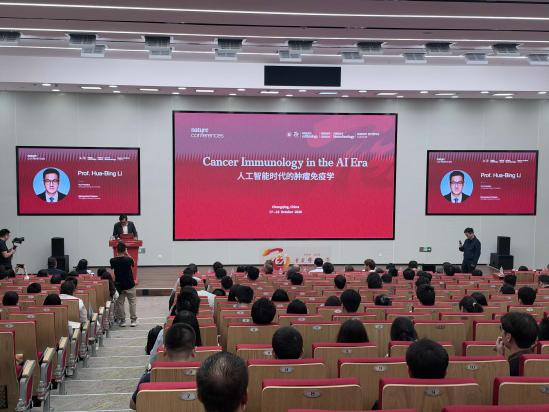
Zhang Zemin, an academician of the Chinese Academy of Sciences and President of Chongqing Medical University, said: "Over the past decade, technologies such as single-cell sequencing and spatial omics have fundamentally changed how we study cancer and its immune microenvironment. Now, artificial intelligence is opening a new frontier."
Zhang noted that "with affiliated hospitals serving 25 million patient visits annually, Chongqing Medical University has an enormous clinical ecosystem. For those of us working at the intersection of AI and medicine, this represents something particularly valuable: not just a large amount of clinical data, but an extraordinary opportunity to identify important medical questions, test new ideas, and translate discoveries into better patient care."
"As we celebrate our 70th anniversary, we are particularly committed to strengthening interdisciplinary research and international collaboration. Hosting this conference is a wonderful opportunity to advance that vision," Zhang added. "I hope the next few days will bring stimulating scientific discussions, unexpected insights, and perhaps some new collaborations that will lead to discoveries we cannot yet predict."
Fabian Theis, director of the Institute of Computational Biology at Helmholtz Munich in Germany, said that AI was profoundly transforming the scientific research paradigm and that life science research had entered a new "model-driven, prediction-first" stage.
Theis noted that the focus on "world models" within the field aimed to build intelligent simulation systems to provide a predictive basis for disease treatment.
Theis suggested that future research should focus on multimodal integration and precise cellular interventions to promote the practical application of AI in precision medicine.
The conference featured four thematic sessions structured around "technology development – exploration of mechanisms – clinical translation." Experts and scholars held academic discussions on AI intervention design, digital organs and other frontier research areas.

























 京公网安备 11010202009201号