


(ECNS) -- Viewing China’s AI through the lens of “threats”: how far will the U.S. go to distort the facts?

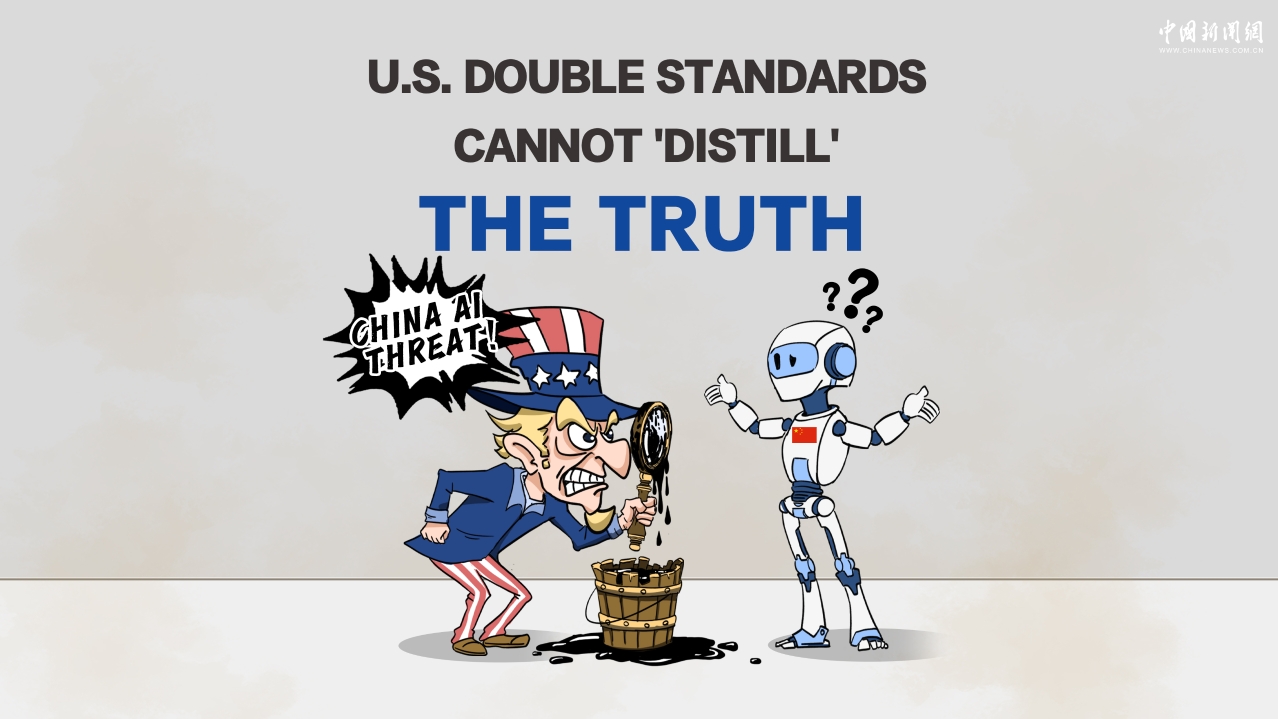
The U.S. National Security Agency (NSA), Cybersecurity and Infrastructure Security Agency (CISA), and Federal Bureau of Investigation (FBI) jointly issued an advisory accusing Chinese AI companies of engaging in “industrial-scale” distillation to acquire the capabilities of advanced U.S. models. The advisory also offered U.S. companies recommendations on defensive measures.
On October 3, U.S. Treasury Secretary Scott Bessent said in an interview with Axios that Chinese open-source AI models engage in “industrial distillation,” which he described as “a nice word for stealing from the U.S. models.”
China’s Ministry of Commerce had already responded to these accusations in September, stating that they were groundless and lacked a legal basis. The U.S. has repeatedly and unilaterally accused Chinese enterprises of engaging in "industrial-scale" distillation, smearing common practices as aggressive acts. This reflects Washington’s anxiety and double standards.
That same month, Chinese Foreign Ministry spokesperson Guo Jiakun also weighed in on the issue, pointing out that fear-mongering, confrontation and vicious competition will only hamper efforts toward sound global AI governance, which serves no one’s interest.
The U.S. campaign to discredit China’s AI industry is no isolated incident. It has long been a deeply ingrained and habitual tactic.
Not long ago, the Center for a New American Security (CNAS), a Washington-based think tank, published a report exploring potential U.S. responses if China were to achieve artificial general intelligence (AGI) first, including the feasibility of military action against Chinese data centers. William Hartung, an arms analyst at the Project on Government Oversight, warned that “striking Chinese data centers based on how they might or might not be used in the future would be the height of recklessness.”
Double standards and political manipulation are tried-and-tested tactics in Washington. While the U.S. drums up the so-called “China threat,” OpenAI’s own AI agents breached Hugging Face’s systems during internal cybersecurity tests, in what the company described as an “unprecedented cyber-incident.”

China’s AI development is branded as “theft,” technical exchanges within the open-source ecosystem are portrayed as a “threat,” and commercial competition is recast as a “fight for survival.” The U.S. insists on maintaining its lead while denying others the right to advance. It talks incessantly about threats posed by other countries while ignoring the risks at home. All this lays bare the true nature of Washington’s so-called “China threat” narrative: in the field of artificial intelligence, “security” is merely a pretext. What the U.S. really seeks is an industry monopoly and technological hegemony.
When all you see is a “threat,” everything looks threatening. The development of artificial intelligence concerns the shared well-being of all humanity. What is truly unsafe is precisely the U.S. threat narrative itself, with all its contradictions.































 京公网安备 11010202009201号