


By Liu Xinyu & Liang Qinqing
(ECNS) – Although artificial intelligence is advancing rapidly, the scientific research paradigm based on physical experiments must be upheld in critical fields, and overreliance on AI should be avoided, said Nobel chemistry laureate Arieh Warshel during an exclusive interview with China News Service at Southwest University in Chongqing on Friday.
"I have a complex view toward AI," said Warshel, who was awarded the 2013 Nobel Prize in Chemistry "for the development of multiscale models for complex chemical systems."
Although his team has begun to apply AI technologies, Warshel stressed that their core methods remain grounded in physical modeling and empirical research in the laboratory.
AI does offer efficiency advantages in processing massive amounts of information, but researchers must carefully gauge the extent of its application, he added.
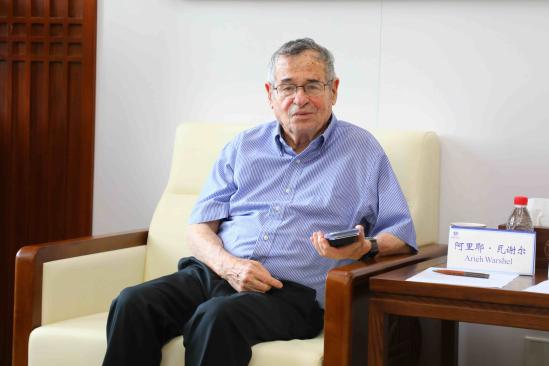
When it comes to specific AI applications, Warshel noted that AI has already demonstrated the ability to replace certain human tasks in areas such as medical diagnosis, and he believes it will have a significant impact on disease diagnosis and treatment in the future.
However, at the level of basic research, physical experiments remain an indispensable key step. He particularly stressed that in matters critical to human health, such as disease treatment, AI can serve as an important auxiliary tool, but final decision-making must remain in the hands of professionals.
Regarding industrial applications, Warshel predicted that in highly automated sectors such as automobile manufacturing, the integration of AI and robotics will play an increasingly important role. "By precisely analyzing how changes in process parameters affect product quality, AI is expected to provide optimal solutions for production process optimization," he said.
Warshel praised China’s achievements in AI development, highlighting not only its solid technological foundation but also its abundance of top-tier talent.
He shared that his own research team includes Chinese scientists and that he has collaborated with several AI experts in China. "I look forward to stronger cooperation between China and overseas partners in the AI field. This is very valuable," he said.
The visit marks Warshel's return to Chongqing after a seven-year absence. He was deeply impressed by the city's well-preserved ecological environment and expressed his willingness to explore future cooperation with local universities and research institutions.





























 京公网安备 11010202009201号