



Growing need
China has sent 283 contestants to compete at WorldSkills since 2010, winning the nation 93 golds, 41 silvers and 28 bronzes in total. Learning skills has not only shaped individuals' lives and careers, but has grown to become a strong support for the nation's development in manufacturing, technology and innovation.
In 2021, China had over 200 million skilled workers, taking up 26 percent of the total workforce. Among them, 60 million were highly skilled, according to the All-China Federation of Trade Unions.
The nation has channeled more effort into training skilled workers in recent years. Figures from the Ministry of Human Resources and Social Security show that from 2019, over 100 million people have attended job training or work skills improvement campaigns organized by the ministry. From 2021, nearly 2 million skilled apprentices have been trained by companies with the aid of financial support from the government.
However, skilled workers, especially the highly skilled, remain in short supply.
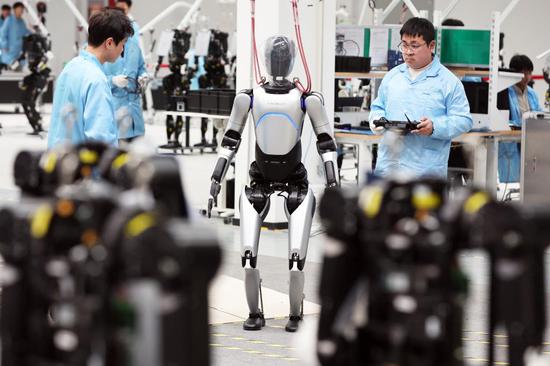
"The technological and industrial advancement of AI, big data and cloud computing, creates higher requirements for skilled workers. The WorldSkills competition has updated its events in line with market needs," said Ye Junfeng, Party secretary of Guangdong Machinery Technician College. The college has produced 16 world champions and won China 12 gold medals at WorldSkills competitions.
According to Ye, the students who graduate from his college have good career prospects and many receive job offers from companies two or three months before they graduate.
"We have about 3,000 graduates each year and those majoring in electromechanical and smart manufacturing, numerical control machines can get three to five job offers at campus job fairs. Their salary can be as much as 7,000 yuan ($960) a month during their internship, rising to 28,000 yuan."
He said that some companies often complain that they can't find suitable skilled people to operate cutting-edge machines or to maintain them. "The structural imbalance of the job market is a problem. From my observation, skilled workers in electromechanical, smart manufacturing and domestic services are in great demand. Companies are willing to hire and pay more for these skilled workers."
The college is cooperating with other vocational schools to help maximize students' career prospects. "What we wish to do is to change people's stereotypes around skilled workers, whose abilities are usually undervalued. Many of our students have served in the nation's key companies and been involved in technique improvements and tackling technological problems with researchers."
Ye Zhihao, executive director of Guangzhou High Genius Dynamics Co, said China's participation in WorldSkills has brought benefits to the nation's cultivation and evaluation of skilled people.
"The updating of WorldSkills competition events has pushed forward the emergence and development of new professionals. For us employers, WorldSkills champions or contestants are welcomed at our companies," he said, adding that his company has recruited more than 10 Chinese WorldSkills competitors since 2017.
However, experts are still calling for better and fairer treatment for skilled workers in terms of payment, career promotion and social status.
Zhang Rui, deputy director of the WorldSkills Competition China Research Center in Tianjin, said that though vocational schools have open attitudes to cooperating with companies to help their students better adapt to market needs, the cooperation should be further deepened in curriculum design and with more investment.
"The public still prefers academic achievement rather than vocational education, thus it still requires efforts from governments, schools and companies to raise the social status of skilled students and skilled workers," she said, adding that the widening regional gap in vocational education needs to be tackled.
"The gap lies in economic development imbalance. The provinces or areas with stronger economies and manufacturing power, such as Guangdong province, are usually more open-minded and channel more effort into cultivating skilled workers," Zhang said.
Ye Zhihao, the executive director, added: "The manufacturing industry is the foundation for the nation's development, and requires diversified talent ranging from knowledge-based researchers to the skilled people who can deftly operate and maintain precision and high-tech machines."



























 京公网安备 11010202009201号