



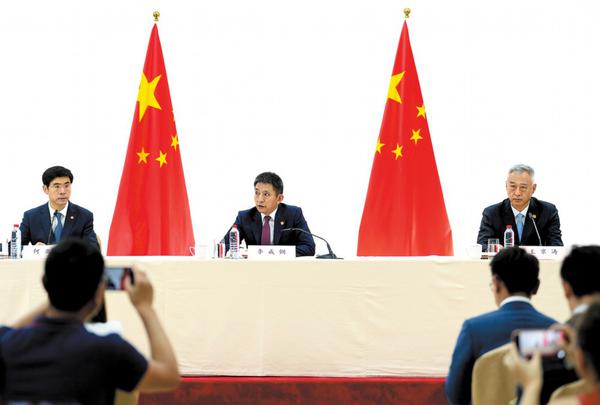
Li Chenggang (center), China's international trade representative with the Ministry of Commerce, seen at a news conference on Monday in Madrid, Spain. (Photo/CHINA DAILY)
China and the United States have translated their latest round of trade talks into new outcomes, signaling their willingness to carry out dialogue on an equal footing and find common ground despite persistent differences, analysts said.
Noting that the meeting in Madrid, Spain marked the fourth high-level engagement between the two nations in four months, analysts said these negotiations help chip away at the prolonged trade and technology tensions between the world's two largest economies, delivering benefits not only within their own borders, but also for the global community at large.
After two days of "candid, in-depth and constructive" talks that ended on Monday, China and the U.S. reached "a basic framework consensus" on resolving issues related to social media platform TikTok through cooperation, reducing investment barriers and promoting relevant economic and trade cooperation.
The engagement in Madrid took place just days ahead of a critical deadline requiring TikTok's divestment from its Chinese parent company ByteDance to comply with U.S. national security laws.
U.S. President Donald Trump has repeatedly extended the deadline, aiming to keep the popular app — which he believes helps bolster his popularity among young voters — up and running in the U.S..
Though the details of the consensus still remain under wraps, Beijing made it clear that it will never seek to reach any agreement at the expense of principles, interests of companies, or international fairness and justice.
The two sides will discuss the details of relevant outcome documents, and complete their respective domestic approval procedures.
"Through our discussion over TikTok, the two sides further understand the importance of a stable and sound China-U.S. trade and economic relationship," Li Chenggang, China's international trade representative with the Ministry of Commerce, said at a news conference on Monday.
"The U.S. side has also expressed its willingness to move together with China toward the same goal when it comes to reducing barriers in investment and promoting relevant cooperation on the trade and economic fronts," said Li, who is also vice-minister of commerce.
However, days before the Madrid talks, the U.S. Department of Commerce had added multiple Chinese entities in the semiconductor, biotech, aerospace, and commercial and trade logistics sectors to its export control list.
The White House also demanded that G7 and NATO countries impose tariffs of 50 to 100 percent on China due to the country's purchase of Russian oil.
"The U.S. side cannot, on the one hand, ask China to address U.S. concerns, and on the other hand, continuously suppress Chinese enterprises," Li said.
Vice-Premier He Lifeng on Monday also urged the U.S. to work with China and lift the relevant restrictions on China as soon as possible.
He called on the U.S. to take concrete actions to jointly safeguard the hard-won achievements of the talks, and continuously create a favorable atmosphere for the stability of Sino-U.S. economic and trade relations.
The fundamental reason why Beijing and Washington are able to sit down at the negotiation table several times is that the essence of their economic and trade relationship is one of mutual benefit and win-win cooperation, said Cui Fan, a professor of international trade at the University of International Business and Economics in Beijing.
The U.S. should move beyond its containment strategy and end its suppression of foreign companies. Only a truly open, fair and nondiscriminatory business environment can unlock greater synergies in China-U.S. economic cooperation, Cui said.
Chen Wenling, former chief economist at the China Center for International Economic Exchanges, said, "Beneath the political rhetoric of 'decoupling' and 'de-risking', the deep-rooted economic interdependence between China and the U.S. makes it difficult to forcibly unwind the world's two largest economies."
The road ahead remains long, and disagreements on certain issues still persist. But the ability of China and the U.S. to engage in equal and constructive dialogue is essential for the stability and development of their bilateral relationship, which has profound implications for the global economy, Chen said.



































 京公网安备 11010202009201号