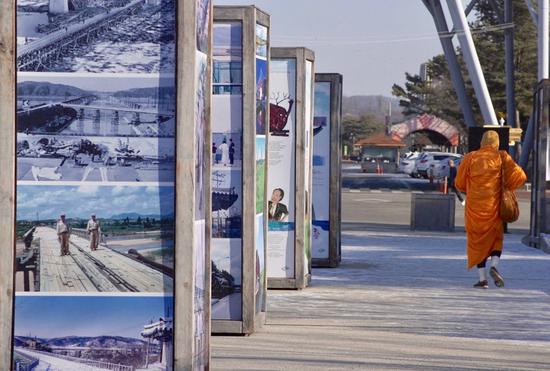
The Peace Park next to the Demilitarized Zone. /CGTN Photo
The year 2018 witnessed the biggest and fastest thaw in inter-Korean relations since 1953, when a truce brought major combat, but not the actual war, to an end.
The year witnessed the first-ever summit between leaders of the DPRK and the U.S. and three summits between DPRK leader Kim Jong Un and South Korean President Moon Jae-in.
Inter-Korean cooperation has flourished at an unprecedented rate.
“Sanctions depressed our efforts to make a new stage of inter-Korean relationship but in total we were successful especially in the military aspect,” said Cho Han-bum, senior analyst at the state-run Korea Institute for National Unification.
Military talks and cooperation have mostly focused on the Demilitarized Zone (DMZ) that divides the peninsula and surrounding areas, which Moon Jae-in and Kim Jong Un announced should be turned into a peace zone during their first summit back in April.
Since then troops have been withdrawn from 22 guard posts in the DMZ, with all but two of them completely demolished.
Artillery has also been pulled back and a no-fly zone introduced.
The joint security area where talks are held has been disarmed and efforts are now underway to remove at least some of the many thousands of landmines still posing a deadly threat.
There are even now plans to restore road and train links, measures that could still be derailed if the broader denuclearization talks do not start to make progress.
“(Donald) Trump and Kim (Jong Un) agreed to the final goal of denuclearization of the Korean peninsula, it's an achievement, but in detail they didn't agree about the denuclearization method,” Cho said.
Denuclearization talks have been in limbo since the Trump-Kim Singapore summit in June and the DPRK called off a planned meeting in November with U.S. Secretary of State Mike Pompeo, which was aimed at reviving dialogue.
"The hope is there should be some bigger progress between the U.S. and the DPRK with regards to north's nuclear weapons than in 2019. Then much faster progress can be made between the two Koreas," said Woo Jung-yeop, a research fellow for the Sejong Institute.
Some South Koreans also worry the current cooperation is not being linked to negotiations, which could undermine the broader diplomacy and security on the peninsula.
"South Korea is pretty much divided on that front. Some can argue that easing the tension in the military area would lead to much more peace on the Korean peninsula, but at the same time there are people who argue that without any further movement by the DPRK it will make South Korea very vulnerable, if it continues to decrease its military readiness," Woo said.
The year 2018 witnessed the most profound inter-Korean détente so far.
But 2019 will require genuine denuclearization to commence in order for an easing of sanctions that could pave the way for the much deeper cooperation both Seoul and Pyongyang are seeking.