



(ECNS) -- U.S. President Donald Trump on Monday warned 14 countries they will face 25% tariffs on exports to the United States unless they strike new trade deals by Aug. 1, a move already rattling markets and raising diplomatic concerns.
The near-identical letters, described by analysts as both a threat and a tactic, marked the latest chapter in Trump's "America First" trade doctrine.
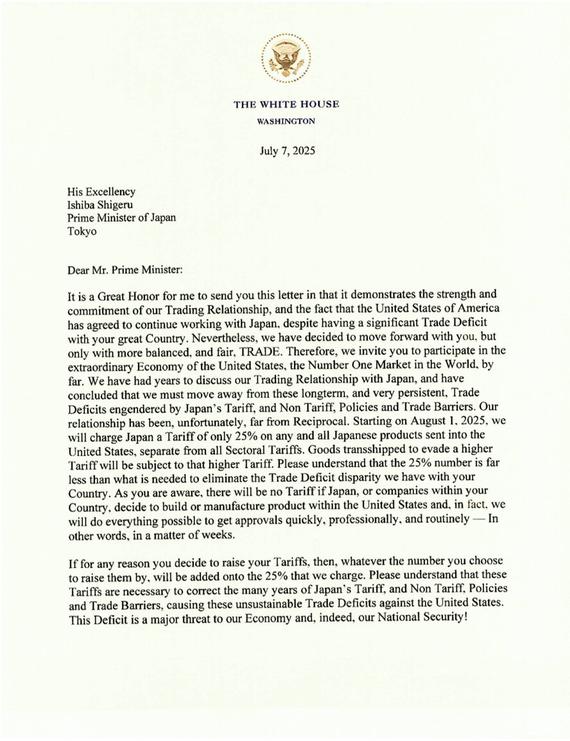
First batch of letters addressed to Japan and South Korea
In Trump's post on Truth Social, the first letter was addressed to Japanese Prime Minister Shigeru Ishiba, followed by South Korean President Lee Jae-myung.
Trump's first letters, addressed to Japanese Prime Minister Shigeru Ishiba and South Korean President Lee Jae-myung, imposed a 25% tariff — which he called "only" 25% — suggesting it was a discount, not a threat.
"Please understand that the 25% number is far less than what is needed to eliminate the Trade Deficit disparity we have with your country," the letter read.
Notably, Japan has held multiple rounds of trade talks with the U.S. over tariffs before. Japanese Economic Revitalization Minister Ryosei Akazawa has reportedly made seven trips to the U.S. in this regard.
And the result? A 25% tariff, one percentage point higher than the 24% set by the U.S. for Japan back in April.
No wonder Ishiba called the latest tariff announcement "truly regrettable."
South Korea's tariff rate remained at 25%, as announced in the reciprocal tariff list published by the U.S. in early April.
As cited by The Washington Post, Wendy Cutler, vice president of the Asia Society Policy Institute and a former U.S. trade negotiator, said the new tariffs violate the U.S.-Korea free trade agreement. This certainly calls into question the value of a free trade agreement with the U.S., she noted.
Letters or psychological warfare?
The uniformity of the letters raised eyebrows among diplomats and journalists alike, was this negotiation or copy-paste coercion?
The letters to Japan and South Korea were almost the same, both beginning with the phrase, "It is a Great Honor for me to send you this letter."
Others, except for variations in country names, leader names, and specific tariff rates, followed the exact same structure and wording.
Even basic details were bungled, with Trump addressing Bosnia's Željka Cvijanović as "Mr." before the error was quietly corrected.
In these largely identical letters, Trump warned that if any of the recipient countries imposed retaliatory tariffs, the U.S. would respond by raising tariffs by an equivalent amount on top of the newly announced rates. These letters also added that the tariffs "may be" modified, depending on the specific relationship.
Those familiar with Trump's style know that today's tough talk often becomes tomorrow's bargaining chip. So is this tariff "bomb" a genuine move toward trade escalation or simply a high-stakes opening gambit?
According to White House Press Secretary Karoline Leavitt, Trump's phone hasn't stopped ringing, as foreign leaders seek deals. U.S. Treasury Secretary Scott Bessent echoed this, saying, many change their tune in terms of negotiations.
Tariff hikes add to global economic uncertainty
Though the true intention behind the U.S. government's latest tariff announcements remains unclear, one thing is certain: if tariff hikes are enacted, the American economy will likely be the first to suffer.
U.S. consumers will bear the brunt of higher tariffs, facing increased prices on imported goods.
According to the Associated Press, an economic expert indicated that the tariff revenue is intended to offset losses from tax cuts, a move that could disproportionately affect low- and middle-income households, as importers are expected to pass the extra costs down the chain.
Markets responded swiftly. On Monday, major U.S. stock indices dropped across the board, as investors reflect growing anxiety.
The Washington Post reported that business and academic communities alike are struggling to interpret American government trade stance: are these tariffs a serious policy shift or a tactic to jump-start stalled negotiations? Regardless of the answer, one outcome is clear: rising uncertainty for the global economy.
Whether these threats materialize or fade, the damage may already be done.
"No one knows what Trump's going to do tomorrow," Desmond Lachman of the American Enterprise Institute told The Washington Post. "Even if all of this gets rolled back, there's going to be a price for the economy."
In the theater of Trump's trade diplomacy, uncertainty is both a tactic and a cost.
(By Gong Weiwei)

















 京公网安备 11010202009201号