


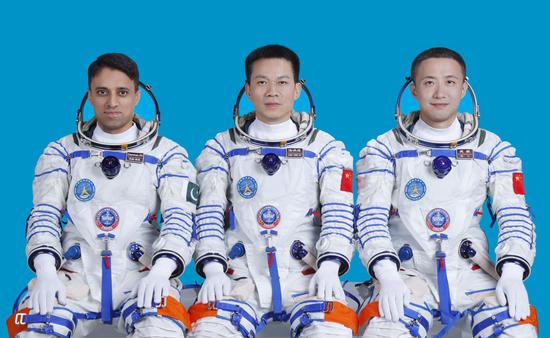
Photo shows Shenzhou-24 crew members Tang Hongbo (C), Wu Yi (R), and Pakistani astronaut Muhammad Zeeshan Ali. (Photo: China Manned Space Agency)
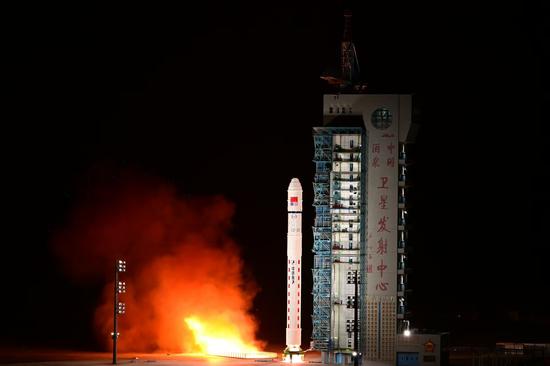
(ECNS) -- Four China-Pakistan joint scientific experiments will be conducted aboard China's space station for the first time during the mission after China's Shenzhou-24 crewed spacecraft was successfully launched from the Jiuquan Satellite Launch Center on Friday, according to the Technology and Engineering Center for Space Utilization of the Chinese Academy of Sciences.
The four experiments will focus on four areas: the photosynthetic microorganism cyanobacteria, the specialty grain crop quinoa, graphene hybrid composites and carbon fiber composites. A Pakistani astronaut will carry out the relevant experimental operations in orbit.
One of the projects, titled "Building Green Microfactories to Support Sustainable Life in Space," will use the general biological culture module of the Life Ecosystem Experiment Cabinet in the Wentian lab module to study the cultivation of cyanobacteria in space. It will examine changes in their photosynthetic efficiency, growth rate and carbon sequestration capacity under the combined effects of microgravity and space radiation, providing a biological basis and data support for oxygen regeneration and biomanufacturing at future space stations and deep-space bases.
Why cyanobacteria? Huang Kun, chief designer of the crewed spacecraft under the Scientific Research and Application System of China's Manned Space Program, said that cyanobacteria are among the oldest photosynthetic organisms capable of producing oxygen on Earth and are key candidate species for space ecosystems. They can absorb carbon dioxide and release oxygen, while also serving as a valuable source of protein.
Another project, titled "Significant Effects of Microgravity and Cosmic Radiation on the Longevity and Nutritional Properties of Quinoa Seeds During Spaceflight," will expose 32 quinoa seed samples to space radiation and microgravity outside the space station. It aims to investigate the stress tolerance and longevity of quinoa germplasm in the space environment, and to screen and identify superior quinoa varieties based on the findings.
The other two experiments focus on materials for space applications. Huang said that materials used in space face two major challenges: radiation protection and structural degradation.
High-energy particles in space pose a threat to instruments and equipment outside the spacecraft. Graphene, a key nanocarbon material, can be used to make lightweight and reliable shielding layers that can flexibly wrap around structural surfaces. Meanwhile, extreme temperature fluctuations, radiation and micrometeoroid impacts can cause microcracks inside materials, gradually weakening their structural integrity. Self-healing carbon fiber composites, whose repair process can be triggered by heat, can autonomously restore their mechanical properties after damage occurs.
The project titled "Extravehicular Exposure Experiment of Graphene-Based Hybrid Composite Materials for Enhanced Protection in Space Missions" will expose multilayer graphene-based hybrid composite shielding materials and aluminum reference samples of the same areal density outside the space station for one year. Particle track detectors embedded in the samples will record the trajectories of incoming particles. After the samples are retrieved, researchers will compare their radiation-shielding effectiveness, mechanical properties and thermal performance.
The other project, titled "Study on the Repair Efficiency of Self-Healing Composite Materials in the Space Environment," will install self-healing carbon fiber composite samples with pre-existing scratches alongside unscratched reference samples on the same exposure platform. Changes in temperature and radiation outside the space station will affect the samples, while downlinked images will be used to monitor the healing process of the scratches in orbit. After nearly one year of exposure, the samples will be retrieved to assess their repair efficiency.
The findings will provide in-orbit data to support the selection and design of new aerospace materials.
Both materials experiments will be conducted using the space station's extravehicular materials exposure facility.
(By Evelyn)























 京公网安备 11010202009201号