


By Liu Lixin & Zhu Fangfang
(CNS) -- Currently, the global food security situation remains grim due to multiple factors such as regional conflicts, extreme weather and trade barriers. About 673 million people are facing hunger, 2.3 billion are in a state of food insecurity, and 2.6 billion cannot afford a healthy diet. There is a long path for the world to achieve the "Zero Hunger" vision set out in the United Nations' 2030 Agenda for Sustainable Development.
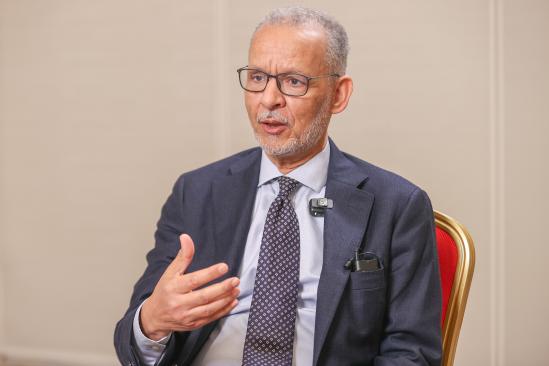
2025 marks the 80th anniversary of the founding of the Food and Agriculture Organization of the United Nations (FAO). What inspirations can China's practices in ensuring food security and promoting rural revitalization bring to the world? Recently, Mohamed Manssouri, Assistant Director-General of Food and Agriculture Organization of the United Nations (FAO) and Director of the FAO Investment Centre, paid an on-site visit to Jiangxi Province in China to learn about its rural revitalization efforts, and shared his insights in an exclusive interview with CNS's "W.E. Talk."
Here are the excerpts of the interview:
CNS: During this on-site visit, which of China's approaches to rural revitalization do you think have been particularly effective?
Mohamed Manssouri: As you know, the strategic direction of FAO is guided by what we call the"Four Betters": better production, better nutrition, a better environment, and a better life. And leaving no one behind. Actually, what we have seen over these days perfectly aligns with each of these strategic pillars:
Better production: We witnessed sustainable production methods that balance productivity with sustainability—whether in bamboo plantations, asparagus fields, or the greenhouses we visited for citrus, chicken farming, crab cultivation, etc. Better nutrition: We observed diverse food production practices—every region is exploring ways to develop products that create employment opportunities and improve quality of life. There is a strong focus on fresh produce, as well as the development of food products for medical and cosmetic uses, which not only enhances nutrition but also generates income. Better environment: This is also what FAO strives to promote. We saw wetland protection, water pollution prevention, and the production of green food and organic food through various approaches, including geographical indication(GI) products. Better life: This is essentially the ultimate goal of FAO's work, particularly through the FAO Investment Centre. What impresses us is that all these initiatives are well-designed and effectively implemented.
We are deeply impressed by China's rural transformation efforts in Jiangxi Province. It is a combination of tradition and innovation: there is extensive innovation, but it is always rooted in tradition. We must not forget that successful innovations eventually become traditions—after all, every tradition was once an innovation(for example, the dishes we enjoy today were invented by someone). It is this cycle of tradition and innovation, and the acceleration of this cycle, that makes China's rural development so effective.
CNS: Does China's rural revitalization practice offer any inspiration or reference for other countries?
Mohamed Manssouri: I think there are two distinctive features I would like to highlight. One is the central role of local governments and public institutions. The central role of governments has not only been providing public investments—of course, infrastructure, and even contributions to public-private partnerships—but also the governance of institutions. Governments ensure that the benefits of development accrue to cooperatives and farmers, that price mechanisms are fair, and that conflicts are resolved effectively.
Second, I think the entrepreneurship of rural people themselves is the key. Many private individuals who have achieved success and are driving job creation are local residents who have been given the opportunity to develop businesses. And they bring others along with them, especially helping people lift themselves out of rural poverty.
I think China's experience has a lot to offer, especially in understanding the elements that make these models successful—not necessarily the models themselves, but the modalities and components. So each country can combine these components in different ways: market access, productivity improvement, access to technology and knowledge, digitalization, institutional building, fairness, infrastructure, and access to finance. The Chinese government and people have combined these elements in their own way combining innovation and tradition. Other countries may combine them differently, but the core ingredients for success are there. So it's an inspiring experience—more about inspiration than direct replication for others.
CNS: The FAO emphasizes "investing in people". How to effectively prioritize human capital in the process of rural revitalization?
Mohamed Manssouri: I think people are at the core of sustainable development. I realize that actually investing in human capital is most of the time quite neglected. We see infrastructure, we see equipment, we focus on production, but human capital remains overlooked.
Investing in human capital refers to assets that improve individual productivity, such as education, training, and health, as well as traits like self-confidence, creativity, and awareness. Investing in farmers, in entrepreneurs, is crucial for advancing rural revitalization or transformation processes.
Between 2021 and 2023, the FAO Investment Centre conducted extensive studies on the subject together with the International Food Policy Research Institute(IFPRI) and other partners.
So there are6 key recommendations. To sum up, first, investing in human capital— producers themselves, entrepreneurs and workers—is essential for long-term, wide-reaching benefits, especially for improving productivity in many developing settings. Second, partnership and cooperation are crucial for greater impact, especially for ensuring the right enabling policy environment. Third, the delivery methods need to be adapted to the needs of the target groups. The fourth is ensuring that everyone is included, leaving no one behind—youth, women, even the elderly—because we can learn at any stage of life. The fifth is providing incentives for people to learn so that they truly see it as an investment in themselves. And the sixth is the need to continue innovating and researching to bring more solutions for more productive and sustainable agrifood systems.
In the case of China, I think we can see all these elements in practice. Investing in people, in their human capital, has improved their access to technology, access to markets, access to decision-making power, and entrepreneurship—this is what we observed in various areas we visited.
Regarding access to markets, we saw many producers, cooperatives, and enterprises led by farmers actively engaged in selling their products and doing business. At least two of them were pitching live to promote their products, with people buying and sending feedback in real time. This is related to access to technology. In this case, it’s e-commerce, but there are many digital tools available today, as well as many techniques for better and more sustainable production.
Some examples include agribusiness enterprises working hand in hand with vocational training institutions to equip young people with the necessary capabilities to become better farmers or excel in processing or other related fields.
CNS: Currently, the global food security situation remains grim. How does China contribute to global food security?
Mohamed Manssouri: I think China has made several substantive contributions to advancing global food security. China is the first developing country to achieve the Millennium Development Goals of halving extreme poverty and hunger, and it eradicated extreme poverty by 2020.
This is well ahead of the SDGs’ 2030 target. China has demonstrated that large-scale hunger reduction is possible through sustained economic reforms and a well-funded national poverty alleviation system. China has also made major strides in SDG 2(Zero Hunger) by ensuring a stable supply of staple foods. The country achieved consecutive bumper grain harvests, while maintaining ample supplies of meat, eggs, dairy, aquatic products, fruits, and vegetables.
These achievements have not only ensured domestic food availability and improved nutrition but also positioned China as an active sharer of its experiences and lessons through South-South Cooperation, allowing many other countries to learn from its remarkable progress and success.
I am particularly pleased that China is funding a large-scale South-South Triangular Cooperation program—to not only share its own successes but also facilitate mutual learning among countries by sharing their respective achievements.
And I think this is the channel or platform for FAO—working with our Director-General, Dr. Qu Dongyu. This is where FAO plays an effective role: bringing countries together to learn from each other. It's difficult for countries to do this on their own. So you can multiply these connections and linkages for the benefit of all.
CNS: Has this on-site visit given you any new understanding of China?
Mohamed Manssouri: I had the privilege to visit China in the past, but mostly in urban areas during official visits. I’m so happy that I could see more of rural China this time, especially in central China.
I think it’s really a space driven by innovation, ideas and entrepreneurship. That’s a major strength—people here have an entrepreneurial spirit; they are ready to move forward, give their best efforts, and achieve their goals. At the same time, being an entrepreneur also means managing risks, right? I think this combination of proactive energy and risk management, with all efforts ultimately aimed at benefiting the people and leaving no one behind, is truly remarkable—especially the great achievements in eradicating poverty and hunger achieved in such a short period of time.
Profile of Mohamed Manssouri:
Mohamed Manssouri is an Assistant Director-General of FAO and the Director of the FAO Investment Centre. He is an agricultural economist and an expert in agricultural and rural development, food security and poverty reduction. Before becoming Director, Mr. Manssouri was the Service Chief for Europe, Central Asia, North Africa, Near East, Latin America and the Caribbean.
He first joined the FAO Investment Centre as a senior adviser in charge of quality enhancement, knowledge sharing and learning. He coordinated FAO’s“Renewed Commitment to a Hunger-Free Horn of Africa” and led the development of resilience-building strategic plans and investment programmes in the Horn of Africa. Prior to joining FAO, he was Country Director with the International Fund for Agricultural Development(IFAD), where he led the development and management of various country investment strategies and programmes in West and Central Africa, including Cape Verde, the Democratic Republic of the Congo, Chad, Ghana, Niger, the Republic of the Congo.
He also led several regional programmes in rural finance, community-driven development, conservation agriculture and regional agricultural policy. Within the scope of IFAD reform to enhance its development effectiveness, he led the preparation of IFAD’s Knowledge Management Strategy and other organizational change initiatives. He served on the United Nations High-Level Task Force on the Global Food Security Crisis, chaired by the UN Secretary-General. He also worked as a trainer in agricultural economics and gave lectures at Roma Tre University’s Master's Program in"Human Development and Food Security".
Edited by Li Jiayin

























 京公网安备 11010202009201号